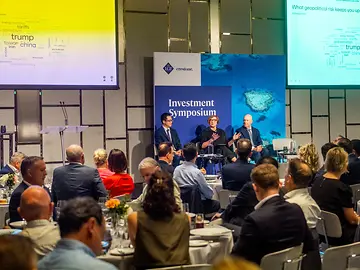

LGT Wealth Management Investment Forum Sydney, March 2026

Six months ago, at our last Investment forum, our panellists forecast a continuation of easing rates with an expectation that growth and inflation would moderate while political and geopolitical risk would remain elevated. At the time, markets seemed unperturbed by lingering concerns about the outlook for the economy given the potential unpredictability of the Trump administration. This is particularly applicable to global trading relationships, US Federal Reserve (Fed) independence and rising geopolitical conflicts. In light of this heightened uncertainty, the panellists equally saw a scenario where, ‘if volatility increased, they expected rate cuts to potentially mitigate growth concerns, provided inflation is under control’.
The market has since experienced The Supreme Court of the United States’ (SCOTUS) decision to strike down the Trump Administration’s reciprocal tariffs, credit concerns, a software selloff, geopolitical tensions and wars, a lack of recorded data, and government shutdowns. But as LGT Wealth Management’s Chief Investment Officer, Scott Haslem, points out, markets have been seemingly impervious to these shocks with any drawdowns somewhat limited. “If we look back at 2025, there were a lot of geopolitical events throughout the year. And when I say to people, 2025 was a volatile year, everyone kind of nods. But the reality is, was it a volatile year? In geopolitics yes, but pretty much from the April Liberation Day after the correction, it has been an ever-upward climb in markets. Markets did not draw down notably over the remainder of the year. If you just put the noise cancelling headphones on, and woke up at year end, markets were up double digits. The challenge for this year is whether it is similar to last year?”.
I'm fundamentally concerned about consumption as the ultimate source of final demand, and we can have this massive productivity uplift where all these companies get massive EBIT because we're making all this output with no human capital. But how does that human capital eat? Because it's the ultimate source of final demand. I feel concerned longer term that there will be more dispersion and disruption." - Scott Haslem
Geopolitics have ‘come in hot’ as 2026 gets underway, at a time when key macroeconomic indicators seem to be flailing, with some benign growth. The US jobs market is slowing due to still-tight policy, the tariff-induced trade shock has slowed H2 2025 growth in Europe, Japan and the UK, while China has yet to stall its weak momentum.
Additionally macro dispersion is also keeping us on our toes with Australia seemingly facing a different set of circumstances. During H2 2025, the cyclical recovery in Australia’s economy gathered momentum. The Reserve Bank of Australia (RBA) had modestly trimmed their policy rate from a peak of 4.35% to 3.60% between February and August, contributing to stronger demand across housing and consumer sectors. This resulted in a significant reassessment of the outlook for the RBA’s policy rate – from rate cuts as recently as November 2025 to the onset of a rate hike cycle.
At our latest Investment Forum, our panellists discussed where investment opportunities lie, given a number of live challenges with the latest Iran developments and impact on oil prices being central to current volatility. While equity markets have experienced some wobbles, movement has by no means been severe. Bond yields have risen in response, but credit spreads have been relatively contained. The panel also debated the relentless pursuit of artificial intelligence (AI) winners, software selloff, and risks in private credit. All panellists agreed on the importance of active management in a currently concentrated momentum-driven and thematic environment.
Key themes from the forum
AI continues to be an ongoing thematic at the top of investors’ minds: Recent evidence suggests AI has started driving a meaningful acceleration in capital investment and economic activity, but at a scale that embeds strong assumptions about future demand and value creation. While AI can boost productivity and ultimately flow through to company revenue, its true impact on industries, competition, and labour markets is still unfolding. We’ve seen inconsistent performance across sectors due to the uncertainty investors now face in assessing the likely ‘creative destruction’ associated with AI’s pervasive acceleration. Panellists believe the best-placed companies and sectors are those with resilient moats and those that can reinvent/reorganise themselves.
Not all credit is created equal: Spiking geopolitical concerns and a benign macro backdrop pose a risk to credit markets that have gone through a prolonged period of tight spreads. While panellists believe the better part of the credit cycle could be behind us, there are still opportunities with new issuance enjoying some reasonable demand. At the same time, defaults are still relatively contained despite some of the media headlines.
Now is the time to be selective, opportunistic, and embrace active management: Global markets are experiencing and anticipating increased levels of dispersion. While a casual glance at indexes doesn’t scream alarm, below the surface, at a stock, bond, sector and regional level, volatility is rife. This environment lends itself toward being selective, opportunistic and active.
Scott Haslem, CIO LGT Wealth Management, provided an overview of 2025, particularly around the perceived volatility of the past market events. He teased out panellists’ views on the macro backdrop and economic cycle.
Adam Kibble, Portfolio Manager at Schroders highlighted that the macro backdrop is very supportive, if inflation continues to stay low and earnings growth continues. The market can look through the noise on the geopolitical side as the macro is generally supportive.
Amy Xie Patrick, Head of Income Strategies at PendalGroup countered that when assessing the US Conference Board’s consumer confidence surveys and unemployment statistics, there is a gap in the data. “The surveys would indicate that the unemployment rate in the US should be about 5% right now, and as we know it is only 4.3%”. Furthermore, while job growth is weak, overall economic growth remains decent at around 2–3%. It’s too soon to credit productivity gains from AI; we expect these to materialise in coming years. Instead, employers might be responding to uncertainty by pushing existing staff to work harder, allowing output to rise even with little or no employment growth.
Kibble added that US employment data is difficult to interpret because both labour supply and demand appear weak. Supply is constrained by negative net migration, while demand has been held back by uncertainty over tariffs, which is now easing and allowing companies to plan further ahead and gradually increase hiring.
Haslem asked panellists whether market participants would still be discussing the Iran war and SCOTUS in the second half of this year. Or, will we continue to have market events that we move through and the underlying fundamentals of markets play a more dominant role?
Kibble summarised that the backdrop for growth assets has been positive, driven by favourable macro drivers, such as inflation coming down and fiscal policy remaining pretty loose, notwithstanding stretched valuations. However, Kibble noted that the current geopolitical events in Iran will create short term volatility, particularly within oil prices and the closure of the Strait of Hormuz, and the subsequent impact this may have on inflation. “We could have a situation where the oil price gets over $100 as 20% of global oil production shifts through that Strait. High oil prices could be sustained with the threat of a supply shock coming through.”
Haslem queried if we are already seeing the impacts of that oil price creating dispersion across different sectors in the market. Kibble agreed, noting the most impacted sector is European gas, with European gas prices up 25%, whereas the oil price is only up 8% and as such, “the sensitivity in Europe is much higher than elsewhere because they're shut off from the Russian gas lines”.
For Schroders to remain continually positive through the second half of the year on markets, the momentum of rate cuts would need to continue, which appears to be priced into growth assets. This would be important if the Iran conflict remains short in duration.
Peter Graf, Head of Direct Lending for Asia at Ares Management, is of the view it is mostly noise. In some respects, that may be favourable for President Trump as he “gets to pull back some of the higher tariffs and maybe that’s better for the end consumers”.
Graf agreed with the consensus view that valuations are stretched within both equity and credit markets and there will be more dispersion between winners and losers.
Graf pointed out that, “Despite the headlines, growth was very strong across the US, Europe, and broader Asia. Overall, he is cautiously optimistic”. He emphasised the importance of selective investment and figuring out where the relative value is. Passive investing is not optimal.
Furthermore, Graf noted that there is massive dispersion within AI. For example, “A software company that does content creation or assesses data will have more issues in terms of headcount loss than if you're an enterprise dealing with payroll or sensitive data.” He implied that the selloff in software within markets may not have factored in the time it takes to adapt in terms of these jobs actually being replaced.
Haslem summarised the consensus view that there are no concerns around global growth collapsing. Markets are holding up and there are no broad concerns around inflation for the next six to nine months. We are in a relatively benign backdrop.
Dushko Bajic, Head of Australian Equities Growth at First Sentier Investors observed that credit growth remained resilient: “The biggest upgrades through the month of February were in banks and resources as analysts mark-to-market commodity prices and flow them through the profit and loss statement on their models.”
Beneath the surface, retailers were also good, with mid-single digit growth. Trading statements were relatively in line with expectations, with most businesses keeping the same rate of change in terms of sales growth at the start of the year.
However, companies such as Domino’s, where if you have gone off discounting, your sales went backwards by 8.3% and your EBIT went down by 10%. If these companies fail to offer value sharp pricing to consumers, they may face challenges. With Wesfarmers, despite how strong it is, they refocused on Bunnings and rearchitecting Officeworks to provide a lower cost base and consequently push competitive pricing.
Investors who held onto software stocks suffered losses, more so than US stocks. Bajic highlighted that on a fundamental basis, you would’ve expected it to fall less due to the lack of uptick in capex. Whilst the starting valuations in Australia were somewhat higher than the US, the macro environment is different between the two economies given the US has lower rates. As such, all else equal businesses are less disrupted.
Kibble highlighted that inflation remains above target, while growth and efficiency are not strong enough, leaving the RBA in a bind. He believes that the impact of rate hikes on consumers as they still maintain their mortgage payments. As such, consumers have a bit of spare capacity. House prices have also moved higher. A key risk is how consumers’ five‑year plans will be affected, if their white‑collar jobs are under risk (i.e. can they buy a new house or car) and consequently how that will impact the economy. Kibble believes that the current market is not as cyclically sensitive to interest rate levels than it has been in the past.
Xie Patrick commented on the RBA data that shows the discretionary payments into offset accounts or overpayments into mortgages, to an extent, has been unchanged after the last rate hike in February. An inference can be made that either households have sufficient excess funds, and higher rates are inconsequential, and simply result in larger offset account contributions, or they are becoming somewhat more cautious, as Kibble alluded to.
Jason Phillips, Head of Australia and New Zealand Credit Business and the Asia Pacific Sponsor Finance Business at KKR, observed that it feels like the period between 2022-23, where the fixed rate mortgage cliff was very topical, however it did not materialise in the way the market thought it would. Arrears within the major banks only ticked up slightly.
Graf added that given the sell-off within software, there has been increased activity around potential takeovers, which feeds into the notion around dispersion and key winners/ losers. Haslem queried if Ares is looking into more M&A activity. Graf responded that they are (selectively) as, “too much volatility will destroy weakened M&A activity a lot, whereas some volatility could be quite helpful”.
Will Hartnell, Portfolio Manager at Hyperion Asset Management, added that Hyperion are seeing a lot of dispersion within software companies and non-software exposures within the portfolio. Whilst they have reduced some exposure, the view is that “earnings and revenue growth are still solid,” and that, “management teams are getting their act together and leveraging AI tools”.
Haslem reaffirmed that it appears that businesses are rethinking how they generate revenue or create value as a consequence of AI.
Bajic added a lot of businesses had overindulged in their software engineering departments, using Block as an example. Although there have been significant advances in AI since November, Bajic believes that only around 10% of the recent 40% reduction in the workforce is due to these new models. He attributes the remaining reductions to CEO Jack Dorsey becoming more serious about running the business in a commercially focused way. This will flow onto businesses and different industries, as they get serious about being efficient in their workforce through the use of AI.
Xie Patrick expects that they will, given the sustainable evidence on how much more powerful AI can get. “We're probably all engaging with AI lot more in our day-to-day lives. You can see how much time it saves us on routine tasks and that's just the tip of the iceberg.” Going forward, however, the main challenge is how do you get the infrastructure built out and how do you secure the energy supply to enhance these models.
Hartnell noted that the model developments are moving on a faster and deeper trajectory than predicted. He observed that, “we’re moving from an era of chatbots to agentic AI”. We are going from a period of humans building these models, to now models building these models, indicating that the innovation curve is going to get even steeper. Hartnell noted that the big question is the impact that this may have on human capital, believing that it will lead to a productivity boom.
Bajic agreed that this technology will change the view, however, infinite blue sky is needed behind it in terms of appetite. For example, zero cost or nearly zero cost of capital, or vendor finance similar to Open AI and Anthropic. Bajic further notes that physical constraints will remain, despite the infrastructure being built out, which means that the labour market has time to adjust. “There'll be pockets of disruption in the labour market, but human desire to consume is infinite, and it'll reorganise itself in different ways. When you narrow down on one impact, you're not taking into account another impact on the other side.”
Kibble highlighted that there is currently little evidence that AI is displacing jobs and suggests it may be too early to think about this. Xie Patrick agrees, noting they look at the youth unemployment ratio relative to whole employment ratio and that isn't ticking up meaningfully.
Haslem and Hartnell explored the view around human capital being displaced elsewhere. According to Hartnell, if you assess the total addressable market (TAM) with respect to LLM that AI companies can pursue software companies, the global TAM is less than a trillion dollars. Meanwhile the white collar and blue collar estimated TAM is mid 60 trillion, and as such, the human capital market is what AI companies will go after. Haslem further highlighted the concerns around the underlying fundamentals of society and economies, and the speed that technology is advancing, over a three-to-five-year view. He is not convinced that we will create more jobs than we lose. “I'm fundamentally concerned about consumption as the ultimate source of final demand, and we can have this massive productivity uplift where all these companies get massive even because we're making all this output with no human capital. How does that human capital eat? Because it's the ultimate source of final demand.”
Graf raised that productivity must actually be productive and noted that he is a bit more bearish relative to global views. He believes that the market is overstating how fast the adoption and growth of AI has been. “It has taken 40 to 50 years to get to this point.” Although the curve is increasing, it must be productive. He is worried about the real improvement in productivity and if it will be as quick as some people will claim.
Bajic added that there is a real disparity in price. For example, software stocks are priced as if white collar workers have been displaced. However, banks, as an example, are not priced to the extent that mortgage holders will be displaced, and as such, there is a market pricing dislocation.
One of the challenges with the AI revolution is funding and infrastructure, with many hyperscalers driving meaningful capex acceleration. Valuations of these companies are predicated based on strong assumptions on future demand and value creation. How, as investors, do you navigate working out where the value is and if the value is worth investing in?
Phillips noted that one of KKR’s focus areas over the past several years has been on companies that own systems of records and have true data moats. Phillips raised that there are examples where point solution type providers have struggled more.
Hartnell responded that Hyperion structures portfolios based on 10-year expected returns. Post the global financial crisis (GFC), software companies were of high quality given high levels of recurring revenue and strong organic growth, resulting in growing annuity streams, strong predictability, and limited competition due to high barriers to entry. These companies were great holdings and had high weights in their portfolios. However, given the advent of AI, predictability of revenue has reduced substantially, resulting in a downward rerating. However, “there's no reason we couldn't increase weights for these companies that we've reduced, if management teams can demonstrate they're embracing this new paradigm, and that their business models are unlikely to be disrupted”.
Stan Shamu, Head of Portfolio Management at LGT Wealth Management, asked panellists what influence there may be from a political point of view around AI and privacy. Hartnell responded that security and governance are central concerns, and that, “traditionally governments have not been able to keep up with rate of innovation, and this is the fastest innovation curve in history”.
Bajic added that First Sentier have had a number of calls with software engineers, and a key take out was that there is no security layer within these AI tools, leaving entire organisational data out exposed. As such, this is a big constraint. There are also natural constraints when it relates to AI. “There’s the watts and wafers. There’s the public data, private data, there’s the engineering of that. There’s that hallucination element probability or probability inaccuracy.”
Graf explained that the consideration to AI, as part of each investment they look at within investment committees, has been a part of the process for a number of years. However, one region they are wary of is China, given the quality of research and work being done there. There is huge government support in China for AI research, which starkly contrasts to the US and Department of Defence.
Bajic highlighted that it is also best to look at what has already been drawn down within the market, reiterating Block as an example again. He noted that the hidden asset in Block was how lazily the company was run and that AI was the approximate cause for the 40% reduction in labour force. There was a lack of product development at Block, particularly as Square lost its growth and taken over by Toast, which consumed Square’s market share.
Another case is Xero, which is a horizontal software company. Although there are certain aspects that are prone to disruption, Xero have integrated accounting, payroll and payments into one product, which is challenging to pull apart. Bajic highlighted that the new CEO removed 700 employees when she joined and that Xero is, “the sleepiest hollow you can get in terms of AI development”. New executives were brought in from Silicon Valley, which has helped drive greater efficiency. He expects there will be a productivity uplift announced in the next six months which is, “a hidden asset sitting in the depressed share price now”. He concluded that these opportunities are easier to identify as opposed to the next structural winner.
Bajic believes that AI is helping the business and following the new CEO reducing headcount, they have seen an increase in product release and bank connections increased dramatically.
Bajic highlighted that, “markets are flicking from one issue to the next, but always worrying about an impending recession in 12 months’ time”. Despite this, the world’s largest economy, the United States, has been growing quite well and when we assess the Australian index, it has also survived quite well, particularly in February 2026. “This has been supported by a barbell of banks and resources that’s held up the index”. However, high valuations have switched from one sector to the next, switching from software in the previous years to banks in 2025. There is a focus on dislocation that is currently happening and the key to active management is getting behind that opportunity when it presents itself.
Xie Patrick raised that a key reason to stretched valuations is the flood of passive money where, “a wave of money has flown increasingly towards the side of passive indiscriminate buying.” As such, there should be an emphasis on risk control and management around active positions versus a regime where passive money didn’t drive the thematics.

Furthermore, Xie Patrick emphasised the strong need for duration to be actively managed in this environment because the job of duration is changing depending on what your primary concern is. Higher inflation presents higher bond volatility, and an active duration approach can better turn that volatility into returns. If recession risks rise, duration becomes the defensive lever whilst enhancing portfolio liquidity. If rate hikes turn into rate cuts, duration also does the job of locking in higher levels of income for floating rate credit portfolios. Duration can’t do all these jobs at once, and active management is critical in identifying and leaning into the various roles of duration at any point in time.
Shamu highlighted how critical currency is for global portfolios particularly from an AUD-domiciled portfolio perspective. Kibble observed that the role of foreign currency has shifted significantly recently from being a strong diversifier within the portfolio and that it is due to the balance of payments, the amount of foreign assets Australia has, and the income that it is producing. Schroders was surprised that the AUD remained at USD 65 cents since September last year, in light of the economy accelerating and the RBA moving to a pause and then to a tightening cycle pretty quicky. Kibble observed that the reaction of the AUD has been slow, having only recently caught up to interest differentials at around USD 70 cents. The risk off sentiment has been there, similar to how everyone previously favoured some yen in the portfolio which does not work anymore either.
Kibble emphasised that investors need to be thinking about the mix of foreign currencies within the portfolio and not just the level of foreign cash, which may be difficult to implement without a currency overlay type program.
Kibble explained Schroders approaches this from a portfolio construction lens ie, what are the contributions to risk and additional risk premium or return will we earn; then what differentiated characteristics will it provide from a portfolio perspective. He highlighted uncertainty has increased over the short term, and as such there is an emphasis on liquidity to take advantage of volatility and dispersion. This is particularly important in line of valuations moving sharply and markets are highly reactive. Furthermore, it is critical to have a diverse number of return drivers within the portfolio.
He emphasised the importance of having assets in portfolios that “are good brakes. You want a good accelerator to generate your returns, but the fastest car around the track has good brakes”. This includes assets such as commodities, materials, currency, insurance linked securities such as catastrophe bonds.
Graf added that there has been a big shift away from the US into Asia and there has been a lot of interest from institutional investors around diversification into other regions such as Australia, New Zealand, Developed Markets, Asia and India.
Xie Patrick explained that Pendal assesses the potential domino effects on liquidity. The majority of where everything AI related has been funded by the US(from a debt perspective), , and primarily privately or semi privately funded. She observed that for average investors who are exposed to private credit that invests into AI and software, they would’ve been exposed to credit across the credit quality spectrum. If they start facing liquidity fears in that pocket of their portfolio, she wonders if investors will start looking for liquidity in other parts of their portfolios. As such, she questions the impact on her portfolio and the liquidity domino chain effects. This is not because of the software as a service (SaaS) risk that exists in investment grade credit, as it doesn’t, but because that is where investors will look for liquidity, which will impact spreads.
Secondly, Xie Patrick assesses what credits are in the pipeline within the physical credit space, noting that a recent bank-led roundtable for ratings agencies discussed that big data centres are looking for funding. There appears to be a “gap between where the issuers would like to be rated, ie investment grade, and where the rating agencies think they ought to be rated, ie sub investment grade”. As such, she believes that the first set of AI related issuance will be seen in asset-backed form or securitised form. She believes that this asset class is not going to be liquid, similar to residential mortgage-backed securities (RMBS) where you can get pockets of liquidity, but it won’t be an asset class marked to market daily.
Graf raised that Ares is still receptive to credit within software, however notes that their APAC strategy is considerably underweight software (with less than 10% invested in the sector). Graf believes many peers are positioned similarly, with fewer opportunities available given the overall size of the software market in APAC. Ares is focused on business services, core consumer products, education, financial services, and healthcare given the stickiness and stability of the businesses.
Phillips noted that KKR’s general view is, “volatility is here to stay” and may ramp up in specific sectors, but certain thematics should be durable over that period. KKR are focused on what they can control. This means getting factors right such as thematics, businesses and capital flows that can endure over a long period of time. Phillips highlighted the importance of, “businesses that have demonstrated their ability to withstand cost inflation over the last couple of years”.
Xie Patrick believes that the market has gone through the best part of the credit cycle. She highlighted that investors typically think that credit and equity markets are positively correlated. However, the behaviour of each through a cycle is different.
During bull markets, both markets go up and credit spreads get to their tight levels and remain tight. Although credit spreads are tight, she does not have a bearish view on credit.
Pendal is cautious of liquidity issues and the potential hidden levels of default, particularly within private credit vehicles and leverage loan type structures that are more opaque. Credit spreads may start to widen when these types of defaults accelerate and influence market liquidity.
Pendal has expressed this cautionary stance through the Australian market by being more selective towards new issuances. If there are investor concerns on where the cycle is headed. ie credit spreads widening, then having dry powder within the portfolio is advantageous. When market fears escalate, liquidity disappears from physical credit first in Australia and that’s where dislocations come to light. As such, it is more advantageous to hold more cash within portfolios to be able to deploy easily. .
Kibble agrees with Xie Patrick’s view, and Schroder’s are holding more cash in credit portfolios as Schroder believes, “we’re in a carry environment, not a capital gain environment”. Given spreads are so narrow, they could potentially widen due to supply.
Receive ongoing access to LGT Wealth Management’s insights and observations - a curated stream of thought leadership, market perspectives, and strategic updates designed to inform sophisticated investors.