


Volatile markets – and an absence of upward progress – were the price to be paid for persistent elevated energy prices, unresolved wars, seemingly frothy valuations and mounting inflation risks. As we flagged in late May and early June, “the next three to six months [were] increasingly likely to be a more challenging environment for markets”. It has been. Yet has that price now been paid? Oil prices and bond yields have spiked higher, as sector and regional equity market rotation has been intense. While central banks have been on high alert, and some have modestly tightened, the worst of the inflation fears have not emerged, helped by tighter financial conditions.
In this month’s Core Offerings, we discuss why we are ‘staying the course’ with a near-neutral but still modestly ‘risk on’ portfolio positioning. We are not out of the woods yet. Central banks remain rightly twitchy, US mid-terms are ahead, and a less fragile Middle East landscape with higher oil supplies remains a necessity. Yet the recent period of market consolidation, and adjustment higher in yields, leaves us still modestly favouring equities as we close our fixed income underweight.
For now, we continue to advocate for a focus on building medium-term resilience into portfolios (both adapted to this multi-polar world and able to capture returns across key thematics). Inside we also discuss two additional topics. Firstly, the shorter-term signals we are watching that could see us lean more fully into risk (as the ‘set-up’ for 2027 shows signs of shifting positive), and secondly, our perspective on the longer-term portfolio implications of artificial intelligence (AI) on real growth, inflation and interest rates, challenging the notion that higher productivity means lower rates.
In mid-March, we again ‘backed-in’ our constraints-based framework and lent significantly into risk to capture much of the equities upside associated with the end of the ‘hot’ military phase of the US-Iran war. Through Q2, we progressively trimmed risk to position ourselves for what has been a relatively eventful (and volatile) period in economies and markets.
That volatility has appeared in largely range-bound equity markets, which have moved up and down as US-Iran peace deals have come and gone – and military skirmishes have escalated and de-escalated. Yet even sharper moves have been occurring below the headline equity indexes as leadership has broadened from a small group of mega-cap AI winners to more traditional sectors.
There has also been volatility in fixed income, with government bond yields moving meaningfully higher through Q2 (with US 10-years rising from 4.0% in February to 4.6% now). The collapse of the US-Iran peace deal and rising oil prices has clearly contributed. However, more importantly, global central banks have shifted their focus from debating the merits of further rate cuts to just how high rates needed to go to avoid repeating the inflation mistakes of the post COVID-19 era. Resilient US growth also saw new US Federal Reserve (Fed) Chair Warsh strike a hawkish tone in June, while other central banks in Europe, Australia, Japan and emerging markets have lifted rates.
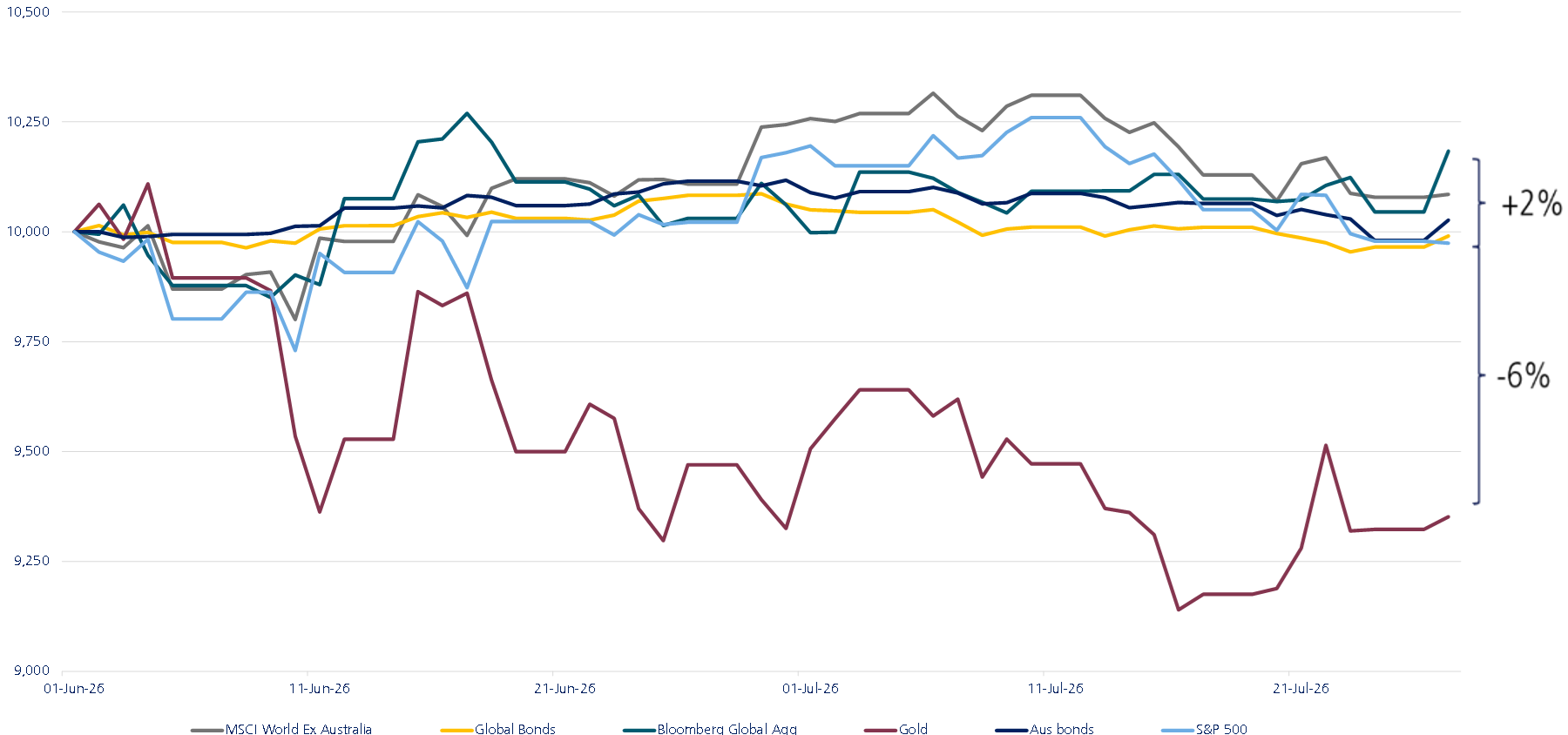
1: Markets have largely consolidated over the past two months
Yet, as we set course at the start of H2, none of this volatility has shifted us from our central case scenario, as we revisited in detail in mid-July (along with the other alternative scenarios we warrant considering). As discussed here, our central scenario of “consolidation and reflation” is one where markets experience a relatively rangebound period ahead of a brighter 2027. In this scenario, markets consolidate (as strong earnings help them grow into their valuations), while an eventual US-Iran deal stabilises oil and activity. Following some modest hikes and some slowing in growth, this gives way to a period of inflation moderation, easier monetary policy, and AI dynamics that underpin a period of reaccelerating global growth through 2027.
There have been moments over recent months when we felt this central case was at risk of evolving into some of our tail risk scenarios. But a number of recent developments have left that central case firmly on track:
Market rotation has built index resilience: Semiconductor stocks are virtually in a bear market, having fallen around 20% since their June highs. This has been alongside a significant rebalancing or rotation between the AI infrastructure and hyperscaler exposures. There have also been increasing signs of a broadening in equity returns. In the US, earnings have continued to surprise positively (with price-earnings easing from around 19x to 17x over the past few months). Elsewhere, European earnings have also taken on a more resilient feel, while a similar rotation to that in the US has been unfolding in Japan, with traditional sectors rallying.
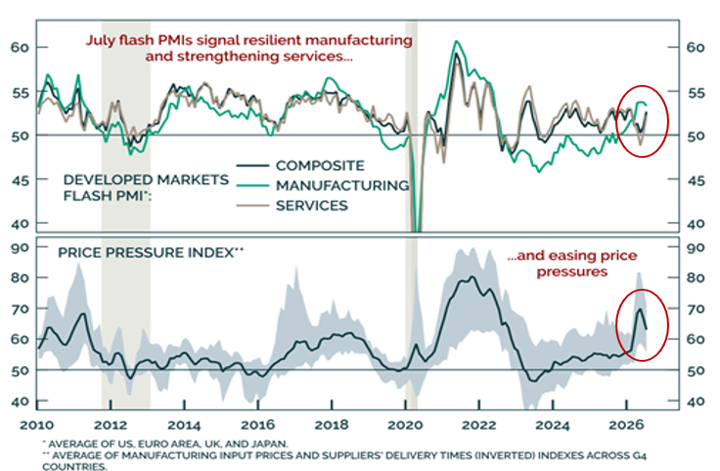
Global PMIs signal a re-acceleration in activity: April and May brought early signs that weaker business confidence, strained supply chains and rising inflation and interest rates were meaningfully threatening the global growth outlook. However, June and July have seen a significant rebound (see the chart below, top panel). Indeed, a strong rebound in the US has been mirrored by accelerating leading indicators of activity across Europe, the UK, Japan and Australia, providing some additional confidence that current earnings outlooks are robust.
Inflation leaders have also stepped back: Despite elevated oil prices, data globally have not signalled significant pass-through to core inflation measures. Indeed, US core inflation has printed at a ‘target-friendly’ 0.2% per month in three of the past four months. More importantly, global-leading indicators of price pressure (see chart below, lower panel) have begun to moderate. Australia’s Q2 inflation also appears to have eased near-term rate concerns.
US and Iran appear to still be recognising their constraints: The collapse of the peace deal has led to escalating military activities. With Iran and the US increasingly attacking non-military infrastructure, there have been moments where a return to a ‘hot war’ seemed likely. Yet constraints have won through each time, driving de-escalation and negotiation. A renewed flow of oil through the Strait is nonetheless necessary for the leading indicators of inflation to remain on a path consistent with only modest central bank tightening.
Tactical asset allocation: Reflecting this, we retain our modest overweight to equities (+1), with an overweight to developed markets (+2) partly offset by an underweight to Australia (-1, see page 9). This month we also trim our underweight to global government bonds (from -2 to -1), reflecting the rise in longer-dated bond yields to near-cycle highs (chart above). With recent data still flagging a sharper-than-expected slowing in Australian growth, we remain overweight domestic bonds (+1). With a neutral investment grade and high yield credit exposure, this shifts our overall fixed income stance to neutral. For more detail, visit our “Tactical asset allocation” on page 9.
Shorter-term signals we are watching to re-lean into risk
More of the (recent) same. The factors above that have left us assured for now about our central case constructive outlook – and some others we will highlight – are the very same relevant factors we look to as a signal to embrace risk more emphatically as we edge toward 2027. That’s not to say there aren’t reasons to remain closer to neutral for now, as we are, for a time. Risks clearly remain around the US-Iran war, US mid-term volatility, the rapidly changing AI environment and the longevity of capital expenditure (capex) plans and vagaries on AI monetisation. Some further modest adjustment upward in central bank cash rates in H226 also holds the potential for near-term volatility in risk assets. There are also the more ‘tail risk’ events, such as a super El Niño or market contagion from the impact of tighter financial conditions on credit and looser lending standards in private credit.
However, with that in mind, below is a checklist of key signals we are watching that collectively support a shift to adding more equity risk exposure to portfolios over time:
Needless to say, this is not an all or nothing list. Moreover, were equity markets to drawdown for geopolitical or other reasons over coming months – and some of these shorter-term signals were still pointing positive – our currently constructive disposition would bias us to deploying the capital we have been ‘accumulating’ over recent months in our now-neutral fixed income positioning.
There is clearly a debate over the extent to which the activity associated with AI’s acceleration, and particularly the capex and energy build-out, adds to inflationary pressures across the world economy in the short term. But beyond the next one to two years, what (if any) conclusions can we draw at this point in the cycle – with all its uncertainty – regarding the longer-term portfolio implications of AI on real growth, inflation and interest rates.
This is obviously a significant topic (worthy of many pages), and one where there will be competing views. One of the more recent viewpoints being advocated is that the long-term AI productivity shock will lower longer term interest rates (thus arguing a similar euphoric long-term positive to fixed income markets as for selected equities that will benefit from the higher growth). But if we start to unpack this, we will find it’s a far more challenged argument.
What drives the long-run neutral policy rate? Theoretically, the average cash rate in an economy is the combination of the ‘real rate’ of interest plus the expected rate of inflation (which hopefully mirrors closely a central bank’s target). In simple terms, it’s all about what keeps things pretty steady in the long run. As European Central Bank (ECB) Executive Board member Philip Lane discussed in a speech last month, the ‘real rate’ (which economists like to call r-star), is the real rate that equilibrates desired saving and desired investment. While the Reserve Bank of Australia (RBA) no longer emphasises a point estimate for our real rate, their commentary suggests it’s perceived to be around 1.5%, which when inflation of 2.5% is added, gives you a nominal ‘neutral’ policy rate of about 4%. This aligns with Governor Bullock’s recent comments that current policy settings are only “a bit” tight (at 4.35%).
The first point is that it cannot be as simple as AI drives a productivity uplift that anchors inflation to a lower path, say 2% (rather than our 2.5% target). If this occurred, then yes, the neutral policy rate could reduce to 3.5% rather than 4%. But this ignores the potential growth-enhancing impact of that productivity shock. An economy’s potential growth is largely a combination of its population growth (the number of people), participation (how many of them are working) and productivity (how efficiently we use those workers, across both labour productivity and capital deepening). AI should raise real growth and, all else equal, lift the neutral real policy rate, r-star. This could occur because AI raises expected returns to capital and the desired stock of complementary capital – data centres, energy systems, chips, software, organisational capital and skilled labour. In our example, our AI-powered faster growing economy actually needs a higher rate of interest to contain inflation. If trend growth rises from 2.0% to 2.5%, then the neutral policy rate rises from 4.0% to 4.5%.
The second point, however, is that it’s not that simple. And that’s because whether real growth (and r-star) actually increases (given a boost to real capex returns) depends on how AI interacts in the long run with labour. If AI is primarily capital-augmenting, and income gains flow disproportionately to capital owners rather than workers, this has the potential to increase inequality, raise precautionary saving, dampen overall consumption and effectively short-circuit the real growth uplift. In this scenario, real growth, real interest rates and nominal interest rates could all be lower, broadly consistent with the productivity shock thesis.
The alternative is that AI proves complementary to our workforces in the long run, which aligns more closely with the optimistic view of AI’s contribution to society. In this scenario, real growth rises, and the impact on nominal rates becomes more uncertain and balanced with the disinflationary impact. For example, if AI productivity drives real growth and real rates higher, and inflation expectations remain unchanged, then nominal interest rates will trend higher. If that increase in real rates is aligned with a productivity-led drop in inflation outcomes, then this could offset or dominate the upward pressure from real growth. In this example, real growth could add 0.5% to the neutral nominal policy rate, which is then offset by lower trend inflation expectations.
To summarise, the conclusion on the long-term impacts of AI are therefore uncertain rather than mechanically disinflationary. AI could raise real growth and r-star, while its initial capacity build-out may be inflationary. If inflation expectations remain anchored, that would imply a higher long-run nominal neutral rate. But if AI substitutes for labour, raises precautionary saving and delivers persistently lower inflation expectations, r-star and nominal neutral could be unchanged or lower. The key issue is not productivity alone, but how AI changes the balance between investment, saving, labour income and the long-run inflation regime. That’s a hard one to pick at this time.
For what it’s worth, our take on AI’s impact leans toward nominal neutral rates being largely unchanged, but reflecting a mix of lower inflation and higher real growth over the long-term.
Finally, we continue to advocate a focus on building medium-term resilience into portfolios. This should reflect the ‘common ground’ between two key drivers, namely adapting portfolios for a multi-polar secular outlook and harvesting returns in the bottle-neck thematics:
A portfolio that will weather this multi-polar geopolitical environment will be one that is biased to growth, protects from sticky inflation, harvests persistently higher interest rates and limits volatility through exposure to truly uncorrelated (and unlisted) assets. This means taking advantage of attractive all-in yields for investment-grade credit and government bonds to secure income and build protection against a potential disinflationary slowdown (the downside risk we assess as most pertinent).
We also believe that ‘growth focus’ should be directed toward areas where mega-thematics are exposed to more demand than supply, so-called bottle-neck thematics. These include the AI enablers (diversified across the entire opportunity set from chips, to cooling, networking, among others), and the AI adopters (again diversified across enterprise software, application and platforms, potentially in non-US markets like India). It is important to balance this with exposure to other important thematics such as energy resilience (such as renewables, nuclear and storage), the future growth in defence industries, and infrastructure (including data centres and other real assets).
Figure 4: Future proofing portfolios includes gaining exposure outside of growth and tech (Performance since 1 June 2026 to 28 July 2026
The US-Iran conflict remains top of mind for investors. The 17 June memorandum of understanding between the two sides unleashed a short-lived bout of investor optimism and sharp oil price declines. These were somewhat reversed as the ceasefire ended in early July, sending oil prices back towards restrictive levels of USD 100 per barrel (p/b), though still well off the USD 120 p/b highs earlier in the year. The near-term outlook remains uncertain, with the Strait of Hormuz again largely closed and global oil inventories at dangerously low levels.
That said, we continue to assess that near-term uncertainty has peaked and that the material constraints of both parties continue to forestall a worst-case scenario of widespread conflict and/or a globally debilitating energy supply disruption. The bond market continues to constrain President Trump, while China and an increasingly aggravated global community are likely to constrain Iran against further aggression.
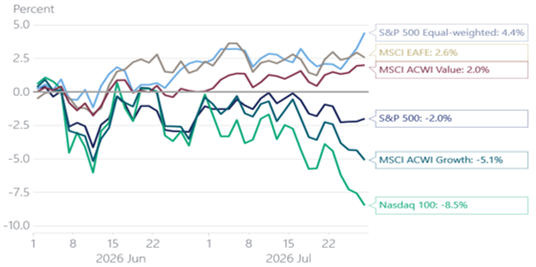
Abstracting from the geopolitics, global equity markets have spent the last few months broadly unchanged at the headline index level. This veneer of inertia has masked a significant amount of churn, rotation, and market broadening beneath the surface. Value equities, smaller and mid-sized companies, and ex-US markets have outperformed since the start of June, as investors rotated away from overheating semiconductor and tech stocks. These consolidatory dynamics have actually reduced some of the froth and over-extendedness of the market.
Coupled with a strong and broad-based Q2 earnings season across the globe so far, there are now growing fundamental and technical justifications to stay invested in equity markets.
That said, markets will still have to navigate some headwinds. These include increasing scrutiny around the scale of hyperscalers’ AI capex spend, and whether they will be able to earn the future revenues needed to justify the increasingly gargantuan outlays. Our base case remains that AI will ultimately benefit the entire economy over the long term, though the best investment winners of tomorrow may not necessarily be the investment winners of yesterday.
We also remain vigilant around the potential for inflation pressures to spur tightening actions by central banks. The resilience of the US economy and the ongoing oil supply shock are key upward catalysts in this regard. Central bank hawkishness and/or rate hikes can disrupt markets and the broader economy, as we are seeing in Australia.
For now, we maintain our modestly constructive stance, and acknowledge the two-sided risks to the outlook. We continue to advocate the importance of future-proofing portfolios for a potentially volatile, inflation-driven second half, while maintaining adequate liquidity to take advantage of market dislocations should they arise.
We still expect the macro to be the key market driver in 2026. While we navigate the near-term US-Iran conflict, where uncertainty clearly remains elevated, our constraints-based framework tells us that the macro should ultimately return to the fore as a prime driver of markets in 2026. We continue to judge that local uncertainty has peaked as material constraints push both the US and Iran towards returning to the negotiating table. Of course, we recognise that new risks can always emerge, and investors should prepare for further potential shocks as the world increasingly comes to terms with multipolarity.
Central banks face tricky crosscurrents in H2 2026: Even before the oil shock of US-Iran, a resilient US economy and rising reflationary risks were increasingly likely to put pressure on central banks to grow more hawkish as the year progressed. That said, easing near-term inflation pressures and moderating labour markets highlight the risk of over-tightening and inducing a policy-driven slowdown.
Opportunities are ripe for ‘active’ hunters versus ‘passive’ gatherers: The best opportunities will likely lie beneath the broad index level, rewarding more active ‘hunter’ versus passive ‘gatherer’ investors. An active approach should pay dividends amid a broadening market.
Now is the time to future-proof portfolios: With reflationary storm clouds potentially accelerating if the current oil shock extends, we believe investors should take the time to interrogate and future-proof their portfolios. This might involve reviewing exposure to AI, non-US markets, active management, uncorrelated and real assets, and bottleneck thematics including energy resilience, infrastructure and defence.
Welcome to a multi-polar world: The global community is increasingly adjusting to a multi-polar world, an environment that should create more volatility and uncertainty but also one that presents more growth and opportunities for investors who understand how to navigate and invest in it.
Are you ready for the ‘Great Recalibration’? We believe global trade, capital, and investment flows are in the process of a ‘great recalibration’ towards a more balanced setting with more active fiscal and consumer spending outside the US. This epochal shift carries significant implications for long-term portfolio design and construction.
The rise of AI: AI presents key challenges and opportunities for the global economy and human society.
Higher base rates increase investor options: We expect interest rates to remain higher for longer. Higher base rates increase forward-looking returns across all asset classes, giving investors more options to build robust, multi-asset portfolios.
Receive ongoing access to LGT Wealth Management’s insights and observations - a curated stream of thought leadership, market perspectives, and strategic updates designed to inform sophisticated investors.