
For some time now, and from a broadly neutral tactical position, we have been looking for an opportunity to deploy more risk. This could be either on the back of a near-term equity correction, or early in 2027 as a more constructive setup for economies and markets emerges. As we’ve discussed, this more constructive setup needs a few boxes to be ticked, including some sort of ‘deal’ or political resolution between the US and Iran that sees the already increasing level of oil transit prompting sustained lower oil prices (helped by visibly rising inventories). After a likely final round of rate hikes in Q426, this in turn should help central banks enter 2027 feeling more comfortable that policy has been tightened enough. Together with a still-positive near-term growth outlook, and the natural demise of US midterm election uncertainty, this should provide a more supportive backdrop across both equities and fixed income during H127.
Over the past month, uncertainty over the outlook has intensified on a broad range of fronts, and we have drifted further away from being in a position to ‘tick the boxes’ we have our eye on. Indeed, the past month has delivered more unsettled conditions, with surging oil prices, global political instability, signs of broadening inflation risks, concerns about artificial intelligence’s (AI) evolution, failed IPOs, and widening credit spreads. While bond yields have surged, global equity markets have broadly tracked sideways, challenging the ability to add risk for even the most optimistic investor. Nonetheless, we hold our central case view of a better 2027 outlook, albeit our conviction is being tested. Inside this month’s Core Offerings, we discuss some key observations as we navigate what could be a still very volatile final couple of months of 2026.
Our expectation that H226 would be ‘choppy’ for markets has not disappointed. Indeed, over the past month, volatility has surfaced on a broad range of fronts. From renewed escalation in the Middle East (pressuring oil prices back near their highs post February 2026’s outbreak of the US-Iran war), to an uncomfortable broadening of inflation pressure in the US that has – together with rising 10-year bond yields – seemingly opened the door to markets becoming skittish and less convinced of the AI-related earnings outlook. Global central banks have also been tightening policy (including in a once-deflationary Japan), and attention has been focusing on civil unrest in Europe related to government attempts to return fiscal positions to a more sustainable path. This has added to the upward pressure on bond yields, increasing the cost of finance and helping to drive another period of weakness in tech equities, as well as a widening in investment grade credit spreads.
Here in Australia, confidence has also been shaken by collapsing business and consumer confidence, with fears of unanchored inflation leading to a likely further hike in November (which would be an 18-year high). At the same time, the unemployment rate has been moving higher, fund managers have been closing property funds, we have seen failed IPOs (notably Australian data centre operator Firmus and Singapore REIT AirTrunk) as well as glimpses of civil disorder rarely seen on our shores.
With all this unfolding over recent weeks, it’s hard not to acknowledge the ongoing resilience of the global economy. Despite wars, surging energy prices, rising tariffs and the recent renewed inflation and multi-decade high bond yields, growth has remained near trend. Moreover, leading indicators continue to flag a similar (if not improving) trend pace of growth ahead. This also aligns with our assessment that the macro remains more ‘mid’ than ‘late’ cycle, with further to run. While some of that resilience rests on the robustness of global jobs markets (supporting income and demand growth) according to Barclays, much also rests with “the optimism about AI and its transformative boost of productivity for the global economy”.
Reflecting this, our central scenario remains one where renewed Middle East deescalation ultimately limits the risk that supply chain-related inflation persists. And following the US midterm elections, a period of inflation moderation, steadier monetary policy, and positive AI dynamics should underpin a period of reaccelerating growth through H127.
However, this outlook has come under significant pressure over recent weeks. As we begin to prepare next month’s customary 2027 outlook, we remain convicted in our central case, albeit the extent of that conviction has edged lower. We made no TAA changes this month, and are awaiting further signals and relying on the diversification built into our portfolios to weather whatever the next few months delivers. Below we discuss some of our key observations, and how these critical issues will impact our 2027 outlook.
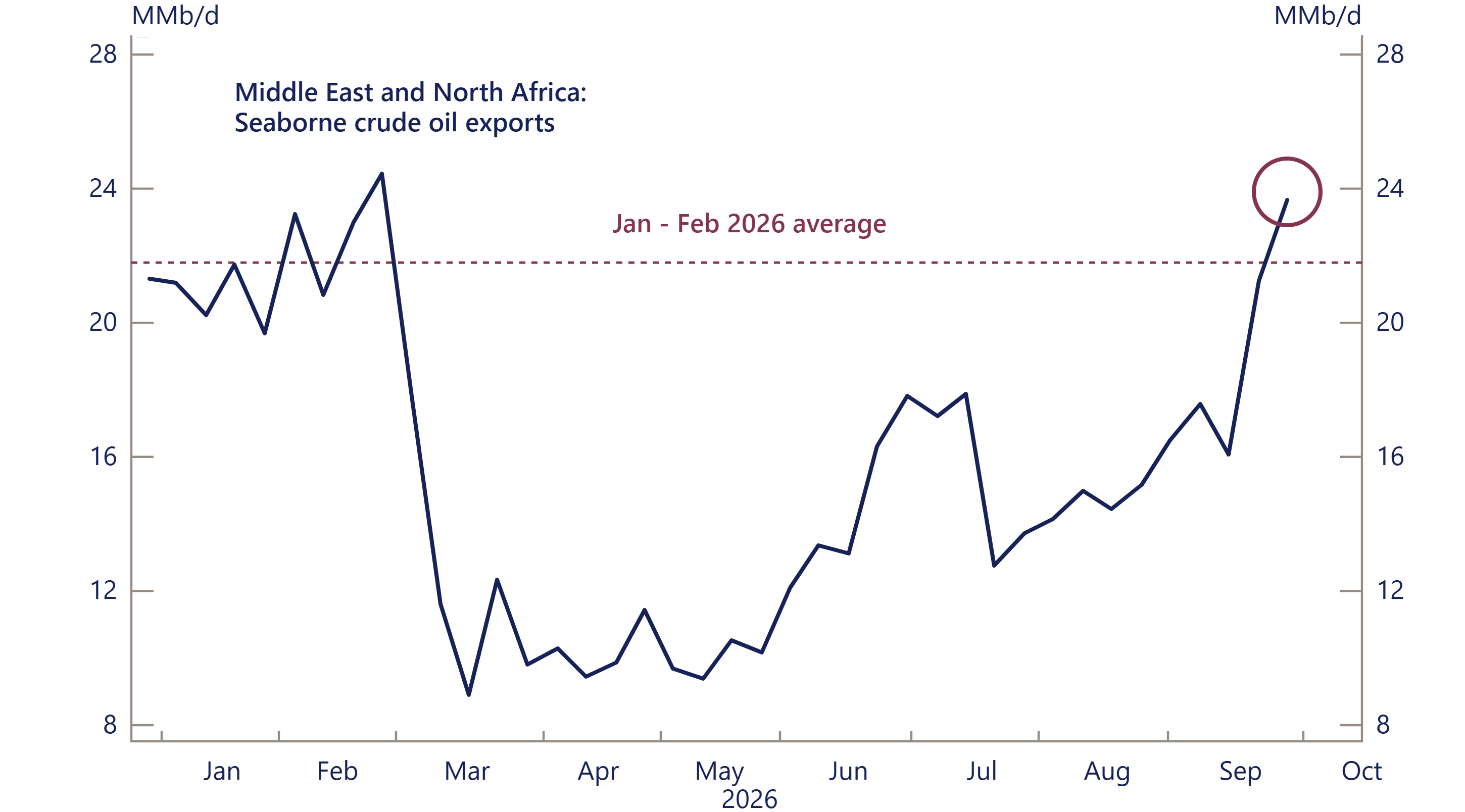
During October, Yemen emerged as a new front in the US-Iran war. Since Saudi Arabia attacked a Yemeni airport in mid-July, the Houthis have made significant territorial advances into southern Yemen and have more recently launched missile and drone attacks on Saudi airports, seaports, refineries and other targets. Why does this matter? As the chart below shows, there is convincing evidence that oil is flowing through the Strait of Hormuz (SoH), as well as the Red Sea East-West crude pipeline (only weeks after the September attacks). Yet oil prices remain elevated.
As discussed in our recent podcast, despite the potential for the world to de-prioritise the SoH, Iran and their supporters have demonstrated their ability to strike these pipelines with missiles and drones. Consequently, a sustained reduction in oil prices almost certainly requires a political resolution between the US and Iran. Such a deescalation over coming months remains our central case, and a key box to check before we deploy more risk. Both the US and Iran have shown an ability to come to the negotiating table and make a deal, although there appears little likelihood that this will occur this side of the US midterms. Still, there remains great uncertainty as to Trump’s post-midterms actions.
The US midterms are imminent. The consensus has been for much of this year that the House was lost to the Republicans, but that it would have to be a stellar night for the Democrats to also secure the Senate. However, the prospect of a ‘Blue Wave’ has been gaining support among political strategists, reflecting the polling data (chart below). As PIMCO’s Libby Cantrill recently noted, “given that many key metrics are increasingly pointing to a wave election, including the Generic Ballot, as well as Trump’s approval ratings, we very much could see the Senate flip in November, and a (narrowly) united Democratic Congress are not all that significant.”
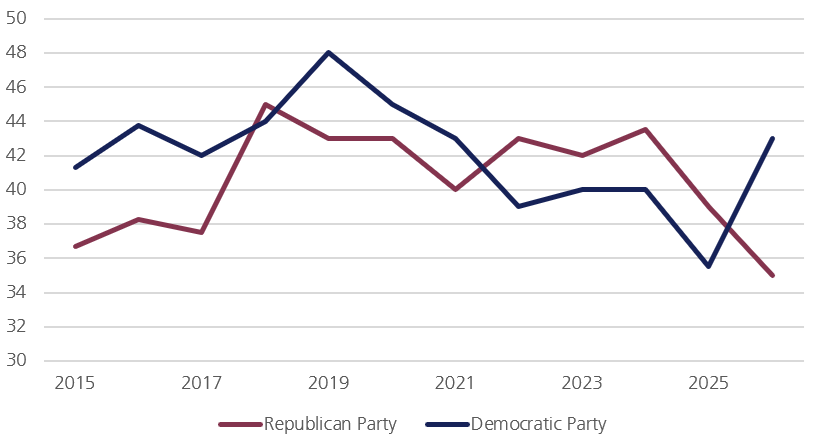
It will be interesting to see how markets respond should Democrats win the House as expected, and even more so should they take the Senate. Crucially, President Trump potentially faces internal Republican blame. The likelihood the Democrats could secure enough seats to influence policy (ie enough to break a filibuster) appears low. However, the greater the ‘blue wave’, the more the chance markets (both equities and fixed income) could focus on the potential for Democrat-led spending on government services (health), higher regulation and taxation.
Inflation is typically demand-pull or cost-push. Demand-pull inflation is almost always associated with tight job markets and accelerating wages growth that leads to household demand that exceeds the relevant economy’s supply capacity. Coming into 2026, global central banks were in the process of unwinding previously tight policy, and expected to trim rates moderately further through H126. However, they have tightened once or twice already this year as a reacceleration in growth (in part due to AI) combined with a cost-push inflation shock due to the US-Iran war’s impact on energy prices. Indeed, as Northern Trust recently noted, the turnaround in rate expectations for end-2027 has amounted to between 80-100 bps across the UK, Europe and US.
In one sense, this renewed ‘tapping of the brakes’ by central banks may suggest that they are near their peak. Through another lens, the recent concern – highlighted by two months of higher-than-expected monthly core US inflation – is that persistent high energy prices are now being passed through to general prices (particularly services), entrenching the supply-side shock into core prices, and suggesting central banks have more work to do.
Markets are now pricing about 0.75% more from the European Central Bank (ECB) and US Federal Reserve (Fed) over the coming year, and similar for the Bank of Japan (BoJ), a response to recent higher inflation data, the renewed escalation in Middle East tensions and high energy price. However, we believe that after a further final round of rate hikes across central banks in Q426, central banks may evolve to an ‘on hold’ position during Q127. While some political resolution in the Middle East is likely an important part of this transition, we would also note that jobs markets are softening (or no longer tightening) and wage growth is decelerating (at least in the US), while financial conditions have also tightened meaningfully relative to expectations. The risk that the persistence of elevated energy costs weaves its way into core services prices has risen and needs to be closely watched.
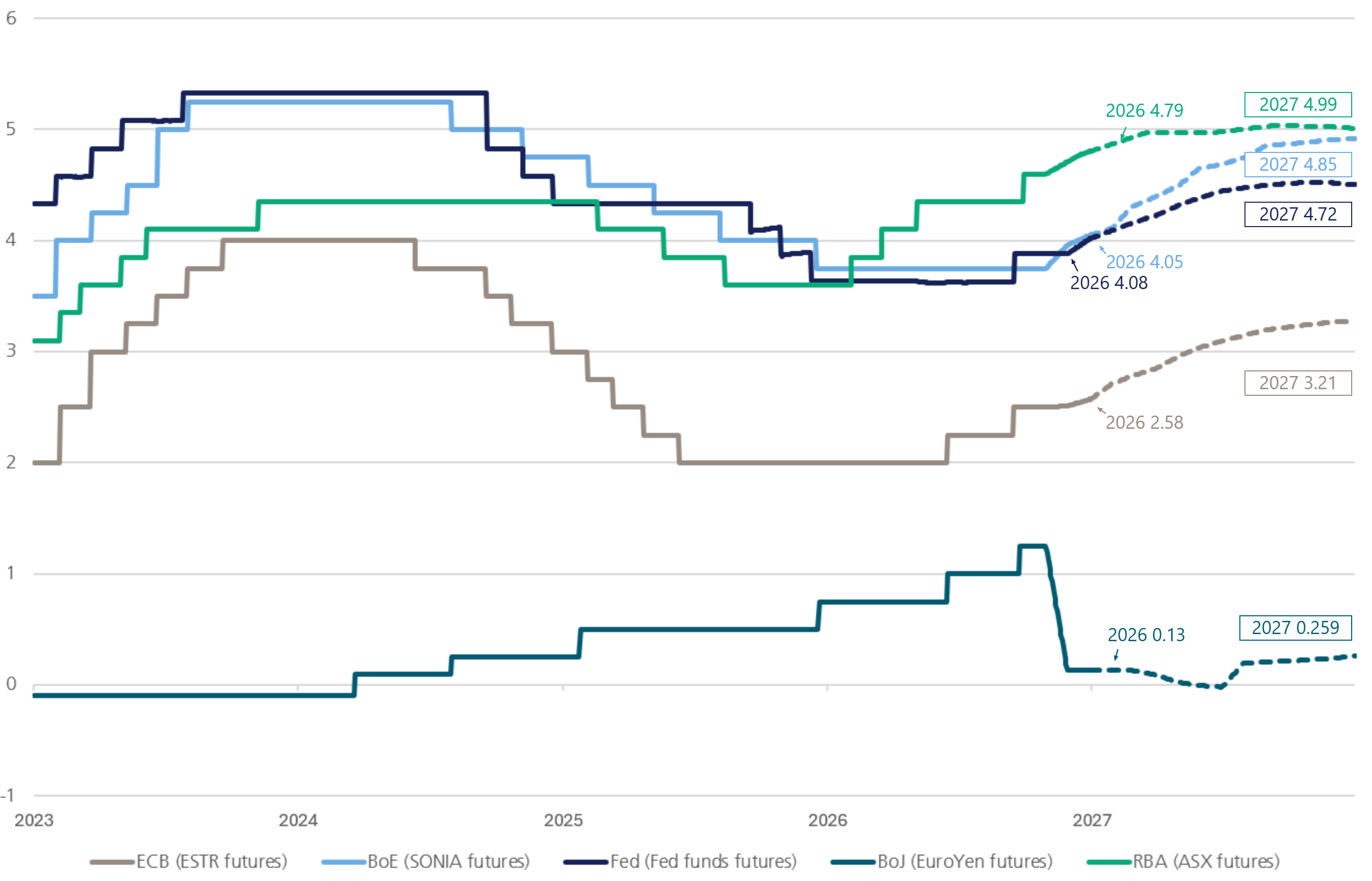
While there is a risk that central banks have more work to do than previously assumed, it’s unlikely that that policy action will exceed what’s currently priced in by markets. With long-term yields at two-decade highs, and central banks closer to embracing a more ‘on hold’ stance through 2027, the reward-risk ratio of taking a one to three year view in government bonds, and nibbling at duration, has materially increased over the past couple of months.
When considering what a long-term average yield might look like, there’s no doubt that a fast AI-led growth story, and a multi-polar secular outlook that adds an increment to inflation, points to a higher average long-term yield than may have been considered five to 10 years ago. But even assuming US real trend growth can lift from 1.5%-2.0% to 2.0-2.5%, and accepting steeper curves, some additional term premium, a neutral stance for the Fed seems unlikely to be above 3.5% (current Fed estimate is 3.2%) and long-dated bonds are above their medium-term average yield.
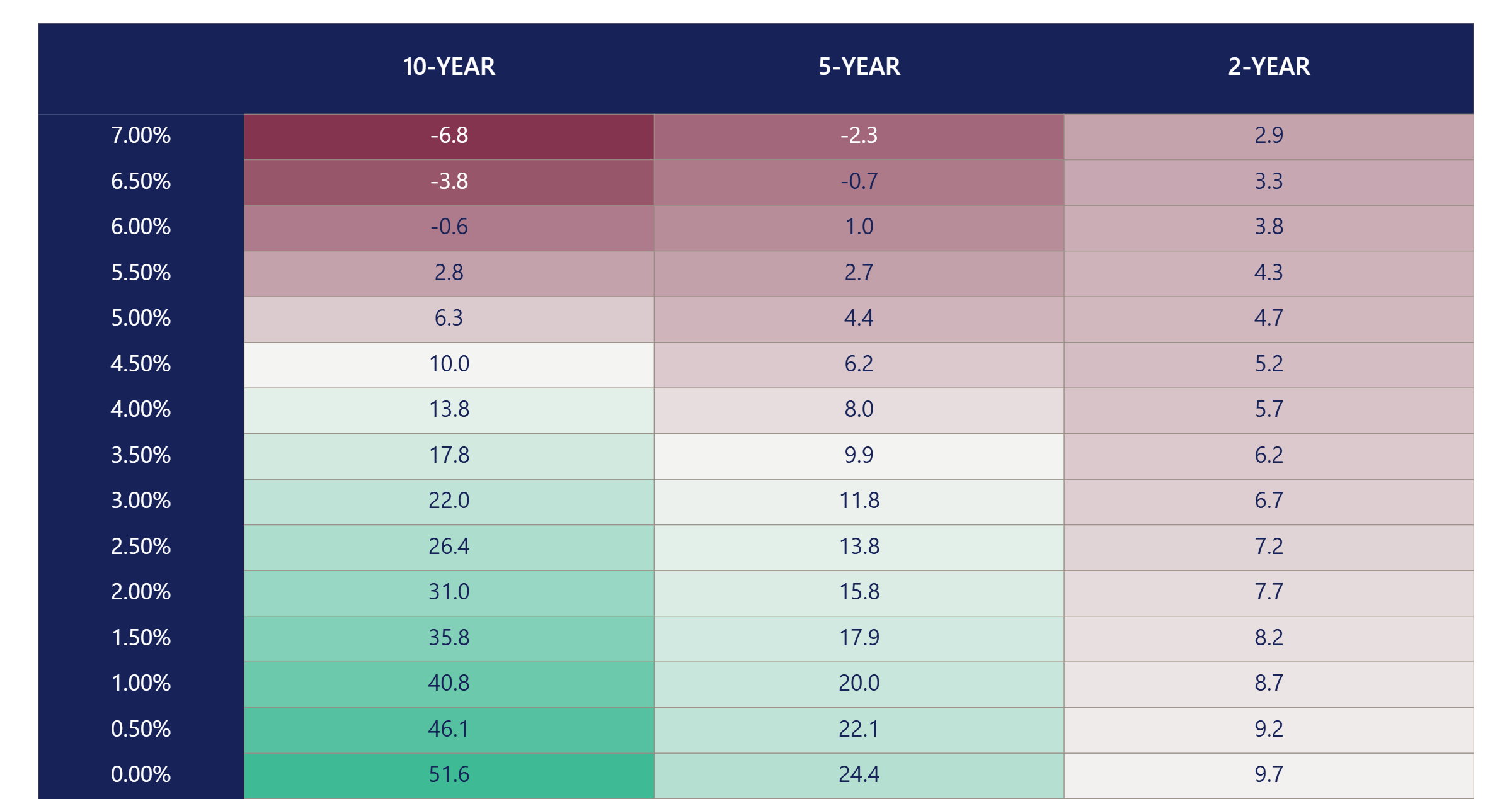
Moreover, given some uncertainty about the steadiness of the AI path – and historical precedent for periodic drawdowns – we still believe bonds will provide significant portfolio protection in the event of a (periodic) correction, smoothing the return journey. Indeed, given the convexity in bond returns, any rally to 4% would deliver double-digit bond returns (while it would take a selloff closer to 6% to reduce bond returns to zero).
“Why invest in Australia at all?” has been a frequent retort over recent months. While we remain unconvinced that globally there is an endemic inflation problem, Australia has all the hallmarks of a more entrenched inflationary or even stagflationary challenge. Both core and headline inflation have reaccelerated strongly above the target range, leading the Reserve Bank of Australia (RBA) to hike four times this year, taking the policy rate above the prior peak (the only country in the G20 to do so on both counts). Another rate hike is now anticipated in the first week of November.
The outlook for Australia’s economic growth is now materially weaker ahead, due to tighter policy, elevated energy prices, as well as the negative short-term impact of the recent federal budget on the housing sector – impacting housing activity, consumer demand as well as state government stamp duty receipts. While we believe this is adding to the attractiveness of Australian government bonds – given the likelihood of a sharper-than-expected slowdown in growth through to Q127 – it nonetheless is weighing on the equity earnings outlook, which is materially below that for other regions (and likely under more downward cyclical growth pressure).
However, while we continue to argue that Australian equities deserve an appropriately sized position in portfolios (circa 30% of the listed equity exposure) from a risk and diversification perspective, we retain our tactical underweight position for now. That said, it is worth recognising that value could emerge for Australian equities into H227 should a significant cyclical slowing in the economy lead to sufficient disinflation in H127, and a pivot to easing from the RBA. Indeed, it seems likely that any global easing cycle by central banks could be led by the RBA.
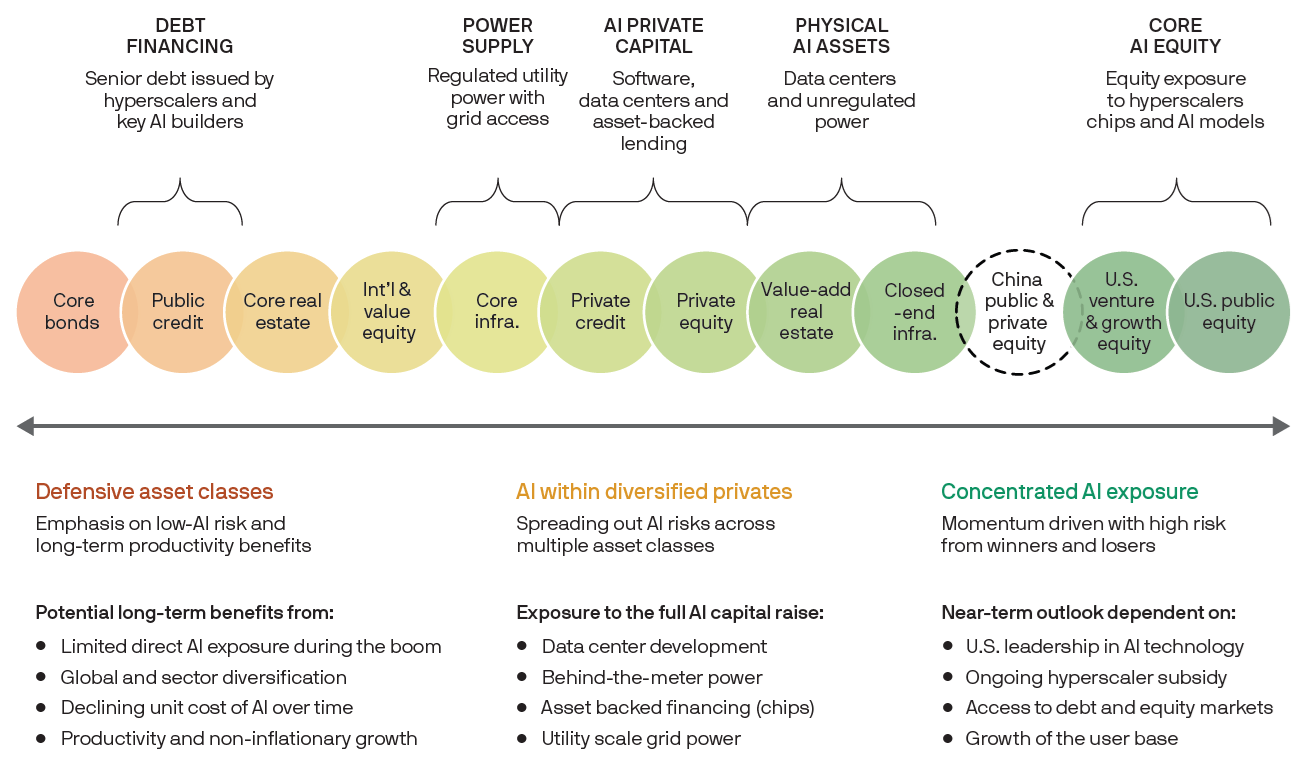
Last month, we outlined our thinking on how to navigate AI in portfolios. The challenge is not whether to diversify, but how to establish a consistent, rigorous framework for doing so. The notion that we should think through our AI exposures across three key buckets (see chart below, from JP Morgan AM) – the AI intensives, the AI exposed and the AI defensive – has resonated positively with our readers. Reflecting this, we re-highlight this useful perspective this month.
As we discussed last month, with hindsight – likely the next five to seven years – we will almost certainly have a clearer picture of the right AI exposure across portfolios: how far to embrace the thematic, diversify within it and, ideally, diversify away from it. For now, this remains challenging, as does understanding the full extent of AI risk already embedded in portfolios. AI is arguably not a sector per se, but a force likely to pervade sectors and asset classes to varying degrees. One could simply embrace that journey. Yet AI’s success does not guarantee attractive returns for every investment, and those creating value may not secure its sustained capture over time.
Volatility also matters. Smoothing the journey is an important objective, particularly for investors requiring regular income. While the appropriate AI exposure across asset classes remains unanswerable, diversification is well founded if future drawdowns extend beyond the two- to three-month periods that have become the norm. Some features of the current cycle temper the urgency: the extended capex runway, a market already differentiating winners and losers, strong hyperscaler balance sheets and rapid societal adoption. That said, it is definitely not too early to scrutinise, evaluate, and assess portfolio exposures to this generational technological revolution.
Receive ongoing access to LGT Wealth Management’s insights and observations - a curated stream of thought leadership, market perspectives, and strategic updates designed to inform sophisticated investors.