

Hear the latest commentary from our investment team.
Most investors believe they have a reasonably high probability of predicting many of the key drivers of investment returns through the cycle, from the prevailing macro forces and policy environment to the likely relative performance of the different asset classes, to name a few. Yet artificial intelligence (AI) is definitely one ‘revolution’ all investors are going to have to stare at ‘through the looking glass’ for a while – and time may need to journey on as well – before a greater sense of confidence emerges on how things will ‘play out’, both here and now, and in the decades ahead.
With AI’s rise becoming increasingly critical to investment outcomes – and given the number of questions our clients have been posing – this month we lay out some of the debates (and less so the answers) the LGT WM Investment Committee (the IC) are having of late. We aim to provide a framework for how we are thinking through the implications of AI, from where we are in the journey to how it’s shifting the macro landscape. Maintaining appropriate diversification (while not missing out on potential returns) and balancing the conflicting energy, environmental and social demands AI is bringing, are also key questions we briefly explore this month.
But first, a few thoughts on recent developments, from the Middle East to central banks, and the boxes to be ticked before we deploy more risk.
A couple of months ago, we shared our thinking around why we believed recent developments were “tilting more positive” for 2027. By early next year (or sooner should a pullback in markets unfold), we anticipate actively deploying more of our risk budget. Yet at the time, we cautioned that a few boxes needed to be ticked before we’d advocate for such a move.
On this front, our view remains unchanged. And not entirely surprisingly, the boxes remain largely unticked. Indeed, as the last quarter of 2026 gets underway, some of the headwinds to adding more risk have actually intensified. Global central banks have, much as we expected, felt the need to lift interest rates a little further to ensure the recent (modest) upturn in core inflation returns to its prior downward path. Whether financial conditions are deemed tight enough given an improving growth outlook, in part due to the AI-led capital expenditure (capex) expansion, is key to this debate.
Yet, recent developments in the Middle East have added to the inflation drama. This side of the US midterm elections, we are seeing the US’s Middle East adversaries seemingly prepared to make the most of Trump’s vulnerability (not least his poor voter polling) by further threatening oil supplies that could drive renewed oil price spikes. As our recent fireside chat with PIMCO’s US Head of Public Policy Libby Cantrill highlighted, US voters are “mad about affordability. They're mad about the Iran conflict,” believing the political class hasn’t addressed cost of living issues.
In September, the re-escalation in hostilities (noting the strikes on Red Sea oil supply facilities as well as renewed strikes on ships transiting the Strait of Hormuz) risks a near-term spike in oil prices. At the same time, there is increasing evidence that oil is flowing through the Strait and other supply routes, also challenging Iran’s perceived leverage. The constraints facing both sides have seen late September’s UN General Assembly in Washington catalyse renewed talks between the US and Iran, the US and the Gulf States, as well as President Trump and China’s President Xi (with their current trade truce extended for a further two months). No doubt, the way these events plays out will have a significant impact on markets through the rest of 2026.
Nonetheless, some US-Iran political resolution (or increased oil output) before end year that settles oil prices into a USD 50-80 range – and in turn makes central banks less twitchy (given renewed tighter financial conditions) – has the potential to drive more positive inflation and growth outcomes to the surface as 2027 gets underway. This effect would be boosted by US midterm uncertainty having abated once the elections are over. In this scenario, a more positive Inflation and growth outlook for 2027 should at least be lifted above the geopolitical noise.
If so, this would open the way for increased deployment across a broad range of asset classes. Such positive developments would need to be weighed against the impact of higher interest rates, potential inflation impacts (and growth headwinds) from a likely ‘super’ El Nino, as well as any unexpected shift in US military activity in the wake of a likely loss in the House by the Republicans at the early November midterms.
At the same time the situation in the Middle East is re-intensifying, attention has recently turned to the more medium-term outlook being crafted by the AI revolution. The current AI boom is arguably larger in scale and advancing more rapidly than any previous technology-focused capital investment surge. There are a lot of (very) smart people in the AI and related spaces, and almost as many differing views of just how the next few years are going to play out. And this is not only from the perspective of growth and investment, but also questions the very future of humanity.
As mentioned earlier, AI has only increased in importance in recent times, and is becoming increasingly enmeshed with investment outcomes. There are also the demands on power and the broader environment to consider. This is all something we are monitoring closely in the IC, and below are the questions we are currently debating.
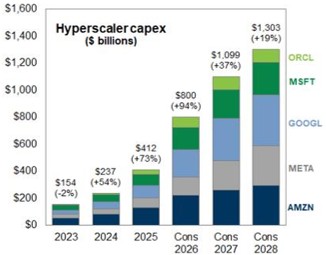
Figure 1: AI capex plans suggest the peak in investment remains beyond 2027
At LGT WM, we are believers in the long-term AI story. Its potential to reshape the world in which we live – including the way we work, deliver investment advice, create value, and assess risk and returns – appears substantial. But history reveals that even transformative technologies rarely follow a smooth path from invention to widespread adoption, and that technological success does not guarantee attractive returns for every investment. We know that railways, electricity and the internet ultimately transformed economies. Yet, their development was nevertheless punctuated by overinvestment, subsequent consolidation and often immense economic and market volatility. Those who create the value may not necessarily capture that value over the long term.
One of the key debates is: when will that volatility emerge? Are we early in a three-to-five-year cycle or is the point where winners and losers quickly start to emerge closer than we think?
And of course, where we stand today depends on which part of the AI cycle we mean. And while our debate continues, as far as enterprise adoption is concerned, we lean toward being still very early in the cycle. Most companies are experimenting with AI, while the evidence of durable returns on investment, and of benefits extending beyond hyperscalers and semiconductor suppliers, remains limited. The most recent US reporting season appeared to reveal early signs that embedding AI into processes was delivering productivity uplifts. In Australia, the evidence is still nascent, with a recent Deloitte survey suggesting only 12% of domestic firms are using AI operationally.
The infrastructure cycle appears further advanced, with enormous commitments to chips, data centres, networks and power. The debate here is whether this still has years to run. As the chart above suggests, while capex forecasts beyond the next one to two years decay in confidence, the peak in the AI capex spend does not appear to be this side of 2027. The financing cycle is arguably more mature: capital is plentiful, expectations are high, and valuations already anticipate a meaningful share of future success. The extent to which the demand for corporate AI capital is crowding out government financing – putting upward pressure on sovereign bond yields – is also a debate.
The IC is not debating the risk that AI proves irrelevant or whether AI will ultimately transform the economy.
It’s more about:
And areas of vulnerability are becoming more visible. These include: the high cost of model training, key large language models (LLMs) falling behind the cutting-edge leaders, end-user awareness of rising AI costs, growing challenges in locating and building data centres, difficulty in accessing sufficient power and water supplies, rising community resistance to data centre developments, concerns over electricity consumption and resource use, increasing scrutiny of data privacy and model safety, and competition from sophisticated low-cost models being developed in China.
On balance, there is a basis to believe we are still moving through the invention phase and the subsequent capital investment phase. What lies ahead should be more technological advancement, steady growth in user adoption, and rising data centre and power infrastructure demand. As JPMorgan recently stated, “Today’s high expectations are grounded in real demand for AI that should grow fast enough to outrun supply for several more years.” While the outlook remains uncertain, that’s a perspective we align with, suggesting any future shake out is probably not yet.
With hindsight – likely the next five to seven years – we’ll almost certainly have a clearer picture of what the right exposure to AI should be across portfolios, the extent to which we embrace the thematic, how we diversify within it and ideally, also diversify away from it. For now, answering that question is more challenging, as is understanding the full extent of AI risk embedded across existing portfolios.
Through one lens, the answer might look like the need to be wary of AI exposure is less important. Arguably, AI is not a sector per se, but is likely to pervade all sectors (and asset classes) to varying degrees in time. Maybe one should just embrace the journey fully. However, as discussed in the prior section, AI’s success does not guarantee attractive returns for every investment, and those who create the value may not necessarily secure the sustained capture of that value across time.
There is also the question of volatility and smoothing the journey for many investors is in and of itself an important objective – particularly those that require regular income – that should be considered. While nailing down the exact exposure one should have to AI across asset classes remains unanswerable, the argument for having diversification to smooth aspects of any future volatility (or indeed evolution) is well founded, particularly if there is a risk a future drawdown could be extended beyond a two to three month period that has somewhat become the norm.
Arguably, there are some features of the current cycle that are tempering the urgency to have an answer to ‘What’s the right amount?’ at this time. These would include the still-extended capex runway, the willingness of the market to explore winners and losers now (ie unlike previous technology and capex cycles, it’s not all one-way trading), the balance sheet strength of the key players, as well as the rapid pace of societal adoption. This early questioning of the appropriate return on investment (ROI) has the potential to provide some ballast. As BCA recently noted, “CDS (default) spreads for the hyperscalers are widening, while multiples keep compressing, causing the hyperscalers to suffer their worst stretch of relative performance since 2022.”
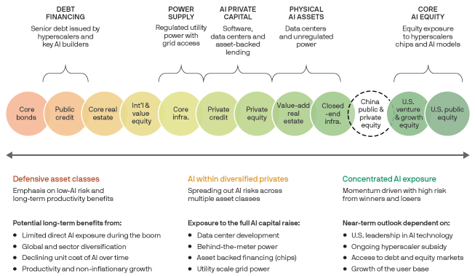
For the IC, the debate is not whether investors should diversify, but how do we develop a framework that is consistent and rigorous through time. At the highest level, diversification implores us to understand the relative level of AI exposure across different asset classes. There is a lot to like in JPMorgan’s graphic (over the page) that reveals the approximate level of AI-intensity across different asset classes. We would argue that having exposure across all three of these distinctive AI-exposed categories will be key to balancing AI exposure, returns and minimising portfolio volatility:
AI-defensive sectors: investments with little or no direct AI exposure and the potential for uncorrelated performance in the event of a broad-based selloff in other AI-sensitive asset classes. Government bonds and diversified investment grade credit and core real estate are likely exposures, and we would also add commodities (like gold) and less exposed equity markets like Australia and India.
Figure 2: Exposure to AI distributed across the asset classes
Discussions debating active versus passive management are a well-worn path. Most investors and analysts accept that there is a role for both. Namely, that we want to utilise passive (or enhanced passive) exposures where historic alpha is limited, while utilising active management where alpha and persistent manager outperformance is most prevalent. And of course, the balance here may well be influenced by an investor, family or foundation’s sensitivity to fee loads.
However, with the emergence of the AI revolution, the debate that has dominated more recently at the IC is not active versus passive, but instead whether active managers should be concentrated or diversified.
As UBS recently highlighted, the high equity volatility at an individual stock level has not translated to high index volatility. In fact, index volatility overall has remained extremely contained. In contrast to often high levels of volatility across sectors, the market appears to be focused more on the winners and losers within sectors, meaning that the “correlation across industries and stocks has remained very low”. It is this intra-sector- or micro volatility within sectors that is rendering stock selection in a rapidly evolving AI environment very difficult.
For active managers, the question that then arises is how confident an investor is that a concentrated active manager selecting 20-50 stocks, with elevated stock volatility, can outperform a more diversified manager with 200-400 positions (and low index volatility), and whether that’s quantitatively or fundamentally driven. Balancing factors in an environment characterised by violent moves underneath benchmarks and heightened interest rate sensitivity is also important, as style-driven concentrated strategies can also experience more episodic returns in this environment.
This is not to argue against any concentrated active positions, but more a debate around whether the mix between these two active styles – concentrated versus diversified – has swung more toward the diversified manager in the current environment.
In recent weeks, global bond yields have risen to multi-decade highs, with the US 10-year Treasury yield surpassing 5.2% and Australian 10-year Commonwealth bond yields rising over 5.4%. Much of the commentary surrounding today’s bond market focuses on growing and unsustainable US and global fiscal deficits, the ongoing conflict in the Middle East and implications for inflation, growing Treasury issuance, and whether investors will continue to absorb the supply of government debt relative to funding needs for the AI and data centre build-out.
These are legitimate concerns. Concerns around debt, higher inflation expectations, and capital competition may be contributing to the upward pressure on yields. However, we believe that a substantial part of the move higher in yields reflects markets reassessing the global economy’s longer-term growth potential. As we discussed in our August 2026 CIO letter, if AI generates meaningful productivity improvements, the economy may be capable of sustaining a higher neutral interest rate. That would mean higher yields reflect expectations of stronger real economic growth rather than fiscal concerns. This distinction matters. Higher yields arising from better productivity and stronger growth can ultimately support corporate earnings and equity markets.
For now, a stronger trend for growth over the next few years seems relatively assured, not least due to the hyperscaler capex runway, and accelerating enterprise adoption that should facilitate significant growth in the immediate years ahead. Indeed, in the most recent US equity reporting season, UBS notes that 44% of S&P listed companies are projecting greater than 10% capex growth for the year ahead. This flywheel of capex adjacency (led by AI-exposed sectors) – in addition to the investment of the AI-intensive sectors – has the potential to lift activity initially in the US, and then across the rest of the ‘adopting’ world. The resulting period of higher-trend global growth and above-average inflation – as our central case – results in central bank policy rates remaining closer to their historic neutral rates than they have for some time. This should foster a period of both elevated capital and income returns across the entire asset class spectrum.
Yet this scenario is not without risk and catalyses into a couple of key debates:
Of course, the key longer-term debate remains – or at least should be – whether AI is going to augment labour (contributing to this stronger growth scenario) or whether it will (even for a cycle) replace labour. The latter is a distinctly different scenario, where despite AI’s advances, rising unemployment drives a sharp uplift in precautionary saving that could prove a headwind for growth, lowering inflation expectations and contributing to a lower-rates environment.
Much of the discussion around AI focuses on technological capability and economic upside. Less attention is given to the constraints that may ultimately determine how quickly AI scales and who captures the benefits. Yet, as with previous technological revolutions, access to scarce resources, infrastructure and societal support may prove just as important as the technology itself.
The rapid expansion of data centres is intensifying demand for electricity, water, grids, semiconductors and critical minerals. Questions are emerging around whether infrastructure deployment can keep pace with demand, whether local communities continue to support large-scale data-centre developments and how the costs of expanding energy systems are ultimately shared between households, businesses and AI providers. In some respects, these debates are beginning to look less like technology debates and more like infrastructure debates.
At the same time, AI raises increasingly complex questions around privacy, intellectual property, cyber security, misinformation and accountability. While it has the potential to improve productivity, accelerate scientific discovery and strengthen operational resilience, it can equally reduce the cost of cyberattacks, misinformation and other harmful activities. As with previous technological advances, regulation will almost certainly evolve alongside adoption. How that occurs, and how companies respond, may have a material influence on long-term investment outcomes.
Staying disciplined, patient, and invested as a positive set-up for 2027 beckons.
The US-Iran conflict continues to dominate newspaper headlines, as the ongoing impasse over the Strait of Hormuz keeps oil prices elevated and threatens to intensify pressures in refined petroleum products. Both sides remain stubbornly opposed as they manoeuvre for maximum leverage in negotiations. Further escalation remains a notable risk.
That said, we still believe that the material constraints on both parties continue to forestall a worst-case scenario of widespread conflict and/or a globally debilitating energy supply disruption. US President Trump is still constrained by the bond market, while China and an increasingly aggravated global community are likely to constrain Iran against further aggression. In addition, we are seeing more evidence of the demand and supply response we expected globally. We’ve seen crude production picking up globally, a more flexible demand response as countries electrify (and reduce their demand for oil), and the reality of more tankers passing through the Strait of Hormuz than had been anticipated.
Global equity markets have remained resilient over September, supported by robust economy-wide earnings growth and ongoing AI optimism. We are also continuing to see a broadening of market returns, with value equities and smaller and mid-sized companies continuing to outperform, though we note signs of deteriorating technicals that might augur further near-term volatility.
Apart from US-Iran, markets still have to navigate some headwinds. These include increasing community scrutiny and angst around the scale of hyperscalers’ AI capex spend, how this will be funded, and the broader societal impacts of unrestrained AI development. We also remain vigilant around the recent rise in global longer dated bond yields, which is being substantially driven by the strong US growth pulse. While we see no imminent cause for concern, higher yields could eventually present a headwind for markets.
Central banks have responded to these pressures, with the Fed kicking off its first tightening cycle in three years to combat inflation and defend its policy credibility. Central bank hawkishness and/or rate hikes can disrupt markets and the broader economy, though we are watching for a peak in this to signal a potential deployment opportunity.
Domestically, economic conditions remain soft, with a lacklustre private sector being further impacted by the housing correction, while sticky inflation led to a September rate hike (with potentially more ahead). We expect this backdrop to continue weighing on the local economy, and ultimately on our currency.
For now, we maintain our modestly constructive stance. We continue to advocate the importance of future proofing portfolios for a choppy, inflation-driven end to the year, while maintaining adequate liquidity to take advantage of market dislocations should they arise.
The macro (AI) will be the key market driver in 2026. While we navigate the US-Iran conflict, where uncertainty clearly remains elevated, our constraints-based framework tells us that the macro should ultimately return to the fore as a prime driver of markets in 2026. In this case, that macro driver is increasingly dominated by the development, rollout, and propagating impacts of AI, which remain skewed to the upside for now. Of course, we recognise that new risks can always emerge, and investors should prepare for further potential shocks as the world comes to terms with multipolarity.
Central banks turn hawkish in the back half of 2026: Even before the oil shock of US-Iran, a resilient US economy and rising reflationary risks were increasingly likely to put pressure on central banks to grow more hawkish as the year progressed. We are seeing this play out in rate hikes across the US, Australia, Europe and Japan. A key test for policymakers will be to balance inflation-fighting credibility with the risks of inducing a policy-driven recession.
Opportunities are ripe for ‘active’ hunters versus ‘passive’ gatherers: The best opportunities will likely lie beneath the broad index level, rewarding more active ‘hunter’ versus passive ‘gatherer’ investors. An active approach should pay dividends amid a broadening market.
Now is the time to future-proof portfolios: With reflationary storm clouds potentially accelerating if the current oil shock extends, we believe investors should take the time to interrogate and future-proof their portfolios. This might involve reviewing exposure to AI, non-US markets, active management, uncorrelated and real assets, and bottleneck thematics including energy resilience, infrastructure and defence.
Welcome to a multipolar world: The global community is increasingly adjusting to a multipolar world, an environment that should create more volatility and uncertainty but also one that presents more growth and opportunities for investors who understand how to navigate and invest in it.
Are you ready for the ‘Great Recalibration’? We believe global trade, capital, and investment flows are in the process of a ‘great recalibration’ towards a more balanced setting with more active fiscal and consumer spending outside the US. This epochal shift carries significant implications for long-term portfolio design and construction.
The rise of AI: AI presents key challenges and opportunities for the global economy and human society.
Higher base rates increase investor options: We expect interest rates to remain higher for longer. Higher base rates increase forward-looking returns across all asset classes, giving investors more options to build robust, multi-asset portfolios.
Receive ongoing access to LGT Wealth Management’s insights and observations - a curated stream of thought leadership, market perspectives, and strategic updates designed to inform sophisticated investors.