

Hear the latest commentary from our investment team.
Energy security is back. The disruption to the Strait of Hormuz has once again highlighted how vulnerable economies remain to geopolitical shocks and disruptions in global energy markets. Coming on the heels of Russia's invasion of Ukraine, the events of 2026 have reinforced a growing realisation that energy systems sit at the centre of economic resilience, industrial competitiveness and national security. What was once viewed largely through the lens of climate policy is increasingly becoming a strategic economic priority.
This shift has important implications for investors. While climate objectives remain an important driver of the transition, governments and businesses are increasingly investing in renewable energy, electrification, battery storage and grid infrastructure for reasons that extend well beyond emissions reduction. The question is whether 2026 will be remembered for the crisis itself, or as a turning point that accelerated the shift towards more secure and sustainable energy systems.
While climate objectives have dominated energy discussions in recent years, it was geopolitics that brought energy systems sharply into focus for investors in 2026. The disruption to the Strait of Hormuz sent oil and gas prices higher, with effects quickly flowing through to electricity markets, industrial costs and household bills. For many countries it was a reminder that access to affordable and reliable energy remains vulnerable to events occurring far beyond their borders.
Yet the significance of the disruption extends beyond the immediate market reaction. Governments around the world have spent decades pursuing energy systems built on efficiency and global trade. These are systems that can leave economies exposed when supply routes are threatened, as 2026 has shown. That experience has reinforced a growing realisation that energy security is no longer simply about securing fuel supplies during a crisis. It has become inseparable from economic resilience, industrial competitiveness and long-term prosperity. Countries (and businesses) with greater control over how they generate and consume energy may be better positioned to withstand future geopolitical or energy shocks.Importantly, the effects are not being felt evenly. Countries in Asia suffer the most direct impacts from disruption to supplies through Hormuz, with 84% of oil and 83% of liquefied natural gas (LNG) going to the region. In 2024, just four Asian countries – China, India, Japan and South Korea – accounted for 75% of oil and 59% of LNG flows through the chokepoint. But whereas China and India can turn to domestically-sourced power supplies, Japan and South Korea are particularly vulnerable to the disruption owing to their reliance on imported fossil fuels.
Figure 1: Oil and gas source and overall dependence on imported power (2025)
Country | Imported power (% of total generation) |
China | 11% |
India | 7% |
Japan | 74% |
South Korea | 88% |
Source: Galvanize and Morgan Stanley
Europe also offers a useful illustration of how different energy mixes have shaped exposure to the supply shock. In countries like Italy and Germany, where natural gas sets the marginal price of electricity, the spikes in LNG prices had a significant impact on household power prices. Conversely, the impact was less severe for countries with higher penetration of renewables such as Spain, which is supported by strong wind, solar and hydro output, while its expanding battery storage capacity also supports the system’s ability to absorb variable energy generation.
Australia offers an interesting contrast. While the country's electricity system is increasingly drawing on abundant domestic renewable resources, transport remains heavily dependent on imported liquid fuels, stressing how exposure to global energy markets can differ across sectors of an economy.
The lesson from both Ukraine and Hormuz is that energy security is no longer simply about securing access to fossil fuels. It is increasingly about reducing dependence on them. For many countries, this has reinforced the strategic value of domestically-generated renewable energy, electrification and storage technologies, which can help insulate economies from global fuel price shocks while supporting climate goals.
This is not uncharted territory. Prior energy supply shocks, as well as the recognition of the need to transition away from fossil fuels to reduce carbon emissions that are driving climate change, have already driven increased spending on renewables. According to the International Energy Agency (IEA), global energy investments are expected to reach USD 3.4trn in 2026, representing a 5% increase versus 2025.
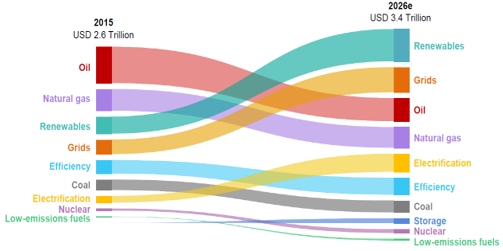
Not all of the capital flowing into energy systems is aligned with decarbonisation objectives. In some regions, concerns about energy security and reliability have prompted renewed interest in coal, particularly where domestic supply offers insulation from volatile global gas and oil markets. Investment in coal is projected to reach around USD 180bn in 2026, its highest level since 2012, with much of this spending occurring in China and India where policymakers continue to prioritise energy security alongside decarbonisation goals.
Yet increased investment does not necessarily imply increasing dependence. In China, coal demand growth has slowed markedly as record additions of renewable capacity increasingly displace coal in the power sector. Taken in the context of overall energy investment flows, which continue to shift decisively toward clean energy, the coal trend is a nuance in the transition story rather than a challenge to its direction.
Far from acting as a brake on the transition, heightened geopolitical tensions have added further momentum to clean energy investment. The IEA expects spending on renewables alone to reach around USD 665bn in 2026, including roughly USD 365bn for solar power and USD 200bn for wind. Importantly, these investment figures understate the scale of deployment taking place. Falling technology costs, particularly for solar modules and batteries, mean each dollar invested today delivers significantly more generation capacity than it did a decade ago.
The transition is also more than just a story about renewable generation. Increasing volumes of capital are also being directed towards the infrastructure needed to support a more electrified economy, including transmission networks, battery storage, electric vehicle charging infrastructure and energy efficiency measures. These investments reflect a growing recognition that the challenge is no longer just generating clean electricity, but moving, storing and using it efficiently.
Investment in energy efficiency, electrification and low-emissions sources helped major fuel-importing economies avoid an estimated USD 260bn in fossil fuel import costs in 2025 alone. This figure makes the economic case for the transition more compellingly than any policy argument could. We may, in other words, be entering a more pragmatic phase of the energy transition: one driven not by climate ambition alone, but by the hard logic of cost, security and competitiveness. Electrification can simultaneously strengthen resilience, lower costs and reduce emissions. The transition is succeeding not because countries are choosing sustainability over economic self-interest, but because these are increasingly one and the same.
In a lecture on electricity at the Franklin Institute in Philadelphia in 1893, Nikola Tesla foretold that “the time will come when the comfort, the very existence, perhaps, of man will depend upon that wonderful agent”. Perhaps that time has arrived.
For much of the past two decades, electricity demand growth in many developed economies was subdued as efficiency gains offset rising consumption and heavy industry migrated to lower-cost markets. Today, that dynamic is changing. According to the IEA, global electricity demand grew by 3% in 2025 and is expected to accelerate to 3.6% in 2026 and 3.8% in 2027, pushing global consumption above 30,000 TWh for the first time.
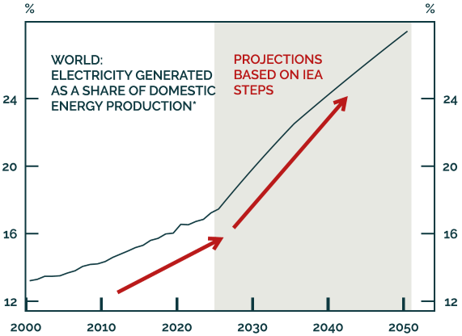
While artificial intelligence (AI) and data centres have captured much of the market's attention, they represent only part of the story. The IEA points to a much broader set of structural drivers underpinning demand growth, including industrial expansion, electric vehicles, and heating, ventilation and cooling technology. In short, more of the global economy is becoming electrified.
This trend is evident across major economies. In China, rising electricity demand is being driven by high-tech manufacturing, electric vehicle charging infrastructure and digital services. In the US, data centres are a significant source of growth, but so too are manufacturing activity, electrification and increased cooling requirements. In Europe, demand is being supported by industrial recovery, electric vehicle adoption and the gradual electrification of transport and heating.
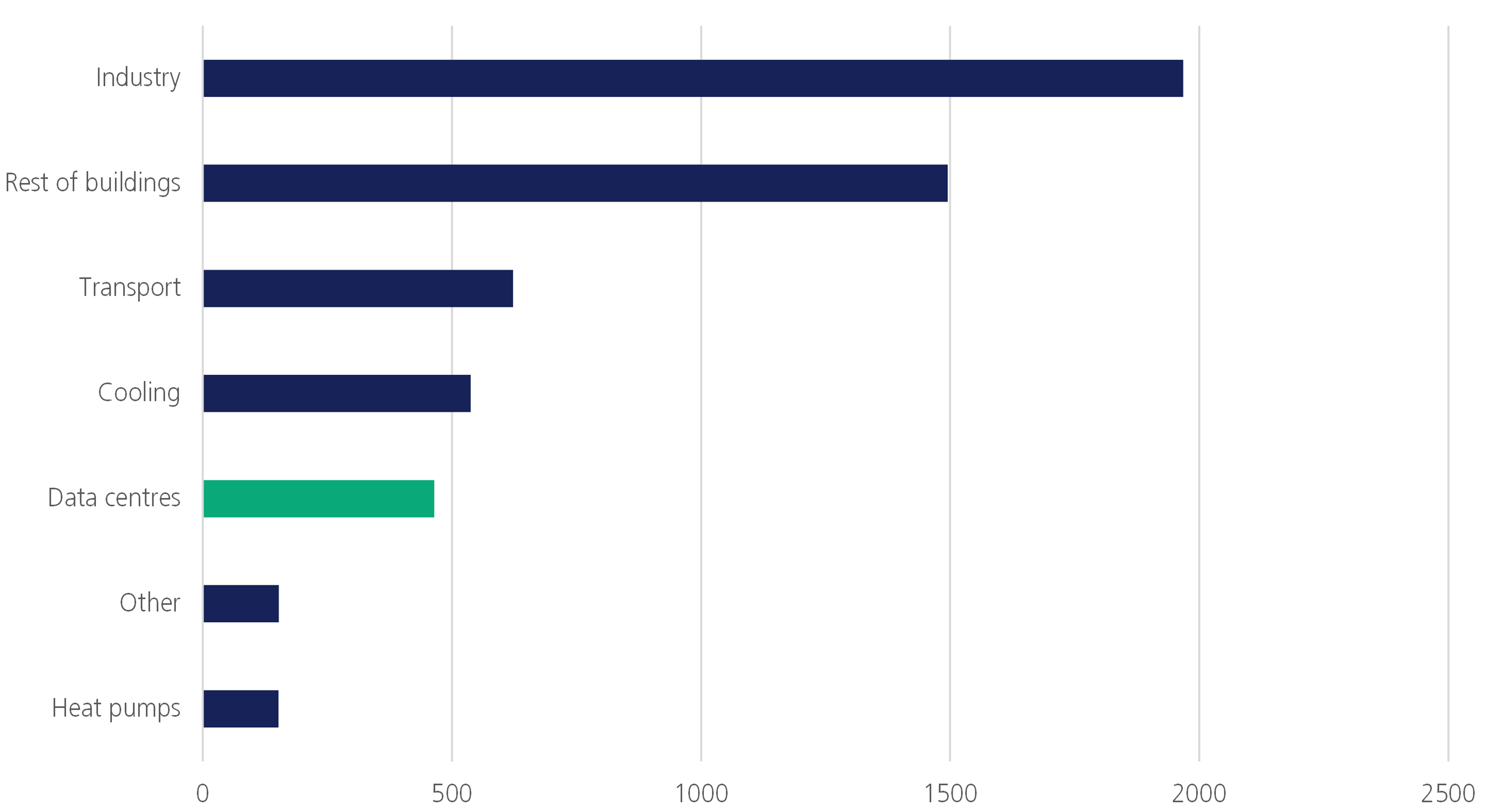
The common theme is that electricity is increasingly becoming a critical input to economic activity. Manufacturing, transportation, buildings and digital infrastructure are all becoming more dependent on access to abundant, affordable and reliable power. Countries that can provide it are likely to enjoy significant advantages in industrial competitiveness, productivity and economic growth. Those that remain reliant on imported fuels may find themselves increasingly exposed to price shocks, supply disruptions and higher operating costs.
China provides perhaps the clearest example of this shift. While the country's energy transition is often viewed through a climate lens, electrification has also been a core component of its industrial strategy. Over the past two decades, China has invested heavily in electricity generation, transmission networks and electrified industry, not only to reduce reliance on imported fuel supplies, but also to support manufacturing competitiveness. Access to abundant and relatively low-cost electricity has become a strategic advantage, helping underpin China's position in industries ranging from electric vehicles and batteries to advanced manufacturing and AI. Increasingly, electricity should be viewed not simply as an energy source, but as a critical input into economic and technological leadership.
Greater electrification promises a more secure, efficient and resilient energy system. However, generating more electricity is only one part of the equation. As economies become increasingly electrified, energy must not only be generated but also transmitted, stored and delivered reliably when it is needed. The transition is increasingly becoming an infrastructure story as much as a generation story.
The IEA estimates that investment in electricity grids will reach around USD 550bn in 2026, while annual spending on battery storage now exceeds USD 100bn. These figures reflect growing recognition that transmission networks, storage capacity and system flexibility are becoming critical components of a reliable power system. As renewable penetration increases, so too does the need for infrastructure capable of balancing supply and demand across different times of day and different regions.
Efficiency will also play an increasingly important role. In an environment where electricity demand is rising and energy costs remain a key consideration for businesses, reducing consumption can often be as valuable as increasing supply. Industrial operators are investing in more efficient equipment, buildings are becoming less energy intensive, and technologies that help businesses optimise energy use are becoming more and more critical. The cheapest unit of energy remains the one that does not need to be consumed in the first place.
If the first phase of the energy transition was about generating cleaner electricity, the next phase is about building the entire economy around it. That is a vastly larger undertaking and one with a correspondingly larger investment footprint. Indeed, this is why, as we continue to focus on ‘bottom-up’ strategies to future proof portfolios, energy security remains one of our key bottleneck thematics, along with investing across the AI stack and defence opportunities. The opportunity spans three distinct layers, each supported by the same underlying forces of energy security, economic competitiveness and decarbonisation.
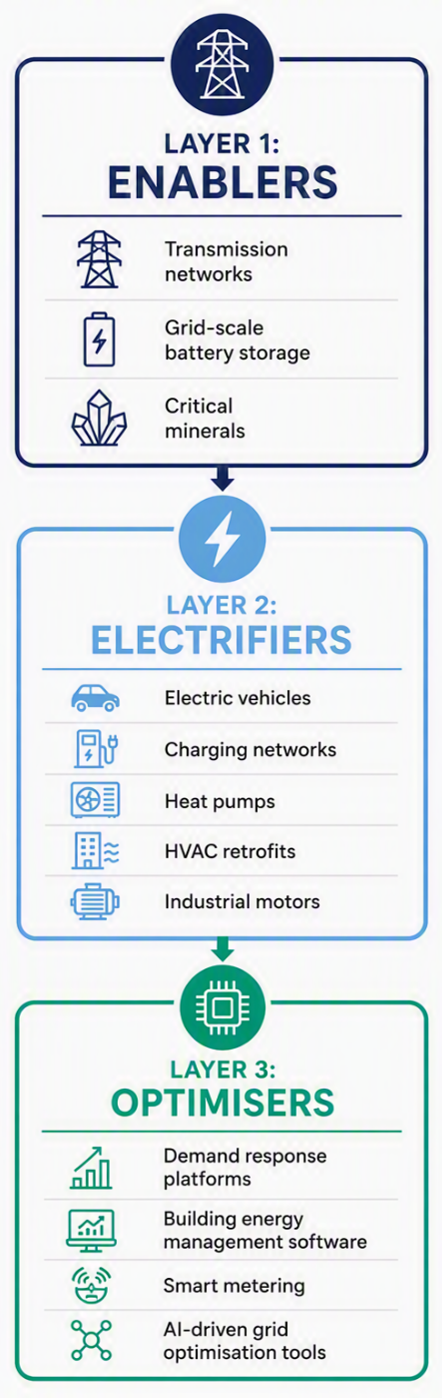
The first layer is the enablers: the physical infrastructure that makes electrification possible. Transmission networks, grid-scale battery storage and the broader systems required to move and balance power across an increasingly complex grid all need to be built. More than 2,500 gigawatts of renewable and storage projects currently sit stalled in connection queues globally, and forecasts for total grid spending over the next decade run into the trillions. Critical minerals sit alongside this: copper, lithium and rare earths are the physical building blocks of electrification and the concentration of their processing in a small number of countries has become a strategic liability. Copper is trading near record highs, with forecasters pointing to a refined deficit of hundreds of thousands of tonnes this year alone. The companies positioned along these supply chains, from miners to processors, represent a part of the transition that listed market indices barely capture.
The second layer is the electrifiers: the businesses actively replacing fossil fuel consumption with electric alternatives. Electric vehicles and the charging networks that support them are the most visible expression of this shift, but the deeper opportunity lies in the less visible applications: industrial heat pumps displacing gas-fired heating across European manufacturing, commercial heating, ventilation and cooling systems being retrofitted in buildings across the US and Asia and electric motors replacing combustion equipment in factories worldwide. These are not niche markets. The IEA projects that heat pumps and industrial electrification together represent one of the largest sources of emissions reduction over the next decade.
The third layer is the optimisers: the technology businesses making electrified systems run smarter and more efficiently. Demand response platforms, building energy management software, smart metering and AI-driven grid optimisation tools are all growing at double-digit rates as utilities and corporates seek to extract more from the capacity they already have. These businesses are often overlooked in portfolios oriented around generation and physical infrastructure, but they frequently carry stronger margin profiles and shorter capital cycles.
Investors can access all three layers via opportunities in listed equities, private markets and fixed income. Together they represent positions in the infrastructure, technology and supply chains that will underpin economic competitiveness for the next two decades, backed by the simultaneous pull of climate policy, energy security and hard commercial logic. The more important question for any portfolio is not how to access them. It is how much longer to wait.
The US-Iran conflict remains top of mind for investors, as an ongoing impasse over the Strait of Hormuz keeps oil prices elevated and threatens to intensify pressures in refined petroleum products. Both sides remain stubbornly opposed, with hopes for a quick resumption of normalcy fast fading. The near-term outlook remains uncertain, with the Strait of Hormuz again largely closed and refined oil inventories at low levels.
That said, we continue to assess that near-term uncertainty has peaked and that the material constraints of both parties continue to forestall a worst-case scenario of widespread conflict and/or a globally debilitating energy supply disruption. The bond market continues to constrain President Trump, while China and an increasingly aggravated global community are likely to constrain Iran against further aggression. In addition, we are seeing more evidence of the demand and supply response we expected globally, with crude production picking up globally, a more flexible demand response as countries electrify and reduce their demand for oil, and the reality on the ground that more tankers are passing through the Strait of Hormuz than feared.
After spending several months consolidating, global equity markets have broken out to new highs in August, propelled upward by robust economy-wide earnings growth and ongoing AI optimism. We are also continuing to see a broadening of market returns, with value equities and smaller and mid-sized companies continuing to outperform.
That said, markets will still have to navigate some headwinds. These include increasing scrutiny around the scale of hyperscalers’ AI capital expenditure (capex) spend and how this will be funded. We also remain vigilant around the recent rise in global bond yields which has prompted US policymaker intervention. While we see no imminent cause for concern, higher yields could eventually present a headwind for markets. We are also wary of the potential for inflation pressures to spur tightening actions by central banks. The resilience of the US economy and the ongoing oil supply shock are key upward catalysts in this regard. Central bank hawkishness and/or rate hikes can disrupt markets and the broader economy, as we are seeing in Australia.
Domestically, economic conditions remain moribund, with a lacklustre private sector being further impacted by an accelerating housing correction, while sticky inflation means that we cannot rule out another rate hike here. Overall, we expect this backdrop to continue weighing on the local economy, and ultimately on our currency.
For now, we maintain our modestly constructive stance, and acknowledge the two-sided risks to the outlook. We continue to advocate the importance of future-proofing portfolios for a potentially volatile, inflation-driven second half, while maintaining adequate liquidity to take advantage of market dislocations should they arise.
Receive ongoing access to LGT Wealth Management’s insights and observations - a curated stream of thought leadership, market perspectives, and strategic updates designed to inform sophisticated investors.