

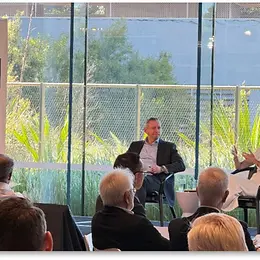
LGT Wealth Management recently welcomed Libby Cantrill, a Managing Director and the Head of Public Policy for US investment management firm PIMCO, for a client lunch event in Sydney. The event was hosted by CEO Michael Chisholm, with CIO Scott Haslem leading a fireside chat with Cantrill.
In her role at PIMCO, Cantrill analyses policy and political risk for their portfolio management group. She also leads PIMCO’s policymaker engagement and policy strategy. Her background includes time as an aide for the US House of Representatives, and she is a regular contributor to major media outlets. Cantrill and Haslem covered major investment themes such as artificial intelligence (AI) and inflation, with a particular focus on the US political environment and upcoming midterm and 2028 presidential elections.
We open by discussing the political climate in the US, with a particular focus on the US-Iran conflict. This is timely given that the midterm elections are coming up in November (more on this later). The conflict is not, and has never been, popular among Americans. Like many things in the US, this support (or lack thereof) breaks down along party lines, with far more Republicans in favour than Democrats.
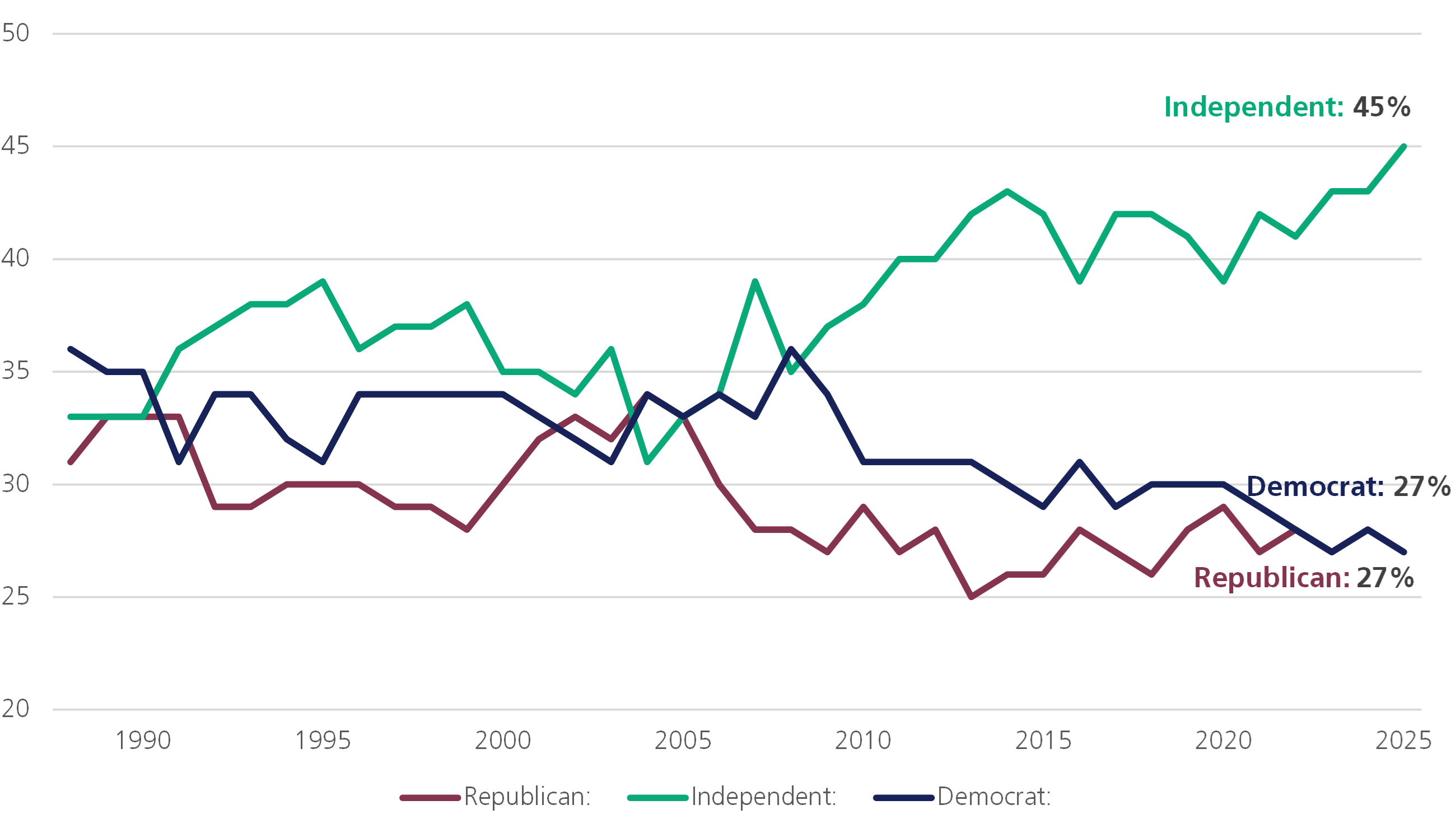
Overall, only about one in three Americans approve of the way that US President Donald Trump is handling Iran (YouGov, 15 July 2026). Critically, there is little support amongst Independents – and Independents are typically the ones who actually decide elections in the US. Cantrill describes them as being similar to the “median voter”. Notably, the number of Americans identifying as Independents has increased significantly in the 2010s and beyond, according to recent research by Gallup.
Which way do Independents lean?
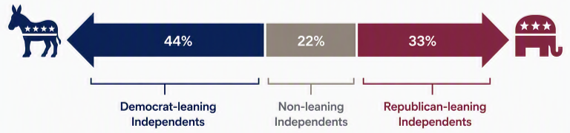
Crucially, of those identifying as Independents, only 22% are non-partisan. And with only around 17% of Independents in support of the US-Iran conflict, and 68% against it, this doesn’t bode well for Republicans, according to Cantrill.
Unsurprisingly, Trump’s approval has fallen. According to Cantrill, the actual issue at hand isn’t a strong view on foreign policy per se. What it boils down to is the price of fuel. In her words, “that's the mechanism [by which] voters really care about these sorts of ventures abroad”. There is in fact a direct inverted correlation between gasoline prices and presidential approval… no matter who is president. Cantrill puts it as follows: “So as the price of gas went up during the invasion of Ukraine by Russia, President Biden's approval rating went down. And the same thing is happening with Trump.”
The war has also happened at a time when affordability was already a key issue across the board in the US. Cantrill states that voters react to “the price of a gallon of gas” and “the price of a gallon of milk,” and that Trump has got “low marks on this”. Overall, people feel that the political class hasn’t addressed the affordability issues. This isn’t a new issue, with President Biden also scoring low marks on addressing the same concerns. And this issue is still at the forefront of voters’ minds, with 33.5% of US registered voters polled by YouGov citing “inflation/prices” as the single most important issue facing the US.
Alongside the rise of US Independents has been an increase in “double haters,” or those who hold an unfavourable view of both parties. As of April 2026, this number was 26%, up from 20% back in 2020.
Cantrill feels this number could be even higher in reality, and that the increase “underscores that people are mad about affordability. They're mad about the Iran conflict”. And with the latter issue increasing the former – on the back of higher energy costs – affordability remains a key concern.
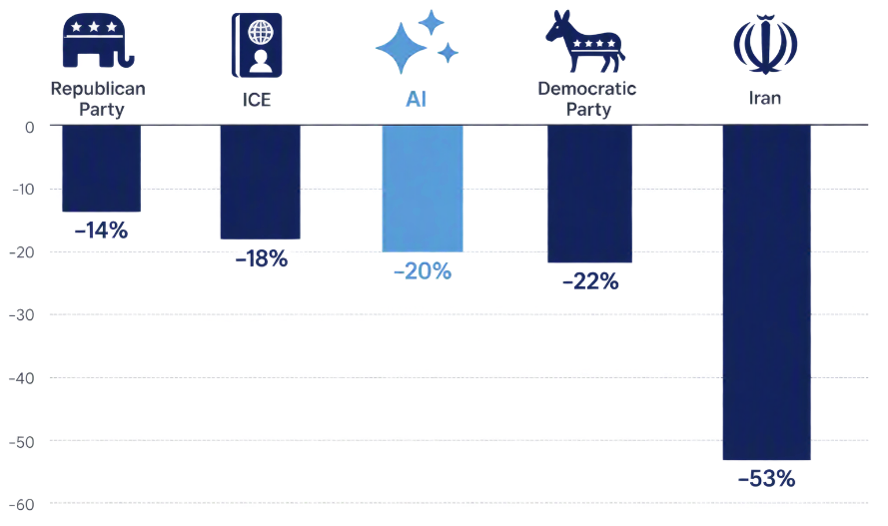
Haslem then turned the conversation to another key concern affecting voter sentiment in the US: artificial intelligence (AI). Americans currently hold a negative sentiment towards AI in general. This is so pronounced that a recent survey found that AI is even less popular there than the US Immigration and Customs Enforcement (ICE). Notably, ICE has had intensely negative press coverage in recent years, including being involved in the removal of parents from children, detainment of children, deportation of children, and even multiple deaths in custody and fatal shootings in public spaces.
As such, the dislike and distrust of AI is incredibly stark. (It’s worth noting that the same poll also highlighted dislike of the Democratic Party – “a real brand problem” according to Cantrill – and intense dislike of Iran.) See the chart to the right for more details.
What do Americans hate the most?
Why the hate?
Cantrill explains the broad sentiment as follows:
Will AI take my job?
Cantrill notes that “a vast majority of Americans think that AI will replace their jobs.” Indeed, according to Pew, 71% of adults surveyed believe AI “will lead to fewer jobs in the US over the next two decades”.
Will AI increase my power bill?
Data centres use a lot of electricity, which has raised the price of power in some areas. According to CNBC/Goldman Sachs, electricity prices in the US increased by more than double the rate of inflation (+6.9% yoy) in 2025. This usage is only set to increase with data centres making up “40% of electricity demand growth”.
Will AI destroy the world?
With industry CEOs publicly speaking with a “very dystopian view” at times, Cantrill feels they have in some ways led public sentiment to negative conclusions about AI. In terms of public relations, she describes this as “like a roadmap for what not to do” and notes that some are now backtracking on their comments.
This is coupled with broader community distrust around tech, specifically social media. Cantrill highlighted the recent landmark civil case against Meta, which was recently handed a USD 375m fine for enabling child exploitation on its numerous platforms.
In the current inflationary environment, these fears are heightened, or as Cantrill says, “intertwined or dovetailing on those concerns about affordability”.
According to Cantrill, policy will be led by politics. She notes that at state level in the US, there have been restrictions on data centre build outs. There is also some state level legislation around child protection and model development. And this will lead to two big implications:
Cantrill feels this is all playing out more quickly than she had anticipated. And while AI scepticism has previously been more closely associated with Democrats and broader populist concerns around big tech and corporate power, Republicans are now also displaying more anti-AI rhetoric. That makes AI not just a political risk, but a “real policy risk”.
At the same time, “power is actually slowing down the progress”. With so many people heavily utilising large language models (LLMs) such as ChatGPT, Claude and Gemini, the demands on power are huge. There simply may not be enough power. Against the background of AI scepticism, Cantrill describes this as a level of cognitive dissonance. AI is “bad”, and yet so many of us use it extensively. Moreover, data centres are using power for all our online activities, not just LLMs. Cantrill feels there is “a real risk that we shut down a lot of this stuff” as it might “feel good” to put on the brakes. But the “horse is a little bit out of the barn”.
We then turn to the US midterms, which will take place this November. Currently, both houses of government and the executive branch (ie the presidency) are held by Republicans. But shortly, the entire House of Representatives (435 seats) will be decided, along with 35 of 100 Senate seats (two special elections along with 22 regularly scheduled elections). In terms of the House, Democrats only need to win three more seats to gain a majority. This is very feasible given “out of power” parties historically do very well during midterms. As Cantrill puts it, “midterms are a referendum on the party in power”.
She goes into more detail as follows: “Americans kind of date their politicians. They don't marry them. So, they're really excited about them. They vote them in. And then the next cycle, they vote them out. On average, since World War II, the party in power has lost 26 seats.” As such, winning back the House would only require a “mediocre” performance from Democrats on election night.
The Senate will be harder to win. Although only four more seats are needed, Democrats also need to defend several vulnerable states that are up for election – New Hampshire, Michigan, and Georgia. Importantly, Trump won both Michigan and Georgia in the 2024 presidential election, which isn’t encouraging for any Democratic Senate candidate there this year. To add to the challenge, Democrats would also need to win several new states that also previously voted for Trump – Alaska, Texas, Iowa, Ohio and North Carolina. Maine (won by former Democratic nominee Kamala Harris in 2024) is also up for grabs. In essence, Democrat candidates in these states would need to convince a lot of voters who chose Trump as president only two years ago to now choose a blue candidate as their Senate representative.
According to Cantrill, Democrats need only a decent-to-good night to flip the House, but they would need a “near perfect night” to win the Senate; they’d need a so-called “blue wave”. She feels this is possible, based on election models developed by PIMCO. However, her base case remains more modest: Democrats are likely to win the House, while Republicans will likely retain a very narrow Senate majority.
Cantrill presented PIMCO’s base case of a Democratic House and a narrow Republican Senate as follows:
|
Source: PIMCO, September 2026.
This could represent “gridlock” and the end of “peak Trump”. Indeed, Cantrill states that the “first year of any presidency with a united Congress is peak presidential potency”. The same situation played out with Obama in 2009 and Biden in 2021. Trump has been constrained by the courts, and will likely be further constrained by Congress. As Cantrill puts it, “Trump likes to talk about how he's going to issue tariff dividends (cash to US citizens from import tariffs) and cut taxes and cut spending. He cannot do any of that without the US Congress. And that's already a very high threshold. But I think come 2027, we're exceeding those constraints”.
Cantrill doesn’t see a “red comeback” either, especially given the ongoing US-Iran conflict. As she puts it, “a lot would have to go right” for them over the coming weeks.
Cantrill believes he will focus on his legacy. This would likely encompass things he can do unilaterally, such as import tariffs. She states that, “he really does believe tariffs are a solution, not a problem.” He does have some discretion around foreign policy, as we’ve seen with the US-Iran conflict, but wars require funding. Previously he was using funding obtained through the 2025 “One Big Beautiful Bill Act”, but these funds are dwindling.
Ultimately, he will have to go back to Congress for more money. This is a real constraint given the Democrats may well take back the House, particularly given the unpopularity of the conflict amongst their voters (only around 5% of Democrats support it). If anything, Cantrill sees pressure to end the conflict. She also notes Trump may well focus on less consequential matters. Cantrill notes that those around him have mentioned he dislikes talking about Iran whereas he is very happy to talk about his ballroom.
Cantrill expects that once the midterms are over, the focus will shift to the 2028 presidential race almost immediately. While Trump cannot run for a third term, she believes he will remain highly influential in shaping the Republican primary, given he remains so central to the party. In her view, this influence will matter in terms of who Republican voters consider viable, although the natural assumption at this stage is that Vice President JD Vance would be the likely nominee.
On the Democratic side, Cantrill cautions against reading too much into early polling. She doesn’t believe that Kamala Harris will be the nominee, and also sees California Governor Gavin Newsom as unlikely. Instead, her early view is that Democrats may look either to a swing-state governor or potentially a celebrity candidate. More broadly, she isn’t concerned about Trump running again (he has made frequent comments and jokes about a third term, going so far as to sell Trump 2028 merchandise). This is because US elections are administered at the state and local level, so presidents do not have the power to cancel them.
We then turn to the US fiscal deficit, which is currently running at 6-7% of gross domestic product (GDP). This is historically quite high. According to the Congressional Budget Office, “the total federal budget deficit remains large by historical standards over the next 30 years, averaging 6.3% of GDP – more than one and a half times its average over the past 50 years – and reaching 7.3% of GDP in 2055.” This is particularly striking given that the US economy has been resilient in recent years. As Cantrill puts it, “so the fact that we're running high deficits within the good times ... it's just very unusual”. This also restricts the ability of policymakers to intervene during a potential downturn.
Higher deficits also mean more Treasury issuance. For bond investors, this has contributed to a steeper yield curve and a higher term premium, meaning investors are demanding more compensation to hold longer-dated debt. From PIMCO’s perspective, these higher yields are not necessarily unwelcome; indeed, they can be seen as a return to a more normally functioning, upward-sloping yield curve, similar to the pre-financial crisis environment. However, this does not diminish the underlying fiscal challenge: persistent deficits remain a significant issue.
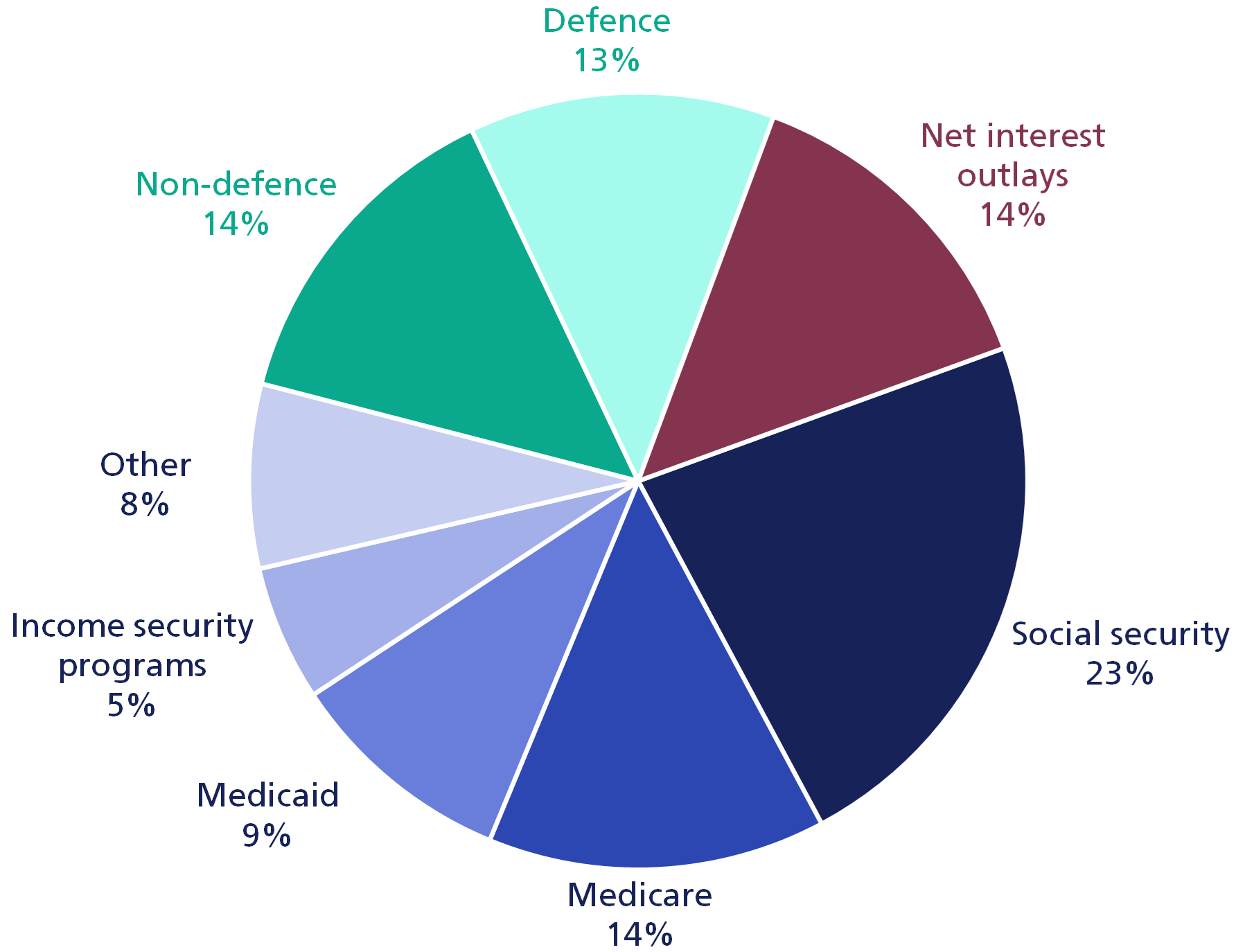
There is also a limiting factor in that the vast majority of government spending is on social programs (around 60%; see pie chart). And with such a large deficit, this leaves policymakers with the option of either cutting popular social programs or raising income taxes. Neither of these options are appealing; they are especially unpopular during election years. With midterms on the horizon and a presidential race kicking off for 2028, there are no easy answers.
Medicare spend in particular will increase in coming decades as the US has an ageing population. (Medicare specifically being “federal health insurance for people 65 or older, and some people under 65 with certain disabilities or conditions”.)
In an era of somewhat endemic inflation, the benefits themselves are also higher: “All of the benefits grow as inflation grows. So, it's been a double whammy – an older ageing population plus higher inflation means more entitlement spending.” And programs such as Medicare are funded by trusts held by the US Treasury. However – and critically – these trusts are predicted to run out of money in 2032.
This, plus the persistently high-inflation environment sees the US set for a “financial reckoning at some point,” according to Cantrill. She believes that Congress needs to “change the fiscal trajectory”, specifically targeting mandatory public spending (ie the blue sections of the chart). But at the same time, she sees the challenges of that, citing that Americans – in a rare moment of agreement – generally love both low taxes and receiving social security benefits. Cantrill says the deficit and debt issue will continue to rise in prominence, and will be “an issue on the (presidential) campaign trail in 2028”.
Notwithstanding these challenges, Cantrill noted that market demand for US Treasuries remains robust. In PIMCO’s internal scoring, recent Treasury auctions have generally been graded around “B+” – not exceptional, but far from distressed. So, while US fiscal metrics are increasingly uncomfortable, the dollar remains the world’s dominant reserve currency (“the dollar is king”) and Treasuries remain one of the deepest and most liquid safe-haven markets. As PIMCO founder Bill Gross once put it, US Treasuries may be the “cleanest dirty shirt”: imperfect in absolute terms, but still attractive relative to many other developed-market sovereign bonds.
FY 2025 total US Government spending
How best to manage inflation?
Moving on to inflation in the US, and the US Federal Reserve (the Fed), Cantrill notes that there is often an intense focus on Chair Kevin Warsh. But she is also quick to point out that he is only one vote in the Federal Open Market Committee (FOMC). Trump may personally prefer lower rates, and he may have appointed Warsh, however policy decisions still require broad support. As Cantrill pointed out, “the press makes way too much of this about how he is placating Trump.”
Indeed, subsequent to our event, the FOMC in mid-September voted 12-0 to lift US interest rates. While some may posit that Warsh was installed to support steady rates, ultimately the Fed has a mandate, data remains key, and the FOMC – as Cantrill notes – is a committee (ie Warsh isn’t the only decision maker). The resulting modest rally in longer-dated bond yields suggests Warsh enhanced the Fed’s credibility through the decision to lift rates.
The US-Iran conflict is deeply unpopular in the US and will soon require funding that is unlikely to be approved by a flipped US House of Representatives.
US voters are broadly feeling dissatisfied with the current environment, and often with political parties in general. This is by and large due to ongoing elevated cost of living concerns.
In an environment of moderating but somewhat chronic inflation, particularly with high fuel costs due to the US-Iran conflict, these concerns are unlikely to abate soon.
Americans are also wary of AI, especially due to its use of power (which can lead to higher power costs) and threats to jobs (again, linking back to cost-of-living pressures).
It appears likely that the US House of Representatives will turn blue in November, though the Senate seems unlikely to flip.
If this comes to pass, Trump will experience constraints.
All the above will be key issues for the 2028 presidential race, which we’ll start hearing about soon after the midterms.
The US fiscal deficit is an increasing area of concern and action will need to be taken in coming years.
Focus on the Fed’s credibility is likely overdone, as evidenced by their recent decision to lift rates ahead of the US midterms.
Receive ongoing access to LGT Wealth Management’s insights and observations - a curated stream of thought leadership, market perspectives, and strategic updates designed to inform sophisticated investors.