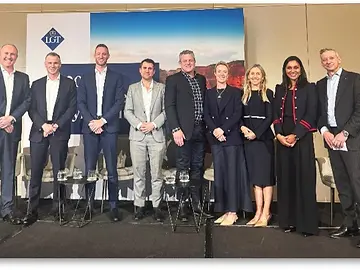

LGT Wealth Management recently welcomed Wendy Cromwell, Vice Chair and Head of Sustainable Investment at Wellington Management, for a client breakfast event in Sydney.
Drawing on more than three decades of investment experience across multi-asset and sustainable investing, Wendy shared her perspective on some of the powerful forces reshaping markets today. While topics such as artificial intelligence (AI) and energy demand featured prominently, the discussion was ultimately about a more fundamental question for long-term investors, namely how to find durable opportunities in a world undergoing rapid economic, technological and environmental change.
One of the threads running through the conversation was the degree to which sustainable investment themes and broader policy priorities are converging, even when the underlying motivations differ. Wendy pointed to several striking examples of this. Supply chain transparency, for instance, is a priority for climate-focused investors concerned about embedded emissions and labour practices, but it is also being driven by tariff policy and trade politics that have nothing to do with climate. Similarly, the push for domestic rare earths and critical minerals is partly an energy transition story and partly a strategic response to reduced reliance on China. And the enormous investment going into reliable, renewable energy sources reflects both decarbonisation goals and the race for AI dominance, with hyperscalers needing vast quantities of clean, stable power regardless of their environmental commitments.
The practical implication for investors is significant. Many of the infrastructure and technology areas that matter most for the energy transition, from grid upgrades and battery storage to nuclear power and advanced geothermal are likely to attract capital and political support across a wide range of policy environments. The tailwinds behind them are not dependent on any single administration or set of climate policies, because the motivations driving them are genuinely plural.
That insight, Wendy suggested, is central to how Wellington approaches the opportunity set. It also reflects her background, having come to lead the firm's sustainable investment practice not from a traditional environmental, social and governance (ESG) background but from leading Wellington's global multi-asset team. This experience shapes her instinct to think across asset classes and follow the economics rather than the labels.
A significant portion of the discussion centred on what Wendy described as the AI paradox. The energy demands of AI are already well documented: a single ChatGPT query uses roughly ten times more electricity than a traditional Google search. But Wendy raised a more striking figure: agentic AI, which only entered broader commercial adoption at the end of last year, can require up to a thousand times more energy than a ChatGPT query. We are still at the very early stages of enterprise and consumer adoption of these tools, which means the acceleration in power demand is largely still ahead of us.
At the same time, the sheer scale of that demand is pulling investment in the energy transition forward in ways that might not have happened otherwise. Because gas turbines are heavily backlogged, hyperscalers needing power quickly have been investing heavily in solar and battery storage, and that investment is driving costs down further and faster. Meeting that demand through 2030 will require what Wendy described as an "all of the above" approach, encompassing slower coal retirements alongside investment in gas, nuclear, renewables and storage.
Electricity consumption from the internet (%)
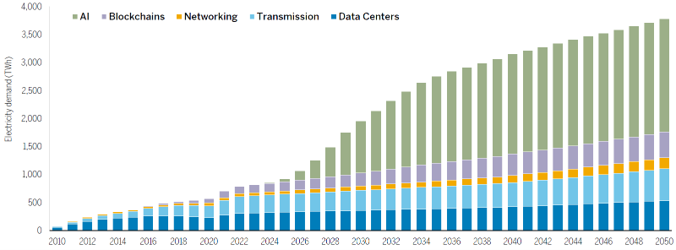
Whether AI proves to be net emissions additive over that period is a live debate within Wellington itself: technology teams tend to be more optimistic about the pace of efficiency gains and innovation, while energy teams take a more measured view of how quickly the supply side can respond. What both sides agree on is that the capital now flowing into nuclear, geothermal and next-generation battery technologies is building foundations that could meaningfully accelerate the transition beyond that nearer-term horizon.
For investors, Wendy's more pointed observation was that the most interesting opportunities may not be where the obvious conversation is. Beyond memory chips and semiconductor names, Wellington has been doing significant work on second-order beneficiaries throughout the value chain:
The winners also rotate over time, she noted, moving from the enablers of the build-out today toward the application layer and end users as the ecosystem matures.
Running through much of the discussion was a consistent emphasis on economics as the real engine of change, rather than policy or aspiration alone. While climate goals remain important, Wendy observed that large-scale transitions tend to succeed most durably when the solutions are also commercially compelling. The falling costs of solar generation and battery storage illustrate the point: innovation and sustained investment have improved competitiveness to the point where adoption has outpaced what policy settings alone would have delivered.
This dynamic is increasingly visible in how governments are framing the energy transition. Climate objectives are now being discussed alongside concerns about energy security, economic resilience and national competitiveness. That combination is reshaping policy priorities and investment flows across regions in ways that create both opportunities and new risks.
China presents one of the more complex cases in this landscape. It remains the world's largest emitter of greenhouse gases1 (on a total emissions basis) while simultaneously emerging as a dominant force across many of the technologies central to the energy transition, including solar panels, batteries, electric vehicles and critical minerals. Wendy noted that China's trajectory illustrates how necessity can accelerate innovation, with concerns about energy security, pollution and economic competitiveness having together driven a scale of investment in renewable energy and related supply chains that few other markets could replicate. Understanding how these dynamics are evolving across different regions remains an important part of assessing where future opportunities are likely to emerge.
Looking further ahead, Wendy highlighted climate adaptation as a theme she believes deserves significantly more investor attention than it currently receives. Much of the investment conversation has focused on reducing emissions and supporting decarbonisation, but physical climate risks are already becoming more visible through more frequent and severe weather events, and that trend is unlikely to reverse. Investors may therefore need to think more broadly about the solutions, infrastructure and technologies required to help communities and economies adjust to a changing climate, across sectors as varied as water management, real assets, infrastructure and insurance. In Wendy's view, adaptation could become one of the defining investment themes of the coming decades.
The discussion closed with a wider observation about how the investment landscape itself is shifting. After decades of deepening globalisation, many countries are placing greater emphasis on resilience, self-reliance and national security, extending well beyond traditional defence spending to encompass energy systems, critical infrastructure, supply chains and strategic industries. For investors, that shift presents both challenges and openings, potentially redirecting capital flows, altering competitive dynamics and bringing new areas of structural growth into focus that wouldn't have appeared on the map a decade ago. As Wendy put it, separating those lasting changes from short-term noise remains one of the most important and demanding tasks facing investors today.
Receive ongoing access to LGT Wealth Management’s insights and observations - a curated stream of thought leadership, market perspectives, and strategic updates designed to inform sophisticated investors.