

Artificial intelligence is no longer just a distant topic for technologists; it’s quickly becoming a core driver of value across the global economy. For Australian high and ultra-high net worth families, the question has shifted from whether AI will be transformative to how to participate in that transformation in a disciplined, long-term manner.
Lightspeed is a leading multi-stage venture capital firm with over 25 years of history, founded on the belief that technology would permeate every sector of the economy. Founded with deep roots in enterprise technology, the firm has evolved into a global platform with deep expertise across Enterprise & AI, Healthcare, and Fintech - backing generational companies from seed through IPO across its platform. Lightspeed began its international expansion in 2006 and today operates across 10 offices in the US, Europe, Israel, India, and Southeast Asia.
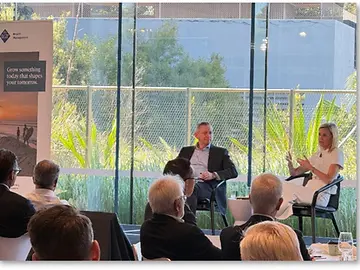
Our role in the AI economy is rooted in conviction built over time, not momentum,” says Isaac Kim, a Partner at Lightspeed and a panellist at the LGT Investment Symposiums. “We’ve been investing in AI since 2012, deploying over $7 billion across more than 155 AI investments, around 80% at Seed and Series A. This isn’t a knee-jerk reaction.”
Lightspeed invests across the full AI stack, but its conviction is concentrated where the most durable value will be created - and where over two decades of enterprise investing provide a genuine informational edge.
At the foundation model layer, Lightspeed has been among the most active investors globally, backing companies including Anthropic, Mistral, xAI, Reflection, and Skild. "Our thesis has been clear: in AI, it is critical to own the frontier," Kim explains. "Foundation model companies do not appear to be converging into a single commodity - they have evolved into distinct, defensible swim lanes." Anthropic leads in enterprise reasoning and coding. Mistral and Reflection are pioneering open-source deployment. xAI is building at the intersection of physical world understanding. Skild is pushing the frontier in robotics. And companies like Suno and Pika are attacking the audio and video segments. "Our direct exposure across these swim lanes gives us real-time visibility into model capabilities and product roadmaps - intelligence that directly informs every investment decision we make further up the stack."
At the infrastructure layer, the firm is focused on the picks-and-shovels businesses that operationalise AI at enterprise scale - orchestration platforms, security frameworks, data infrastructure, and deployment tooling. "We've been investing in these categories for over two decades, well before the current AI wave," Kim says. "That pattern recognition is a significant advantage as enterprises move from proof-of-concept to production at scale."
At the application layer, the focus is on verticalized AI-native companies that combine powerful models with deep domain expertise, proprietary data, and workflow integration that creates genuine switching costs. Companies like Glean in enterprise search and Abridge in healthcare AI exemplify this thesis. "AI is the engine, but the moat is everything surrounding it - the clinical workflows, the regulatory pathways, the enterprise relationships, the compounding data advantages," Kim explains.
With a 40-plus person investment team - the majority focused on Enterprise/AI Infrastructure and Applications - Lightspeed's full-stack position creates a compounding information advantage: insights from foundation model investments inform application-layer decisions, the early-stage portfolio provides pattern recognition on staying ahead of the frontier, and growth investments give visibility into which business models durably scale with enterprise adoption.
Lightspeed's investment in Anthropic, creator of the Claude family of AI models, illustrates the firm's conviction-driven approach.
Lightspeed first invested in Anthropic's Series D in January 2024 at an $18.1 billion pre-money valuation, when the company was generating approximately $100 million in annual recurring revenue. "Lightspeed understood that the leading foundation model for enterprise would be the one that corporate buyers trusted with mission-critical workflows," Kim says. "Anthropic's focus on safety, interpretability, and reasoning architecture aligned with what we were hearing from Fortune 500 CIOs and developers - and we believed that the reliability and enterprise-grade deployment would determine adoption at scale."
That thesis has since been supported. Claude has achieved adoption among 70% of Fortune 100 companies, with eight of the Fortune 10 as active customers. It leads the industry on SWE-bench Verified, the gold standard benchmark for real-world software engineering, and 4% of all GitHub public commits are now authored by Claude Code, with projections suggesting this could reach 20% or more by the end of 2026. Anthropic scaled from $100 million to $1 billion in annual recurring revenue in just 12 months - then from $1 billion to over $9 billion in the following 12 months, with recent public reports approaching $20 billion in annual recurring revenue.
As conviction grew, Lightspeed scaled its investment across each subsequent round - Series E, F, and G. "Perhaps the most telling moment came on the day DeepSeek released and NVIDIA stock dropped roughly 17%," Kim recalls. "While the market reacted with uncertainty, we wired over $1 billion into Anthropic's Series E, representing a majority of the first close. That decision was the product of the team’s deep, ongoing diligence and a fundamental belief that Anthropic was building a generational company." Lightspeed is today the largest venture backer of Anthropic.
While much of the conversation around AI centres on the companies building the technology, Kim believes the next decade will also be defined by deploying AI into industries technology has not yet meaningfully permeated.
It's the $13 trillion global services industry - accounting, healthcare services, engineering, financial advisory, etc. - massive, fragmented markets where the work is fundamentally cognitive and manual," he says. "AI is the first technology capable of automating that cognitive labour at scale, and we believe this will drive a structural transformation in how these businesses operate and how they're valued."
This is the thesis behind Lightspeed's AI Renaissance strategy - using the firm's AI expertise to identify where the technology can create operational transformation in traditional industries, paired with PE-style execution to drive the change. "It sits in a gap between traditional venture and traditional private equity that very few firms have the expertise to occupy," Kim explains.
For Australian families and family offices, the partnership between LGT Wealth Management and Lightspeed is intended to provide a bridge into this evolving opportunity set.
Access matters,” Kim says. “AI transformation is producing what we believe will be some of the most consequential companies of our generation, but meaningful access, at the right stages and with the right manager, is difficult for most private investors."
Through the partnership, LGT clients will have the opportunity over time to gain exposure to the full breadth of what Lightspeed is building - from foundation models and infrastructure at the earliest stages, to verticalised AI-native applications, to the transformation of traditional services businesses through the AI Renaissance strategy.
"It's not a single bet on a single layer of AI," Kim says. "It's a diversified, conviction-driven portfolio managed by a team that has been investing in deep enterprise technology for over 25 years, and AI for over a decade."
As the LGT Investment Symposiums discussion will highlight, AI is no longer just about frontier models and Silicon Valley startups. It’s about the global, long-term reshaping of how businesses operate, and the role patient capital can play in backing both the builders of new infrastructure and the industries that will be transformed by it.
Receive ongoing access to LGT Wealth Management’s insights and observations - a curated stream of thought leadership, market perspectives, and strategic updates designed to inform sophisticated investors.