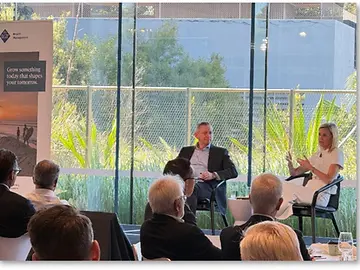

StepStone Group explores how investors can access private companies building the AI economy, from AI infrastructure and applications to the emerging physical AI frontier.
As artificial intelligence (AI) reshapes industries at speed, much of the market’s attention remains fixed on the listed technology giants and the infrastructure providers powering the current cycle. Beneath that, however, many of the companies defining the next phase of AI are still private, and often only accessible through a small group of deeply embedded venture and growth investors.
StepStone Group is one such investor: a global private markets investment firm and one of the largest allocators to venture capital and growth equity globally. They argue that the key question is no longer whether to have exposure to AI or not, but how to access the companies building the AI economy before much of the value creation has already occurred.
For investors seeking exposure to the private companies at the centre of this cycle, StepStone describes its role as an access and selection engine: a way to gain diversified, professionally managed exposure to hard-to-reach companies and the managers who identified them early, rather than relying on one-off private market bets.
StepStone looks at AI across five layers: compute, foundation models, AI infrastructure, AI-native applications and AI-enabled deep tech (including physical AI). Rather than trying to identify a single winning layer, the firm is focused on how value is created and captured across the stack.
Foundation models are proving durable and sticky, infrastructure companies are expanding rapidly as enterprises work out how to adopt AI securely, and application-layer businesses with proprietary data and deep workflow integration have the potential to compound on top of those advances.
StepStone believes its edge comes from three sources:
In a market where returns are often driven by a small number of outlier companies, StepStone argues that breadth alone is not enough. The more important combination is broad visibility paired with discipline and selectivity.
Cursor, built by Anysphere, is the type of company StepStone seeks to identify early. The AI-native code editor has become a default tool for many professional developers, with StepStone gaining exposure in 2025. This was early relative to the scale the business has since reached.
Three attributes stood out. First was the pace of growth: Cursor reportedly scaled from around USD 65m in annualised revenue in late 2024 to more than USD 500m by mid-2025, and has since surpassed USD 1bn. Second was a genuine data flywheel, with increased usage improving the product and reinforcing adoption. Third was its position at a control point in the AI value chain, orchestrating major foundation models while also running its own models underneath.
For StepStone, Cursor is an example of what can happen when product, data and distribution reinforce one another. The company’s subsequent validation has been striking, including reports that SpaceX agreed terms to acquire Cursor in a deal valuing it at around USD 60bn – a dramatic increase from where it sat barely a year earlier.
Against a volatile macro backdrop, StepStone argues that the most important decision for investors is not whether AI matters, but how exposure is accessed. Private companies are staying private for longer, raising large rounds from a concentrated set of investors and, in some cases, delaying public listings well beyond the point at which early value creation has occurred.
That makes manager selection, data and access increasingly important. In StepStone’s view, this AI cycle is accelerating growth for a concentrated group of category-defining companies, meaning selective exposure to high-conviction private assets may matter more than broad, undifferentiated exposure.
The next frontier: physical AI
Looking ahead, StepStone sees physical AI – artificial intelligence moving off the screen and into the physical world through robotics, autonomous systems and embodied intelligence – as one of the next major frontiers.
Three factors are converging to make the theme investable: foundation models, including vision-language-action models, have crossed an important capability threshold; hardware costs have fallen sharply over the past decade; and labour shortages in areas such as logistics, agriculture and manufacturing are structural rather than cyclical. Robotics venture capital funding reached roughly USD 22bn in 2025, up around 70% year on year.
StepStone is selectively constructive on the theme, with a focus on the generalised foundation-model layer for robotics and on companies deploying into structured industrial environments with proven commercial traction, rather than chasing the capital-intensive humanoid form-factor race. Companies such as Physical Intelligence are among the category leaders it is tracking closely.
Physical AI is, in StepStone’s view, the natural next chapter of the current innovation cycle, and one of the largest markets AI may ultimately address, given physical and cognitive labour together represent an estimated 50-60% of global gross domestic product (GDP).
Connecting families to the innovation pipeline
For Australian families and family offices, AI presents both a significant opportunity and a practical challenge. The most visible opportunities are often in public markets, but some of the most pronounced value creation is still occurring privately, well before companies are large enough to list.
StepStone’s message is that participating in that opportunity requires more than enthusiasm for the theme. It requires access to the right managers, visibility across the venture and growth ecosystem, and the discipline to build diversified exposure to the companies with the strongest potential to define the next chapter of AI.
As AI disruption intensifies, the companies that may shape the next decade are not all trading on public exchanges. Many are still being built, funded and scaled in private markets. For long-term investors, the question is whether, and how, they choose to access that part of the story.
Receive ongoing access to LGT Wealth Management’s insights and observations - a curated stream of thought leadership, market perspectives, and strategic updates designed to inform sophisticated investors.