
Up until recently, investors could enjoy strong market returns despite geo-political turmoil, so long as they donned a pair of noise-cancelling headphones, so to speak. But the environment has shifted. Geo-politics has moved from background risk to being a central driver that will likely deliver a more persistent inflationary environment than many expected in the year ahead. And artificial intelligence (AI) has emerged as a structural force reshaping not only technology, but business models and labour markets across the real economy.
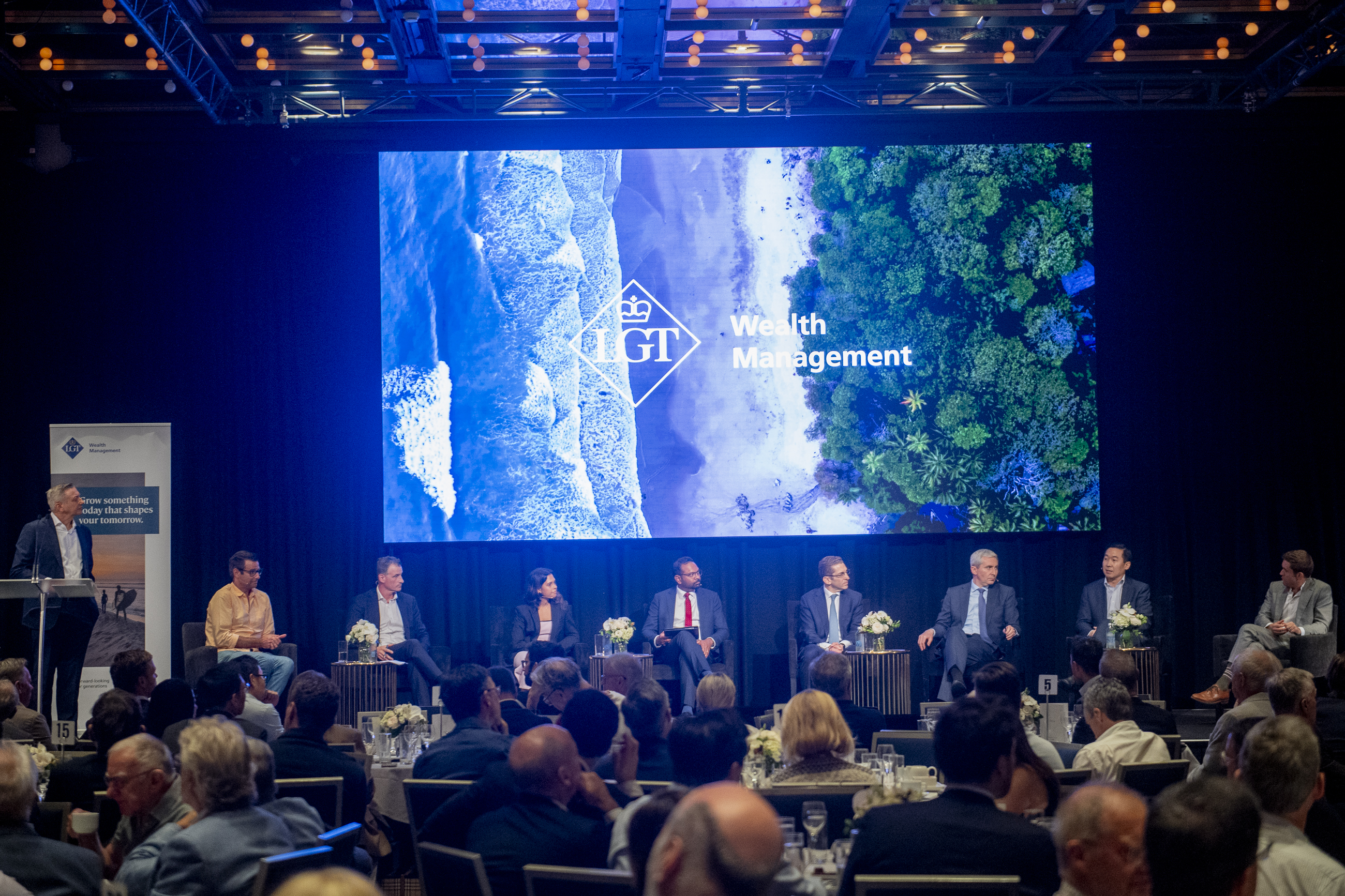
Against this backdrop we hosted our latest Investment Symposiums in Sydney, Melbourne and Brisbane in March 2026.
LGT Wealth Management’s CEO Mike Chisholm hosted, while Scott Haslem (Chief Investment Officer) set out the macro, inflation and portfolio positioning views. Martin Randall (Head of Private Markets) and Todd Hoare (Head of Public Markets) were moderators.
Our first external panel brought together leading AI specialists: Niki Chevak (and Tom Humphrey in Brisbane) from Blackbird and Isaac Kim from Lightspeed.
Our second panel included Ken Kaplan from Blackstone (Sydney and Melbourne only), Craig MacDonald from HarbourVest (Brisbane only), Alex Brazier from BlackRock, Jay Sivapalan from Janus Henderson and Vahari Ross from Antipodes.
Macro risk has risen: Geo-political events have intensified and energy‑related inflation may push rates higher, creating a more challenging backdrop than in 2025. Growth is still expected to hold up, but inflation is a clear, near‑term risk, and markets are likely to see more volatility in the second half of 2026.
Diversification matters more than ever: Portfolios need broader exposure across asset classes and return drivers to navigate a more inflationary and multipolar environment. Relying solely on equities leaves investors vulnerable, so portfolios should continue to focus on diversifying across both public and private assets, including non-US regions, infrastructure, real assets, private equity and private debt.
AI remains front and centre: AI is reshaping industries at unprecedented speed, with businesses scaling far faster than in previous technology cycles. It is driving productivity gains across services, transforming incumbent business models, and creating long‑term investment themes such as AI infrastructure, data advantages and technology‑enabled efficiency improvements.
Manager and security selection are critical: With higher financing costs, valuation dispersion and shifting market leadership, disciplined allocation is essential. Opportunities are emerging across regions and styles, but careful assessment of business models, data advantages, liquidity, and structural risks (particularly in credit) is key to capturing returns while avoiding mispricing.
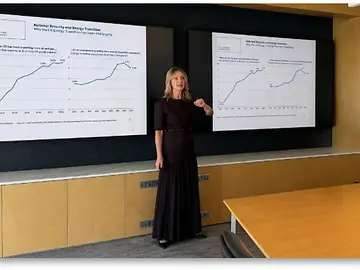
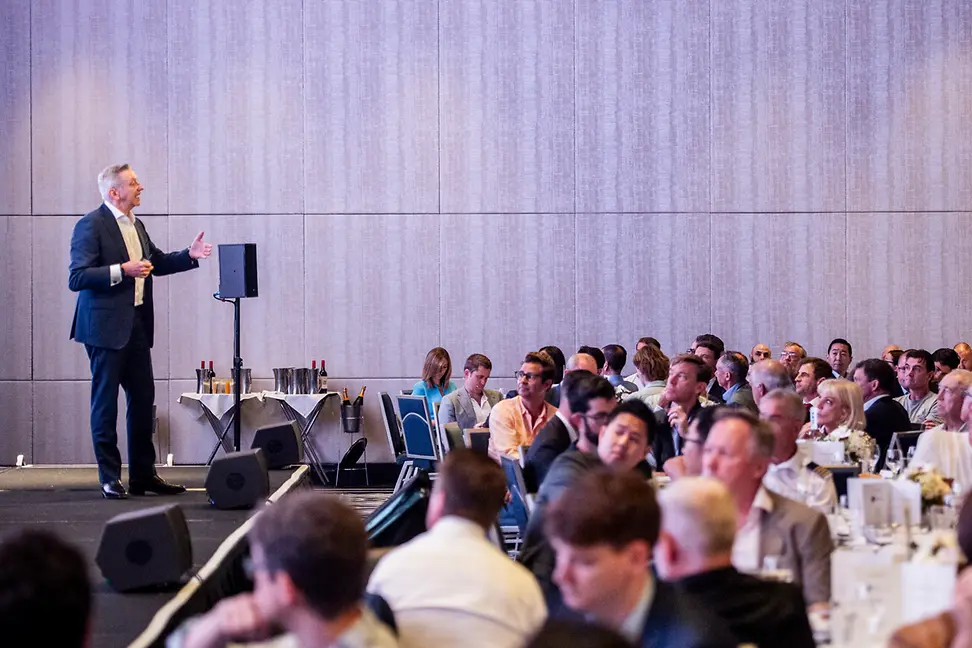
Scott Haslem, CIO of LGT opened the Symposium by setting out the macroeconomic landscape and the challenge of moving from an effectively benign backdrop to one that is more threatening and inflationary. He noted that, back in 2025, it was possible to tune out geo-political volatility and still anticipate strong returns, partly due to that benign macro backdrop:
Once we got through Liberation Day, markets just went on an ever-upward grind, never drawing down more than 3 or 4%. You could put the noise‑cancelling headphones on, get to the end of the year, and markets were up 15–20%.”
However, 2026 looks different, with three important shifts:
Geo-politics have intensified
Events that might once have been spread across a year seemed have been concentrated into a few months, including renewed Middle East conflict and ongoing tariff and trade uncertainty.
The macro environment is no longer benign
We had previously expected that despite growth re‑accelerating through 2026, as past rate cuts and large fiscal programs (US, Europe, Japan and China) took effect, inflation would present challenges only later down the track. But now we have to contend with a near-term energy supply shock that pushes inflation higher. This of course then complicates the task for central banks that had begun (or planned) to ease rates.
Back in Australia, Haslem sees a compressed microcosm of these global trends:
We cut rates, the consumer housing sector has picked up, we used all our spare capacity, and now we're having to tighten interest rates, because inflation re-accelerated.”
As a result, interest rates in Australia now sit above levels in the United States for the first time since 2017. The Australian dollar is also up against the US dollar and may continue to rise. However, consumer data already show signs of strain, including lower consumer confidence than during the pandemic. Growth may slow more quickly in Australia over the next six to 12 months than people widely expect.
Despite this, Haslem remains cautiously upbeat on growth overall, albeit with the caveat that inflation is a clear and present danger. He expects to see more share market volatility in the second half of this year (and more average-like returns), but for global growth to still be upwards. The latter will be supported by earlier rate cuts and large fiscal programs.
Haslem explained our two core ideas: building well‑diversified, long‑term portfolios that can withstand market ups and downs, and making measured adjustments over time to reflect changing conditions and market mispricing.
In the current environment, our portfolios are tilted modestly towards equities over fixed income. Despite a higher than expected inflation outlook, the Middle East conflict was viewed as likely to be shorter term and calm before significant damage to the global outlook occurred. Risk is being deployed cautiously, with equity exposure focused on regions such as Europe and Japan, where valuations have been more favourable.
Strategically, the emphasis is on broader diversification across asset classes and return drivers to navigate the multipolar world we find ourselves in. Relying solely on equities leaves portfolios exposed to a narrow set of return drivers. We’re placing greater weight on a mix of public and private assets, including private equity, private debt, infrastructure and real assets. Within this framework, particular attention is paid to long‑term themes where demand exceeds supply, such as AI infrastructure and enablers, energy resilience, defence and critical infrastructure.
Diversification and making careful selections matter more than ever. While conditions may remain challenging and volatile in the near term, disciplined portfolios are designed to absorb uncertainty and selectively capture opportunities as they arise, rather than reacting to short‑term noise.

Head of Private Markets, Martin Randall hosted a fireside chat with Niki Scevak (and Tom Humphrey in Brisbane) from Blackbird and Isaac Kim from Lightspeed.
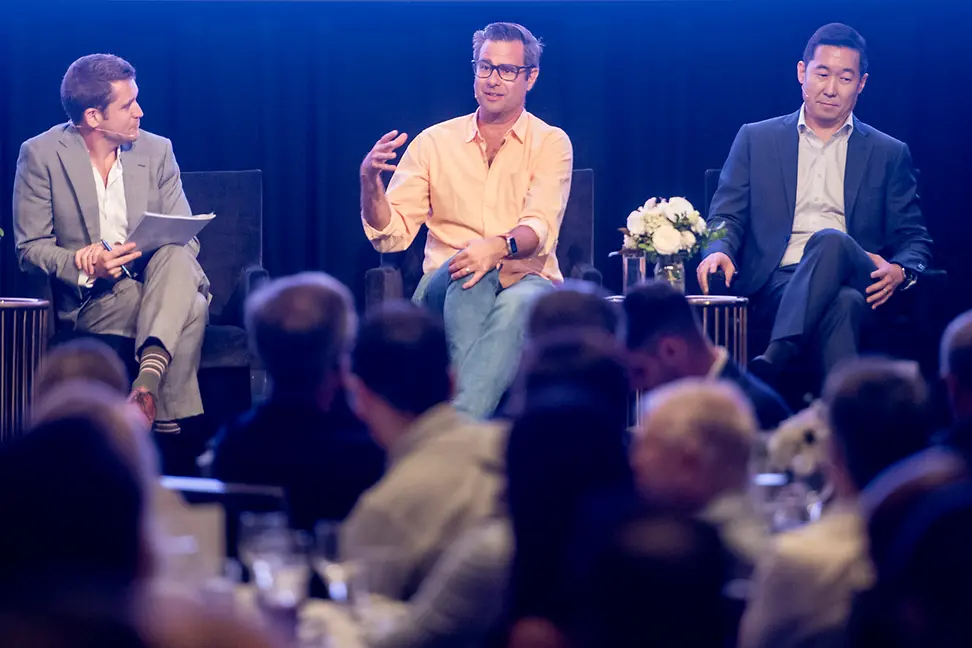
Randall opened by asking both Scevak and Kim their thoughts on the sheer velocity of AI disruption in recent years. In response to this, Kim highlighted how the current wave of AI disruption is unfolding far faster than prior technology cycles. Whereas successful software companies historically took eight to twelve years to reach USD 100m in revenue, some AI‑native applications and model providers are now achieving that scale in as little as six to twelve months. He noted that:
We're seeing some businesses in AI getting to tens of billions of revenue in three or four years. That's the difference in this wave than ones we've seen in the past”.
Scevak agreed that the pace is what makes this wave different, even compared with major shifts such as the move to cloud or mobile. Those transitions created large winners, but they unfolded over a decade or more.
Kim then described how Lightspeed is approaching the opportunity. He noted that early on, many investors assumed that the underlying models would become a commodity and that only the infrastructure around them would make money, but Lightspeed took a different view and backed the intelligence layer itself.
One key example that shows how productivity can be transformed was via their acquisition of a tax accounting firm. Lightspeed worked with management to introduce AI tools alongside the existing staff. No one was fired and no one was hired, yet over two years the free cash flow per employee increased by around 600%. For Kim, this shows that AI is already transforming productivity in areas like tax and accounting that sit squarely in the services economy.
The discussion also explored how incumbents are responding. Scevak highlighted design software company Canva as an example of a software company that has moved quickly. Canva had already been using AI for features such as background removal, and when new generative image models emerged it was able to integrate AI into its product within weeks. Revenue growth has re‑accelerated, and millions of users now access AI features through the platform. In his view, this is the pattern to look for in public markets: incumbents that genuinely build AI into their products and see growth improve, rather than simply talking about AI.
Both speakers acknowledged concerns about the impact on jobs. Scevak pointed to the experience of ATMs: when they arrived, people feared that machines would remove the need for bank tellers, yet over time banks have employed more people in higher‑value roles such as providing advice and credit.
Kim noted that:
There's going to be a moment in time here where we don't know exactly what jobs are going to be disrupted versus not. And … it is the highly educated folks, it's the knowledge workers that are getting impacted.”
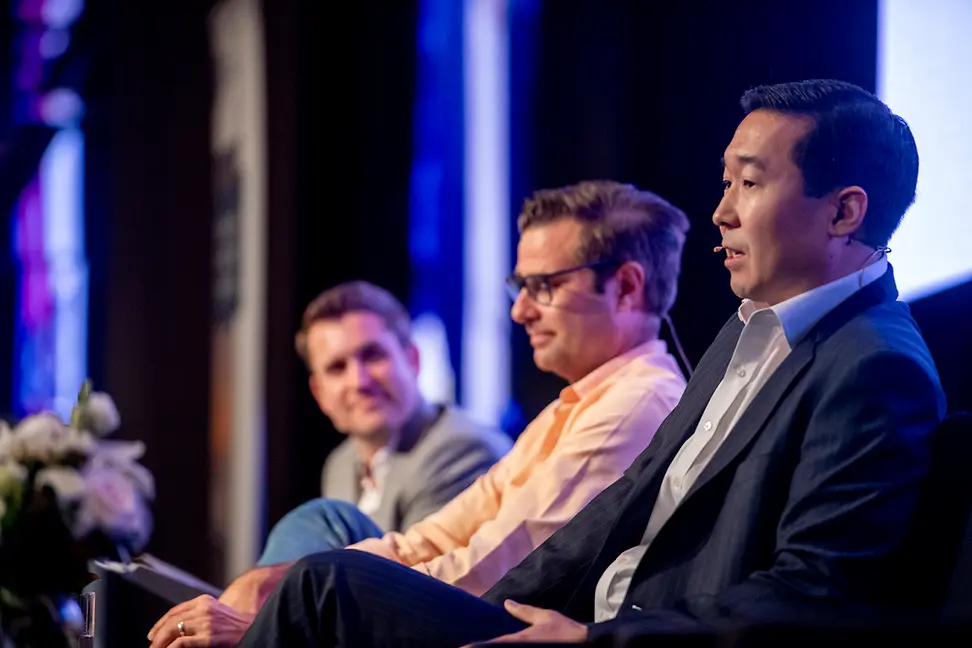
Our Head of Public Markets, Todd Hoare, then hosted a panel discussion on how to position across asset classes in an environment of higher inflation, higher rates and rapid technological change.

At the Brisbane event, MacDonald noted that equity can no longer rely on leverage and multiple expansion alone. He explained that in 2015 a manager might have achieved a 2.5x return over five years with roughly 5% annual EBITDA growth, helped by cheap debt and rising exit multiples. Today, with higher financing costs and less scope for multiple expansion, the same outcome requires 12.5%‑plus EBITDA growth.
In Sydney and Melbourne, Brazier argued that current market conditions call for discipline rather than retreat. He rejected the idea that AI valuations necessarily represent a bubble, saying prices have largely moved ahead of earnings rather than beyond fundamentals. Using NVIDIA as an example, he said the key investment risk is not valuation, but identifying which parts of the AI stack will ultimately monetise.
Sivapalan turned to Australia’s distinct macro backdrop, arguing the Reserve Bank of Australia has less flexibility than other central banks due to structural inflation pressures, particularly housing rents. While markets have largely priced in further rate rises, he said investors should also consider how weaker growth could eventually shift policy outlook.
Ross led by addressing equities and valuation dispersion. She said macro conditions matter most at equity turning points and noted that recent market drawdowns have occurred against a backdrop of stretched valuations, particularly in US large‑cap quality stocks. At the same time, she highlighted opportunities in US cyclicals, value stocks, ex‑US equities and small‑ to mid‑cap companies. She described the current environment as one where opportunities are emerging as market leadership shifts.
Ross then expanded on AI and mispricing within equities. She argued that recent sell‑offs in software and hyperscalers have been highly indiscriminate. While risks exist, she sees opportunity in businesses with durable “analogue moats”, proprietary data or two‑sided market structures. She also stressed that some of the most underappreciated AI opportunities lie in companies using the technology to improve productivity, particularly in financials and healthcare, where efficiency gains can be material and immediate.
In the discussion on private credit, Ross framed potential risks as a tail‑risk issue, noting a “fat tail” of highly leveraged borrowers that could pose broader economic risks if conditions deteriorate. She argued these risks sit primarily at the margin rather than across the system.
Responding, Kaplan emphasised portfolio composition and liquidity management. He said concerns often fail to distinguish between managers. While defaults may normalise (from a low base), he argued the fundamentals do not point to a systemic credit crisis.

Across all three cities and multiple panels, several consistent messages emerged:
Our portfolios have been deliberately structured for this kind of environment. They are multi‑asset, globally diversified, with access to specialist institutional managers across both public and private markets.
Our goal is to build deep, trusted relationships with our clients so that we understand in detail what they’re looking to achieve both financially and non-financially. We then leveraging our research capabilities and our investment manager relationships to understand what's happening around the world and to help build resilient portfolios that can support those goals over generations, regardless of market conditions.
To achieve this in the current environment, we need to do a few things well:
Firstly, we need deep investment expertise and access to the best investment managers and thought leaders from around the world, people who are close to the key developments, risks, and opportunities that will shape the markets over the long term.
Secondly, we also need to take a genuinely long term view, not only on our relationships with our clients, but in identifying the early trends and mega themes that will materially shape portfolios over the coming years and decades.
Clearly, we’re in the midst of a more multi-polar and more volatile period. It’s an environment that reinforces the importance of trusting diversification and avoiding panic trading around headlines. It's also more important than ever to think about the long term mega themes that will shape portfolios.
Receive ongoing access to LGT Wealth Management’s insights and observations - a curated stream of thought leadership, market perspectives, and strategic updates designed to inform sophisticated investors.