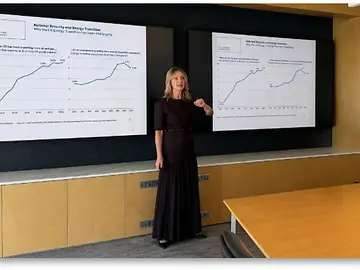

LGT Wealth Management Investment Forum Melbourne, October 2025
Six months ago, at our last Investment forum, our panellists forecasted a continuation of easing rates with an expectation that growth and inflation would moderate while political and geo-political risk would remain elevated. At the time, markets were concerned about the outlook for the economy given the potential unpredictability of the newly appointed Trump administration particularly in regard to global trading relationships and rising geo-political conflicts, namely in the Middle East and Ukraine. In light of this heightened uncertainty, the panellists equally saw a scenario, where if volatility increased, they expected rate cuts could potentially be deferred to allow central banks to have ‘a bit more insurance up their sleeve’.

The market has since experienced Liberation Day, credit concerns, geo-political tensions and wars, a lack of recorded data and government shutdowns. But as LGT Wealth Management’s Chief Investment Officer, Scott Haslem, points out markets have been seemingly impervious to these shocks, “over the past six months, we have seen a dispersion in central bank activity across the globe, bond markets and equities markets have been grinding higher over 2025. Equally, during the 2H 2025, the US consumer appears to be slowing down, China is facing domestic and economic issues, and Europe and UK are slowing”. Additionally, monetary policy easing has continued across most of the developed world with the US being the latest economy to ease following a prolonged period of speculation amid mounting pressure from the Trump administration. ‘Liberation Day’ blanket tariffs have also been followed by a series of negotiations between the US and various nations, with many still playing out. There is a belief we are past peak trade uncertainty.

Despite spatters of geo-political and global policy induced volatility, markets have continued to deliver positive returns, with equities pushing higher (mostly led by the large-cap tech stocks) and challenging record levels month on month. In the fixed income space, bond yields have moved lower, and credit spreads remain well contained. Private market returns have remained buoyant for debt, although they have remained subdued for equity. In Australia, markets have also rallied, supported by monetary policy easing although growth has been softer and inflation stickier.
At our latest Investment forum, our panellists discussed where investment opportunities lie, given equity markets have continued to rally and bond yields have fallen. They considered the risks to equities, given their current elevated valuations and where value could emerge in the year ahead. They also debated the relentless pursuit of AI winners, diversification benefits of fixed income in portfolios, and the role of gold and hedge funds in a market where ‘crowded trades’ are elevated. Despite these market conditions, all panellists agreed on the importance of active management in a currently concentrated momentum-driven and thematic environment.

Artificial Intelligence (AI) continues to be an ongoing thematic at the top of investors’ minds: AI adoption is accelerating rapidly due to increased computing efficiency, with some companies like Microsoft and Facebook showing revenue growth and cost savings without expanding headcount. AI can boost productivity and ultimately flow through to company revenue. AI’s true impact on industries, competition, and labour markets is however still unfolding. Panellists in general believe that the better you make it, the wider the adoption, albeit the ultimate winners from AI are yet to be determined.
Beware of crowded trades: There are several potentially crowded trades with investors primarily expecting rates to fall and the US dollar declining which is driving the majority of investment calls. This is driving equities higher as well as raising the prospect of increased volatility – making them vulnerable to shocks. Multi asset portfolios should consider ways to diversify directionality with active management.
Preference for equities and duration risk in light of stretched corporate credit valuations: Global markets are anticipating US dollar weakness and are positioned for falling interest rates, favouring equities – particularly technology stocks. Corporate credit is also seen as overvalued and less attractive. Investors appear to be focusing on equities, hedge funds, and duration risk rather than corporate credit, highlighting increased default risks among lower-quality credits, especially in the Australian private credit market.
In the months following Liberation Day, global markets have steadily climbed, displaying an apparent resilience to shocks, even as recent credit concerns emerge with regional banks. Furthermore, investors believe markets are on the cusp of a potential pivot. Growing regional divergences are especially notable, as economic momentum in the US shows signs of deceleration, while growth across Europe and the UK appears stalled.
Scott Haslem, CIO LGT Wealth Management, highlights some of the challenges we are facing with a lot of regional divergence in the macro backdrop. “If we look at the first half, the US was clearly slowing at the consumer level, China was pretty resilient while Europe and UK bounced back then as we're coming through into the second half of the year, it feels like the US is slowing, although we don't have a lot of data. The labour market is certainly slowing, and Europe and the UK have stalled. China looks like it's got real issues. At the same time, central banks are trimming.” Scott ask panellists whether this would facilitate a cyclical recovery into 2026?
Adam Bowe (Head of Australian Portfolio Management at PIMCO) anticipates a cyclical recovery but does not expect materially above trend growth. PIMCO’s baseline scenario assumes that central banks will gradually adjust policy toward a neutral stance well into 2026. “In most parts of the developed world, we have growth slowing, inflation that's pretty close to target, labour markets are loosening, and we have a starting point of monetary policy still tight. In the US, there was a lot of pull forward spending that’s unlikely to continue. As central banks ease towards neutral, that will support growth moving back towards trend.”

Haslem agrees, adding it fits squarely within a benign macro backdrop.
Albert Matriotti (Co-CIO Hedge Fund Solutions BlackRock) echoes this view, pointing out we are currently in a ‘goldilocks scenario’. However, he is concerned as it doesn’t take much to tip over markets that are priced for perfection.
Meanwhile, policy preferences continue to impact economic outlooks. Rob Tucker (Portfolio Manager at Chester Asset Management) highlights that the Trump administration is after fiscal dominance. “If Trump can control the Federal Reserve, he wants interest rates lower and that’s what’s driving markets. He favours lower interest rates, seeing them as a mechanism to alleviate government debt burdens.”
Tucker added, “very simplistically, you've got $38 trillion of debt right now, that's $40 trillion next year. At a 4% interest rate, that's $1.63 trillion in interest. Trump sees lowering interest rates as the easiest way to reduce their deficit.”
Most participants are not concerned about inflation. Qiao Ma (Portfolio Manager at Munro), highlights that “growth has generally been AI driven and sectors outside that such as retail, construction, housing have been struggling. This is potentially another reason to continue cutting rates.” Ma holds the view that if AI is working it’s going to be deflationary as it takes inefficiencies out of the system.
Tucker feels the oil price has the ability to surprise noting that a surprise oil price shock could derail the equity market rally. Matriotti believes there are a lot of crowded themes at the moment. “I think it could be as simple as a large company saying they're going to spend a little bit less on tech than what the market thinks. This could result in a significant unwind very quickly. Everyone is in the same trade.”
Bowe also points out the enthusiasm around gold with heightened retail participation.
Min Zeng (Portfolio Manager at Fidelity Japan) adds another China DeepSeek moment could have a material market impact given how stretched valuations appear.
According to Zeng, Japan is not just an export led economy as many people think. “Net exports as a percentage of GDP are actually lower than European counterparts.” Fiscal expansion has become a key topic, particularly with the new Prime Minister, Sanae Takaichi, who is advocating responsible proactive fiscal and defence policies. While the economic backdrop appears favourable, inflation remains a concern and consumer demand is still relatively weak with the persistence of negative real wage growth, though business investment is expected to outpace consumption.

According to Bowe, PIMCO believes the Reserve Bank of Australia’s (RBA’s) cash rate of 3.60% remains restrictive and although growth is picking up it remains sluggish. They expect this to continue to gradually loosen the labour market and pull inflation back to the 2–3% target range.
With the private sector labour market mirroring trends in New Zealand and Canada, where rates are already much lower, Bowe forecasts the cash rate settling between 2.5–3% next year which differs from market consensus. Recent tax cuts may finally be boosting household consumption after 18 months of stagnant real consumption and business investment, but as the unemployment rate gradually rises it will likely take easier policy next year to stabilise growth around trend and inflation at target.
Ma adds that a US-China deal could benefit Australia, though the impact will depend on China’s response and how big the deal is.
Index investing and sectors such AI and commodities, namely gold and some rare earth materials, have become increasingly concentrated. This environment is prime for multi asset portfolios as well as strategies that can use multiple levers such as hedge funds to diversify and manage risk. This environment is also prime for active management as high volatility can present opportunities.
Haslem highlights the economy is not the market. He asked panellists how they are positioning their multi asset portfolios given the apparent dispersion between what economic indicators and signalling versus what the market is actually pricing in.
Matriotti highlighted that much of the investment world appears to have the same trade on which is for rates to decline. This trade is common across both equities and fixed income. “Equities are dominated by tech, which is long duration. There is no credit spread left in bonds, so it’s all duration. People are also short the US dollar on the same theme.” He prefers to find cheap ways to diversify against the market being wrong with a lot of convexity. At BlackRock they are focusing on finding trades that don’t have a lot of market beta. They are also finding cheap ways of building credit convexity. He sees corporate credit as presenting shorting opportunities as it is in the fifth percentile, making it expensive.
Bowe highlights that duration is the cheapest risk factor at the moment and also has the benefit of being negatively correlated to equities. “Duration is much cheaper than equities and credit risk, I would start with duration as a risk factor when allocating within a multi asset context”.
Stan Shamu, Head of Portfolio Management at LGT Wealth Management, highlights that the increasing adoption of gold as a strategic long-term position in multi asset portfolios is happening at a rapid rate. He asked panellists whether some of the larger long-term allocations are justified from a fundamental perspective and whether some of the positioning is overdone?

Matriotti and Tucker talk to the role of gold and other commodities in portfolios, noting recent crowding in gold, is in their view, unsustainable and based on sentiment towards perceived market volatility and dispersion from the traditional fiat currencies like the US dollar. They both believe there is potential for energy and hard assets to benefit from structural trends like AI-driven energy demand.
Matriotti does not see gold as a big source of return going forward, albeit some are using it as a way to hedge against the potential for more volatility. He suggests broadening out to other commodities as a way to diversify the risk of a retracement.
According to Tucker, gold as part of a portfolio tends to be uncorrelated and helps reduce drawdowns which has historically been the case. However, sentiment has just got too hot and Chester have been reducing their gold exposure. He does think there is a store of wealth in gold as central banks continue to diversify away from the US dollar. Tucker notes that while sentiment is currently too hot, gold equities still have compelling valuations from an historical context, with strong free cash flow growth, thus maintaining some exposure is warranted.
Matriotti believes strategies that do not have to take directionality, are prime to benefit from the current backdrop. When you get a consensus trade, at the very least it means volatility will go up. Pair trades are particularly beneficial in this environment. “There are ‘if then’ statements that are becoming prevalent in the market, as we just don't know what the outcome will ultimately be. There are trade expressions and themes that you lean into, whether it's sector selection, relative value etc.”
The number of crowded trades also means there is an opportunity to short instruments such as gold, which has had a tremendous run. Matriotti also uses Japan as an example. BlackRock are seeing the level of flow on a weekly basis, and over the last nine months flows to Japan have been staggering which of course can reverse. This brings volatility and whilst you can still generate alpha, higher volatility means the Sharpe ratio falls. Therefore, Japan is a trade you can be a bit more tactical around.
Matriotti believes the current environment is primed for active management in equities compared to what we’ve seen in the last 7–10 years. Haslem highlights some of the challenges of index investing at the moment and the importance of looking deeper for opportunities.
Tucker highlights the increasing risks of investing in narratives that are disconnected from fundamentals. This adds to the case for active management in this environment.
Bowe agrees, noting the loftiness of beta valuations within equities and also within fixed income, “we have a lot of macro volatility, we don’t have central banks suppressing volatility, starting rates are high, curves are steep. All this makes a good case for active management.”
Recent earnings and sentiment momentum in the US and Japan has stretched valuations. Equally, more subdued corporate-earnings forecasts in Europe and Australia are resulting in capital outflows. Given the potential for cyclical improvement in growth and activity next year, there are pockets of opportunity, particularly when it comes to stock selection and basing decisions on fundamentals.
How would you approach equity investment in the current environment, given the currently stretched valuations?
Haslem highlights stretched valuations particularly for those directly exposed to AI. He asks panellists how they plan to seek opportunities and manage risk (particularly outside of the AI sector) in their portfolios given this ‘expensive’ theme.
On the earnings front, Ma notes that Munro’s house view attributes market strength to robust earnings growth, particularly in the US. However, this growth appears highly concentrated; AI is a key driver within certain sectors, while others, such as retail and housing, face ongoing challenges.
Tucker observes that while overall markets appear expensive, there are notable anomalies such as the heavy weighting of bank indices and stretched valuations, suggesting the need for a mean reversion and careful stock selection within the Australian market. He believes that contrarian opportunities may exist beyond the major banks, stressing the importance of being mindful of index composition. He also talks to the importance of holding hard assets such as utilities in this environment given their correlation to inflation and interest rates.
Ma noted that we are still early (year 3) in a 10-year investment cycle, and the market may be underestimating true AI earnings potential. “Whatever earnings estimates we have for the real AI winners are likely way too low for next year and even lower years from now. Investors should recognise that technology sector leadership has not yet fully emerged, and today’s large-cap winners may be different from future leaders.” Ma also points out that the benefits of AI could extend beyond the technology sector, igniting growth in areas such as security, healthcare, and consumer sectors. Investors should be agile and realise there is still a long way to go, “AI winners might not even be tech in the end”. Valuation has not picked up to the same extent in other sectors.

How do you view the competition for global AI supremacy, and what are the investment implications?
Ma notes that AI demand was driven by increasing computing power, with greater efficiency leading to wider adoption ie creating demand. Haslem questions whether AI was truly resulting in productivity gains? Ma states that Munro’s view that there is clear evidence, citing Microsoft and Facebook's ability to accelerate revenue growth and reduce R&D spending without increasing headcount. Ma also points out that AI adoption is occurring at an unprecedented pace and this will likely have short-term impacts on the labour market as it adjusts.
Ma believes valuations are yet to pick up in other sectors that are experiencing a positive impact from AI, which provides good opportunities namely in small-to- medium sized listed companies. She also notes the ability to accelerate revenue without increasing headcount (through AI) is key which makes it a challenge to find opportunities outside the US, “it’s slim pickings to find earning growth in Europe outside turbines and defence”.
Tucker is a little less enthusiastic at this stage, noting that, with the widespread availability of AI platforms like ChatGPT and Perplexity, the ultimate industry winners remained unclear. He stresses that more evidence is needed to confirm AI’s benefits to company cash flows and productivity.
Zeng highlights that companies lacking pricing power before AI might struggle to retain savings from efficiency gains, as competitive pressures quickly drive down pricing power.
Matriotti comments that, if valuations for semiconductors, hyper scalers, and AI server demand were accurate, associated sectors such as memory and energy might be undervalued, and broadly concurred with the panellist’s observations on AI’s market impact.
Tucker highlights that rare earths and defence spending are popular investment themes, but both sectors have experienced price movements disconnected from underlying fundamentals, partly due to supply concerns and government incentives. Tucker stressed the importance of focusing on fundamentals when investing, particularly if driven by retail demand.
Bowe adds that the prevailing macroeconomic volatility, high interest rates, and steep yield curves had created a favourable environment for active management, offering opportunities that could have significantly enhanced portfolio returns.
Furthermore, Zeng has been anticipating a global industrial cyclical recovery, expecting sectors such as manufacturing to benefit if a broader upturn materialised by 2026. Up until now, market enthusiasm has largely been focused on AI-related opportunities. Zeng notes concerns around the market potentially being ‘too frothy’, and as such, Fidelity’s investment thesis is to not become too defensive in Japan, with a preference to focus on domestic sectors with above-average growth, tight demand and supply, and improving pricing power, especially where performance is less dependent on external factors.
Matriotti agrees, expanding that they hold a tactical overweight to Japan due to governance reforms and positive trends, but cautions that heavy capital inflows could reverse if consensus shifts, increasing volatility. Both firms agrees that Japan’s corporate reform-driven rally has been highly profitable but recommended a tactical approach as the trade matures.
Ma shared insights on emerging markets, emphasising Munro’s focus on earnings growth worldwide. Regionally, they allocate about 75% of their investments to the US, where Munro see the strongest earnings momentum. While Munro hold some positions in Japan and China, finding meaningful earnings growth in Europe, apart from sectors like turbines and defence, remains difficult. China is also of interest, particularly given developments related to the US-China deal and details surrounding the chip industry.
Haslem highlights the growing rhetoric around credit risks highlighting concerns about tight credit spreads, risks in private credit. He asks panellists about the relativities to government bonds.
Matriotti describes corporate credit as historically expensive, with little room for upside and significant downside risk if spreads widen. The panel agrees that credit is crowded and vulnerable, especially in the riskier segments. With no credit spreads left in bonds, only duration risk remains attractive. Consequently, Matriotti focusses on "if-then" trades that are less correlated to overall market movements and seeking cost-effective credit convexity, viewing corporate credit as a short investment opportunity given its extreme expensiveness. BlackRock see greater value in equities and hedge funds over fixed income in the current environment.
Bowe agrees with Matriotti's assessment of corporate credit valuations and highlights the correlation with equity valuations. Bowe further notes that, relative to history, duration is the most attractive risk factor, reinforcing the importance of valuation in asset allocation and cautioning against exposure to corporate credit at current stretched levels. “The main risks in corporate credit are concentrated at the riskier end of the credit spectrum, rather than among high-quality corporates.” In the Australian private credit market, there are signs of increasing default risk and financial stress, in addition to tighter regulations and heightened market scrutiny. The lack of a public high-yield market in Australia concentrates risk in private channels. These challenges are most pronounced among riskier credits, but signs of stress are evident both locally and internationally.
Haslem highlights concerns around regional banks in the US and askes panellists if markets are seeing a repeat of past events given the Silicon Bank Valley event.
Bowe observes that the current situation with the regional banks does resemble past events, particularly pertaining to issues with US and regional banks. Bowe highlights his concerns about lending occurring outside traditional banks. He sees potential for hidden risks to emerge, especially after a period of excess liquidity and cheap capital, which in his view, is now revealing market anomalies.
Haslem challenges the idea that duration is cheap, “if central banks cut rates two or three times, Australian consumers recover and housing activity increases, and in the US, homeowners tap into significant equity and refinancing. Combined with substantial investment in AI and capital expenditures, these factors could drive inflation higher next year. What makes duration so compelling?”
Bowe believes that monetary policy remains tight and that the recent surge in US growth, driven by a pull forward of demand ahead of the tariffs and technology investments, will be difficult to sustain. With the US fiscal deficit already at 6–7% of GDP, a significant further increase seems unlikely. As private demand moderates through the second half and policy remains tight it is hard to see inflation accelerating in 2026.
Bowe suggests that current bond market pricing of the Fed taking policy back to neutral next year doesn’t seem particularly aggressive. There is a tail risk that the path to reach neutral could be delayed into 2027 rather than 2026, but equally a tail risk that growth slows more abruptly and Fed policy need to go through neutral like Canada and NZ. Additionally, Bowe prefers bonds as current yields offer a buffer: even if the Fed hikes again, bond returns may remain flat, which may not be the case for other asset classes.
Albert Matriotti |
“Alternatives; the drivers of hedge funds are as prevalent as they have been in the last 24 months.” |
Adam Bowe |
“Hard to avoid high quality core bonds, one of the risk factors that look cheap relative to history.” |
Qiao Ma |
“Small-mid cap on the growth side.” |
Rob Tucker |
“From a sector perspective, health care looks cheap, certain REIT’s look cheap and certain industrials look cheap.” |
Min Zeng |
“The manufacturing sector is interesting, as the benefits of AI drive innovation in robotics.”
|
Receive ongoing access to LGT Wealth Management’s insights and observations - a curated stream of thought leadership, market perspectives, and strategic updates designed to inform sophisticated investors.