
We believe the market outlook for 2027 has recently shifted more positive. Yet there remains much to consider when making investment decisions for the years ahead. To start, asset classes are behaving differently; stocks and bonds are more correlated than they used to be. To achieve true diversification, investors need to look beyond a traditional 60/40 equities/fixed income portfolio split and include unlisted private market assets, including infrastructure and asset-backed finance.
At the same time, artificial intelligence (AI) is an ongoing theme that reaches far beyond technology into almost every aspect of investing. AI extends to areas such as energy demand, infrastructure (like data centres) and business models, to name a few. And as companies stay private for longer, investors are increasingly gaining access to these opportunities via private markets. One message is clear: the headlines will keep changing, but discipline, diversification and a long-term focus are what matters most.
We explored these ideas at our Investment Symposiums in Adelaide and Perth in late August 2026.
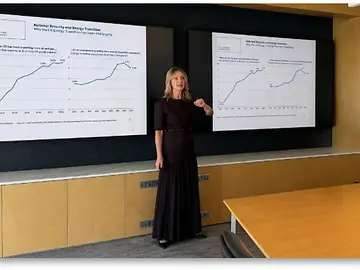
The events were hosted by LGT Wealth Management’s CEO Mike Chisholm, with Chief Investment Officer Scott Haslem providing a macroeconomic and market update, including the implications for how we are positioning client portfolios.
Our first panel was moderated by Head of Public Markets, Todd Hoare and featured Ani Satchcroft from Macquarie, Kyle McCarthy from PIMCO, and Katie Petering from BlackRock. Our Head of Private Markets, Martin Randall, then hosted a fireside chat with Phil Cummins from StepStone and Leila Lee from Square Peg.

Key takeaways:
There is cautious optimism heading into next year, but discipline still matters when deploying capital.
Stocks and bonds are more correlated than they were in decades past, so real diversification requires looking beyond 60/40 to broader alternative investments, including infrastructure and asset-backed finance.
AI runs through the entire investment stack, from energy and infrastructure to applications and private markets.
As companies stay private for longer, private markets are increasingly becoming the way that investors access innovation.
Scott Haslem opened by outlining how the investment team is interpreting the current macro and market environment, and how portfolios are positioned as conditions evolve.
The first half of the year was testing for investors. The first quarter gave us renewed geopolitical shocks and conflict, pressure on oil prices, inflation concerns and even more uncertainty around AI. As the US-Iran war unfolded, equity markets fell, with sentiment edging towards a sort of “peak fear”, before rebounding strongly through the second quarter. By the end of May, however, markets still had to digest higher oil prices, inflation pressure and more cautious central banks. As a result, major indices were largely flat in June and July, although beneath the surface, there was a shift from growth to value stocks.
Haslem explained why the LGT Investment Committee decided not to continue trimming risk when it met in late July. There were four key reasons:
Valuations were now looking more reasonable (after appearing expensive).
Global leading indicators of growth had rebounded.
Some forward-looking inflation pressures had eased.
Renewed military activity between the US and Iran appeared to be settling.
As such, the team was and still is feeling somewhat more positive about the outlook for 2027. At the same time, there were a few key signals to watch:
The US midterm elections, which are often preceded by volatility
Central bank rate hike expectations stabilising rather than pointing higher
Ideally seeing oil prices fall below ~USD 70
For now, portfolios are moderately overweight equities relative to fixed income, with only part of the overall risk budget deployed.
Regionally, we favour the US, as it is supported by resilient growth, a better positioned consumer than in Australia and ongoing investment in AI-related infrastructure by hyperscalers. Japan also looks attractive, with improving macro conditions and continued benefits from corporate governance reform. We also view Europe increasingly positively, despite external challenges, including war and energy pressure.
On the other hand, Australia is less favoured. Haslem noted structural productivity challenges, the growing role of less productive government services in the economy and the likelihood of slower growth ahead. Higher inflation and the possibility of further Reserve Bank of Australia (RBA) tightening only add to the pressure. Moreover, some consumer-facing companies are already pointing to softer activity. A weaker housing market may also weigh on the economy in the year ahead.
Softening data in China was also a key point. Chinese retail sales have weakened sharply over the past year, while a weak housing sector continues to weigh on household balance sheets, confidence and broader activity. With growth slowing significantly, markets are now looking for further fiscal stimulus from the Chinese government, but the outlook remains challenged.
Longer term, Haslem emphasised the need to build more resilient portfolios. This means staying invested, but ensuring equity exposure is broad and not overly concentrated. Fixed income remains important, with attractive starting yields and potential defensive benefits if rates fall. However, bonds may not provide the same extent of diversification they did during the “great (inflation) moderation”, so portfolios also need exposure to less correlated assets.
As mentioned, this diversification may include private markets, as companies stay out of the public domain for longer. It can also include real assets such as infrastructure, real estate and commodities, which can all offer some inflation protection. The broader theme is the interaction between a more multipolar world, higher inflation, more geopolitical conflict and an energy transition, alongside the investment opportunities arising from AI, rising defence spending and energy security.
You need to think about the crossover between the world we're living in with a little bit more inflation, less peace and an energy transition and how that engages with some of those bottleneck thematics around AI, around defence spending and the energy transition."
Scott Haslem
The message for investors is to remain disciplined: stay invested, diversify broadly, keep liquidity available and be ready to deploy capital if market volatility creates opportunities.
The first panel picked up directly from Haslem’s point that investors now need to think carefully about diversification. The discussion centred on how infrastructure, asset-backed finance and liquid alternatives can help build more resilient portfolios in a world where traditional diversifiers may not behave as they once did.
Hoare framed the conversation around one of the LGT Investment Committee’s key concerns: portfolios may not actually be as diversified as they seem at first glance. Understanding the underlying risk exposures inside each asset class is becoming just as important as the asset-class label itself. As Hoare put it, “AI is touching infrastructure. It is touching asset-backed finance. It’s touching equities, investment-grade credit.”
Petering reinforced Haslem’s observation that the old relationship between stocks and bonds has changed. During the “great moderation”, she said, investors could combine equities and bonds and have “a lovely, diversified portfolio”. Since COVID-19, however, BlackRock believes markets have moved into a new regime of structurally higher inflation.
According to Petering, this inflation is “not cyclical, it is not going to reverse, we are not going to go back to the great moderation”. That means multi-asset investors need to look harder for complementary sources of diversification, including listed infrastructure, listed property, gold, inflation-linked bonds, shorter-duration fixed income and both liquid and illiquid alternatives.
Then Satchcroft explained why infrastructure can play a stabilising role in portfolios, particularly in private markets. She noted that the asset class’s returns have historically been slightly below US equities, but with around half the volatility. The reason, she said, comes back to the nature of the assets – “infrastructure is an asset class that is critical to the functioning of an economy.” Roads, electricity networks, data centres, fibre networks and mobile phone towers are all essential assets, often with high barriers to entry and visible cash flows. Revenue may also be linked to inflation, either explicitly through consumer price index (CPI) escalators (contract-bound payment increases) or implicitly through demand.
For Satchcroft, the everyday use of infrastructure helps explain its investment relevance. For example, a parent filming a school concert and sharing it with family overseas would likely be using data centres, fibre networks and mobile towers without even thinking about it. “We are just creating data all the time,” she said. “We never delete anything anymore. We expect to be connected all the time.”
This demand is one reason digital infrastructure has grown so strongly, although she also cautioned that investors still need to identify the best access points rather than simply follow capital into crowded areas.
McCarthy described asset-backed credit as another way to seek stable income and diversification. In simple terms, he said, it is “hard asset lending”: a credit-oriented asset class focused on contractual cash flows and collateral backing. Unlike corporate credit, asset-backed finance is usually linked to real-world assets and activities, from mortgages and auto loans to aircraft leasing, digital infrastructure, music royalties, chip financing and energy transition assets. McCarthy emphasised that asset-backed credit offers “yield orientation, steady income generation over time,” while also being complementary to more traditional forms of credit.
The panel maintained its focus on AI. McCarthy said digital infrastructure is one of the fastest-growing areas within asset-backed finance, but warned that investors still need to be discerning because “there will be winners and losers”. He pointed to the scale of required capital expenditure across chips, data centres and the energy needed to power them. Satchcroft similarly argued that the more attractive opportunities may be in places where investors are “paying for capital expenditure (capex), not platform value”, including fibre and power infrastructure, rather than simply buying into expensive existing data-centre platforms.
Petering brought the discussion back to portfolio construction. BlackRock uses what she described as a “total portfolio approach”, looking through each asset class to understand the real return and risk drivers, then deciding where best to spend the risk budget. That matters because AI risk is now embedded across many markets.
Petering also noted that, when BlackRock looks through global indices, “between 60% and 85%” of returns are being driven by AI, with the exposure “about as high for value as for growth”. One potential diversifier, she said, is hedge funds, particularly strategies designed to be market neutral and strip out broad market beta.
The practical takeaway was consistent with Haslem’s opening message: investors still need to stay invested, but the way they diversify needs to evolve. Infrastructure, asset-backed finance, aviation leasing, data registries and hedge funds were all cited as potential sources of resilience or differentiation. The common thread was not to add complexity for its own sake, but to understand the role each exposure plays and whether it provides an income stream, inflation linkage, downside ballast or genuinely different risk driver.
AI, venture capital and the next software cycle
Randall’s fireside chat with Cummins and Lee moved from the infrastructure implications of AI to the investment opportunity across venture capital, growth equity and the broader software ecosystem. The central message was that this AI cycle is not simply another software upgrade.
Lee argued that the difference is scale: previous software cycles targeted “the software budget,” while AI is going after “the labour budget” (around USD 10tn). In her words, AI is “not just supporting the work that you do, it’s doing the work and hopefully making us more productive”.
Cummins agreed that AI represents a more profound shift than prior cycles. He described the past six decades as one long technology cycle, from mainframes to personal computers, the internet, mobile, cloud and software-as-a-service (SaaS). AI, by contrast, marks the start of what he called “the intelligence era”, where computers can make decisions and complete tasks. As he put it, “this is the way we will do computing from now on”.
A key part of the discussion was where value may accrue across the AI stack. Cummins explained that investors need to look beyond the best-known applications and large language models. Below the model layer sit energy, compute, silicon, data centre and orchestration layers; above it sit the applications users interact with. Innovation is happening across the entire supply chain, and the value may shift between layers over time. He noted that this is already playing out quickly, with companies moving from almost no revenue to hundreds of millions of dollars in only a few years, or even less.
Lee focused on the application layer, where Square Peg typically invests at an early stage. She stressed that venture capital is governed by a “power law dynamic”, where “around 80% of your returns will come from 20% of the companies”. That makes selectivity critical. The challenge is to identify companies with a sustainable moat that ChatGPT or Claude cannot replicate in a few months.
Lee pointed to industry-specific applications with proprietary data, low tolerance for errors and clear productivity benefits, such as AI tools for tax professionals or radiologists. In both cases, she stressed that the goal is not to replace skilled workers, but to help them manage rising demand and focus on the highest-value tasks.
The panel also considered the risks for incumbent software companies. Lee said Square Peg treats any company founded before ChatGPT in November 2022 as an incumbent. Her framework is simple: some industries have natural AI tailwinds while others face headwinds, but management mindset is also decisive.
Cummins argued that the SaaS business model is now “highly challenged”, particularly where a model can easily perform the same function. However, companies with proprietary data, trusted workflows or higher accuracy requirements may be better placed to adapt.
Australia’s position in the AI and venture capital ecosystem was another theme. Lee said the local market has matured materially, helped by more capital, stronger talent and visible role models such as Canva and Airwallex. She noted that more of Australia’s “best and brightest” now want to join start-ups, scale-ups or venture funds, rather than automatically choosing finance, consulting, law or medicine.
Cummins added that Australia has historically produced world-class venture-backed companies relative to its size, and could be well placed in AI applications, fintech, healthcare, mining automation and what he described as “physical AI”.
When it comes to investing, both speakers emphasised access and discipline. Venture returns can be attractive, but they are concentrated in a small number of companies and managers. Cummins warned that investors cannot simply back “the average manager or the average company”; they need exposure to the top echelon. Lee added that the “portfolio approach is very important”, including fund or fund-of-funds structures, vintage diversification and avoiding overconcentration in one or two opportunities. Once again, AI may be transformative, but disciplined portfolio construction still matters.
While markets and news stories will continue to change and we will be constantly barraged by information, successful investing calls for discipline, genuine diversification and a steady focus on the long term. At LGT Wealth Management, we use rigorous investment research and access to leading global investment managers to build resilient portfolios
Receive ongoing access to LGT Wealth Management’s insights and observations - a curated stream of thought leadership, market perspectives, and strategic updates designed to inform sophisticated investors.