

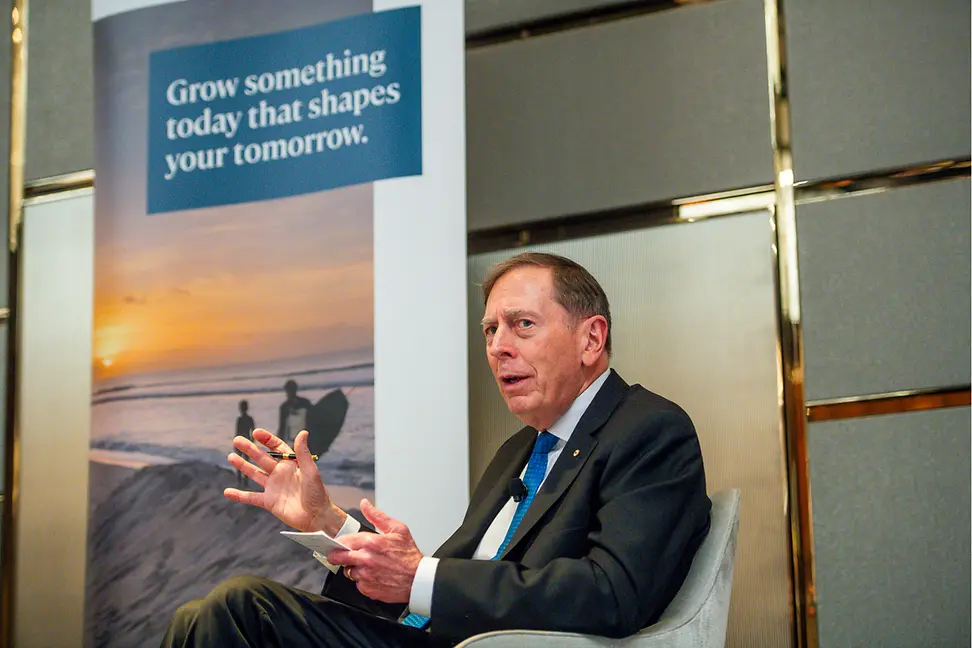
Today’s rapidly changing investment environment is presenting investors with significant challenges as they seek to navigate a fluctuating geopolitical order, rapidly advancing technological change, and the complexities of leading portfolios, teams, and organisations as the world shifts around them. In June 2026, we explored these topics in conversation with General David H. Petraeus, Partner at KKR & Co, Chairman of the KKR Global Institute, and Chairman of KKR Middle East. The event was hosted by our Chief Investment Officer, Scott Haslem, and moderated by our Head of Asset Allocation, Matthew Tan.
General David H. Petraeus spent 37 years in the United States (US) military, then became Director of the Central Intelligence Agency (CIA) in 2011, after his military retirement. He graduated with distinction from the US Military Academy and is a top graduate of both the demanding US Army Ranger School and the US Army’s Command and General Staff College.
Petraeus continued his academic career by also earning a PhD in international relations and economics from Princeton University. As to why he pursued graduate school, the General notes,
“I think the most developing experiences in life are those that are most out of your intellectual comfort zone”.
Graduate school was this place, for him.
Over the course of his distinguished career, Petraeus developed an exceptional perspective on global affairs, strategic leadership, international security, and the forces that are shaping the world around us. At KKR, he harnesses all his former experience, providing keen geopolitical insights into complex international markets.
We started by asking Petraeus what drew him to join KKR, 13 years ago. A firm believer in the power of personal relationships, Petraeus was approached by founder and then-CEO, Henry Kravis. Kravis sketched a vision that immediately appealed to the former intelligence agency boss.
Petraeus notes a clear overlap between the worlds of military and intelligence, and the world of investing: “If you really think about what a CIA director does, you're trying to understand the world around you and you're trying to lay that out for the national security team. What I do for KKR is understand the world around us, focusing obviously on the countries in which we actually invest, and then I advise the investment committee”.
He also applies his extensive academic and international experience to his role at KKR by assessing geopolitical, macroeconomic and public policy risks during due diligence, and determining whether those risks can be mitigated sufficiently to support a successful investment decision. At the firm, he has a track record of holding steady on difficult decisions that have benefited KKR. He also advises on challenging situations, traveling to over 30 countries per year to, “get the feel that can only come from being on the ground”. Strong relationships are key to this, particularly in developing regions. It is very intellectually stimulating work that he considers an ‘extreme privilege’ to pursue.
It's an extraordinarily privileged existence to do something that you enjoy doing.
With this context in mind, we then asked the General for his firsthand account of the current situation in the Middle East, and how he feels negotiations between the US and Iran may evolve. Having visited the region recently, Petraeus has given the matter a lot of thought. In line with our own outlook, he noted that both sides of the conflict are limited by their respective constraints. The US’ position is limited by high oil prices and broader cost of living challenges, both of which weigh into voter sentiment in the upcoming midterm elections. Until very recently, Iran was constrained by immense international pressure to reopen the Strait of Hormuz. Additionally, it has felt the weight of the US and Israel’s conventional military superiority in the form of human casualties and infrastructure losses.
Petraeus believes both sides are testing each other, with a full return to the status quo unlikely in the short term (even with the Strait reopened). Although Iran has been depleted militarily, it may well emerge with strategic advantages. The impact of the closure of the Strait of Hormuz, and Iran’s ease of disrupting it, cannot be denied. As such, Petraeus fundamentally sees a paradigm shift that could occur due to this war. Put simply, the world at large would benefit from being less reliant on the Strait of Hormuz.
The US-Iran conflict may well be a profound event for the region and the world. Initiatives are likely to be pursued that reduce reliance on the Strait, and on Iran’s good graces. Indeed, “the countries of the world that depend on crude oil from the Gulf have largely expanded the strategic reserve releases that they're going to do. They're taking whatever other measures they can. They're all finding oil wherever they can around the world,” according to Petraeus. As a key example, the US issued – and later extended – a waiver on sanctions of Russian crude oil. In the General’s words,
this is a pretty profound endeavour with a lot of implications for the future.
What the other Gulf states choose to do next is of critical importance. Petraeus expects that there will be an “enormous amount of inward investment” in order to future-proof their economies and become less reliant on vulnerable oil and gas shipping lanes, potentially limiting the pools of capital available to global investment firms. Much of the Middle East’s capital may well need to be invested within the region.
Drone warfare is the other major shift Petraeus flagged, drawing a clear linkage to the Russia-Ukraine conflict. According to Petraeus, the Russia-Ukraine and US-Iran conflicts are “redefining modern warfare in a massive way”. Ukraine is doing this by showing how unmanned systems, deployed at scale and continuously adapted, can outweigh conventional ‘on the ground’ capabilities.
The widespread use of drones, combined with rapid software and hardware iteration, is shifting conflict toward autonomy, where operations are no longer constrained by human pilots. This progression toward autonomous systems suggests that the side able to innovate and adapt fastest will hold a decisive advantage. As such, Ukraine is another bellwether for the future nature of warfare and geopolitical functioning in general.
In the world of finance there tends to be a strong focus on risk, but we should not discount the opportunities arising out of this changing world. With this in mind, we asked Petraeus where he sees opportunities globally amid a rapidly shifting global environment.
In response, he pointed to shifts in global manufacturing and supply chains. A key example is that rising labour costs in China – alongside companies’ desire to reduce concentration risk – have created openings in other markets, particularly India. More broadly, however, he said that KKR is pursuing opportunities across major developed countries and regions. Additionally, themes like ‘friend-shoring’ (where countries shift supply chains to trusted allies in stable regions) and ‘near-shoring’ (where countries favour neighbouring countries as trading partners) are on the rise.
In terms of sector specifics, he cited a “very deeply informed, granular understanding of sectors” as being critical to making investment decisions. Defence was highlighted as a major growth area, as spending increases. Another area is artificial intelligence, with Petraeus stating that KKR’s approach to AI has focused less on large language models themselves than on the infrastructure supporting them. In particular, he pointed to data centres, energy generation, storage, management and transmission, chips, and cooling systems as key areas.
To close out the session, we asked Petraeus a broader question around leadership and initiative, specifically ‘mission command’. Per Wikipedia, mission command is “a military command philosophy that pairs centralised intent with decentralised execution”. It’s a philosophy that the US military and others practice which focuses more around flexibly implementing a commander's intent rather than following a rigid set of orders. We asked the General to flesh out the concept a bit for us, and to explain how it works in practice.
In Petraeus’ own words, “the idea is to have really well-trained people who you've actually trained to be capable of reacting to the unexpected”. He then went on to exemplify this mindset by describing his trust in the surgeon who operated on him after a life-threatening training injury. Rather than pepper the doctor with questions, he asked which college he’d attended. As it turned out, the doctor was a fellow Princeton graduate with an impressive major, and a medical degree from Harvard. Petraeus knew he was in good hands. Micromanaging the situation wasn’t required.
He says the key to this style of leadership and management comes down to two key areas:
Critically, he notes it’s important to be able to step away from ideas that don’t work: “You just end the program and move on and find other new big ideas”.
Back on management styles, Petraeus also stresses that leaders must be flexible with their management style. Some direct reports may need more personal interaction and encouragement than others. Some may only need general guidance. He notes that his style is to do what’s necessary to “bring the best out in each of my direct reports individually”. He finds out what will enable each individual to do their best, what the organisation around them needs to do to facilitate this, and executes on that intent.
Overall, Petraeus presented a picture of a world being reshaped by geopolitical competition, technological disruption and shifting patterns of global investment. His central message was that, while the risks are significant, they are also creating new opportunities for disciplined investors with a long-term perspective, a clear strategic framework and a deep understanding of the sectors and regions in which they operate. Across the discussion, he returned to the importance of adaptability, sound judgment and the ability to respond thoughtfully to a fast-changing global environment.
The views expressed are those of General Petraeus and do not necessarily reflect the views of KKR.
Receive ongoing access to LGT Wealth Management’s insights and observations - a curated stream of thought leadership, market perspectives, and strategic updates designed to inform sophisticated investors.