Australian equities have underperformed international markets in recent years, weighed down by subdued domestic growth and limited exposure to the AI-driven technology rally. Despite our tactical underweight, we continue to see a role for Australian equities in a long-term strategic portfolio.
from
Stan Shamu
Head of Portfolio Management and
Nicholas Chen
Portfolio Construction Specialist
Over recent years, we have seen Australian equities materially underperform international equities. This has been driven by a number of factors such as weakening earnings growth within the local market, a China slowdown, higher interest rates, and a relatively moribund domestic macro environment. The lack of direct exposure to artificial intelligence (AI) within the domestic market has further amplified the magnitude of underperformance, given the exceptional performance that we have seen across US technology companies who have benefited from the capital expenditure on AI infrastructure. Nonetheless, while we are tactically underweight Australian equities, we still believe in a strategic long term Australian equities position.
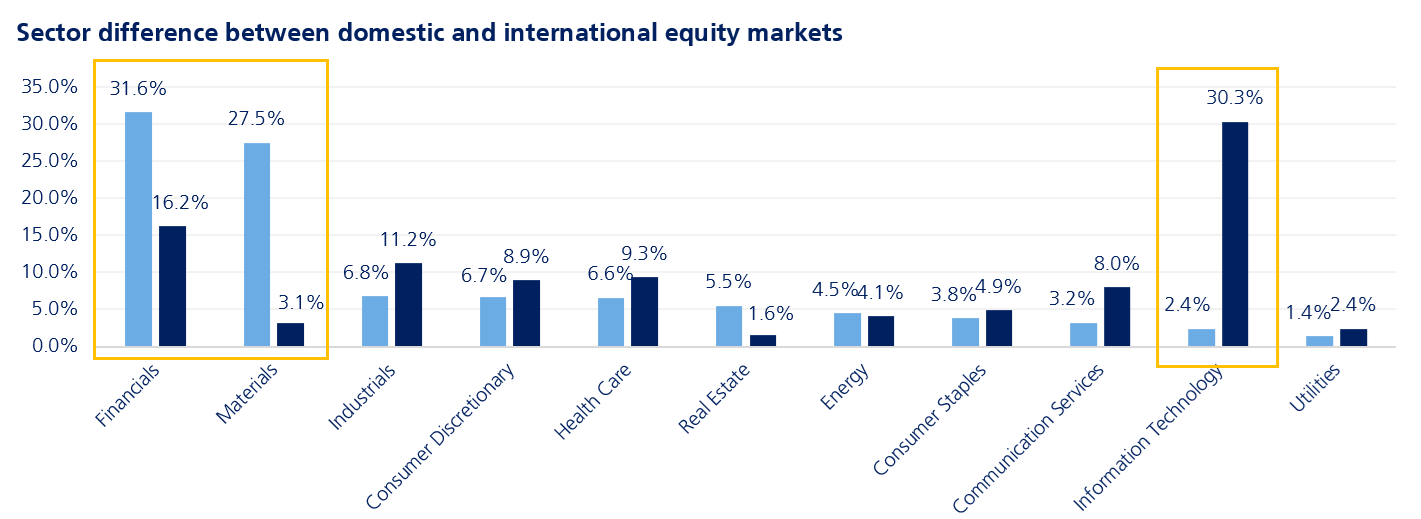
Despite the subdued outlook for Australian equities, we believe that there is still merit in maintaining exposure to domestic equities, particularly from both a diversification and yield perspective. Global indices such as the MSCI World have significant exposure to US mega cap and AI-linked companies. While this has been a powerful source of growth, it can result in unintended thematic and sector bets within portfolios.
Australia offers a different sector mix, with greater exposure to financials and materials. These sectors respond to different drivers, including domestic credit conditions, commodity prices and regional economic activity. They can therefore complement a global equity allocation by increasing diversification. They also lean more into the value factor compared to the MSCI World, where the largest sector leans into the growth factor.
Source: Morningstar, LGT Wealth Management as at 30 September 2026
Higher yields may cushion returns
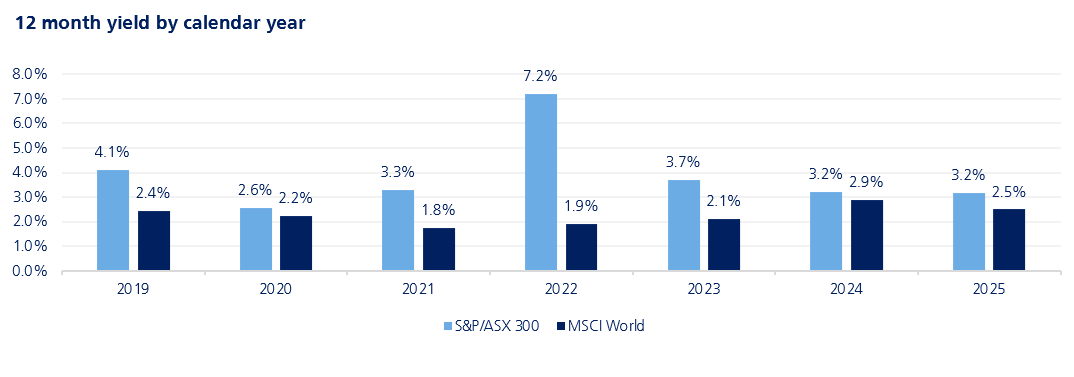
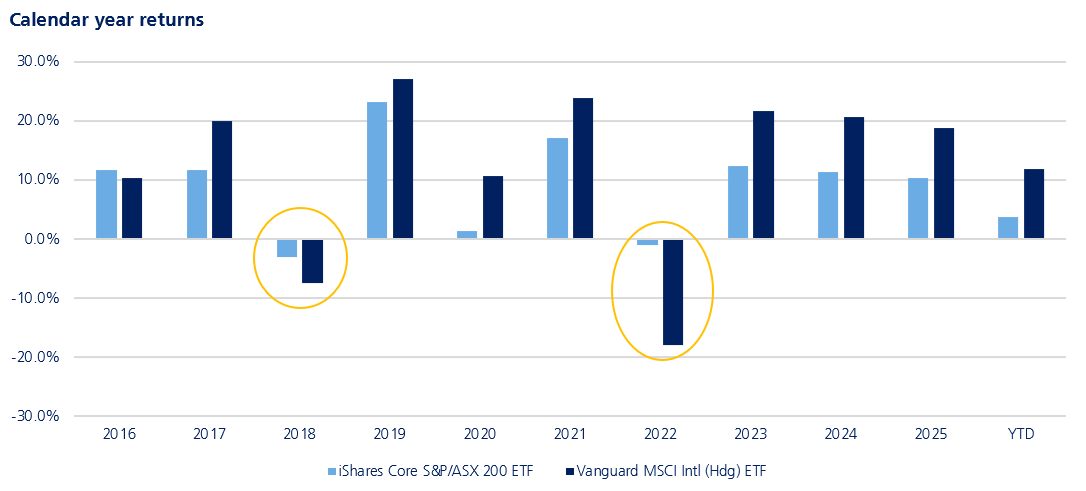
Australian equities have consistently delivered a higher dividend yield than global peers. Not only do they provide access to higher dividend-paying companies, franking credits can also improve after-tax income for eligible investors. In fact, ASX-listed companies typically distribute the majority of their earnings as dividends, unlike many overseas equity markets. Should earnings growth domestically improve, or we see a China-linked demand recovery, returns should also improve. In periods of significant growth selloffs, as experienced in 2022 and 2018, Australia’s dividend yield and value exposure helped shield domestic investors.
Source: Morningstar, LGT Wealth Management as at 30 September 2026
Source: Morningstar, LGT Wealth Management as at 30 September 2026
In addition to the dividend yield, over time the Australian market has had a higher correlation to the value factor relative to the MSCI World, which has typically had a higher correlation to the growth factor. During periods of sharp international equity selloffs, the Australian equity market can, at times, provide a degree of downside protection, supported in part by its income component as well as its higher correlation to value as experienced in 2018 and 2022. The mean regression effect tends to have a greater impact on growth-leaning markets. Given international equities have a higher reliance on the capital component of returns, intra-period swings can be more violent when equity markets experience sharp factor rotations. However, this can also result in a stronger recovery for international equities in subsequent periods. As such, this is an important consideration, particularly when we look to optimise portfolios and determine the most appropriate strategic and tactical asset allocation settings.
How this translates into our SAA
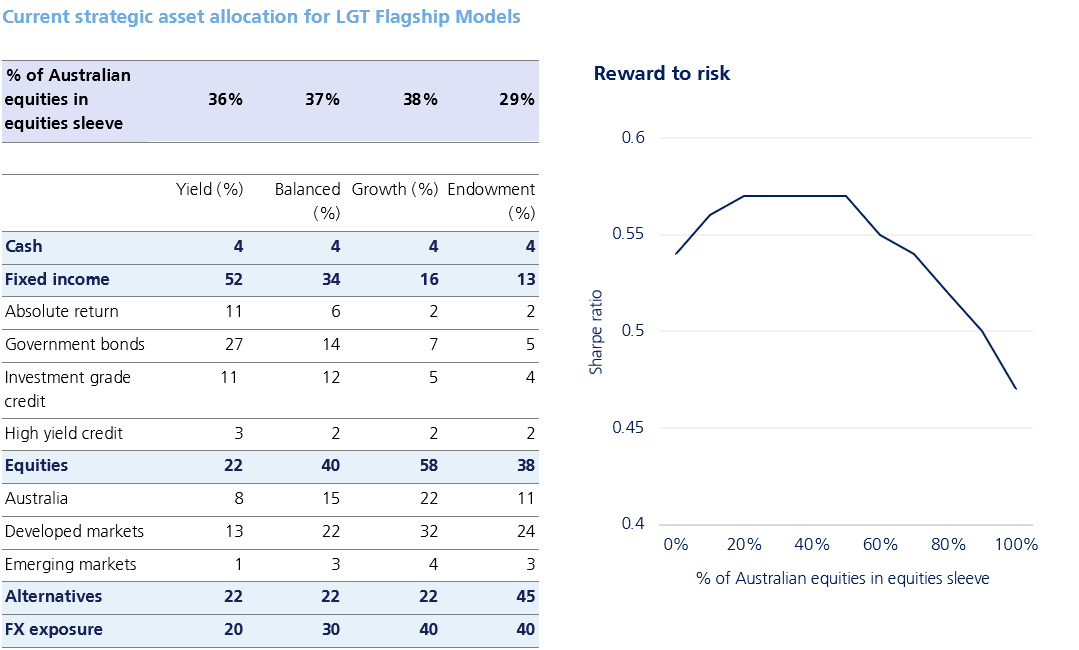
As part of our annual strategic asset allocation review, we regularly assess and decide how much of a portfolio’s equity exposure should be invested in Australian versus international equities. We regularly review this balance across LGT’s flagship models, where Australian equities currently account for approximately 25%-40% of the total equities’ allocation.
Our internal modelling, based off our capital market assumptions, suggests that an Australian equity allocation of roughly 20-50% of the equities sleeve produces the strongest risk-adjusted outcomes. Reward to risk decline beyond that range. Additionally, if we remove the unhedged AUD currency benefit of international exposure, the expected risk in international equity exposure rises. LGT’s current model allocations sit within this 20-50% range, balancing exposure to the domestic market with broader diversification across international markets.
This document has been authorised for distribution to ‘wholesale clients’ and ‘professional investors’ (within the meaning of the Corporations Act 2001 (Cth)) in Australia only.
This document has been prepared by LGT Wealth Management Limited (ABN 50 005 311 937, AFS Licence No. 231127) (LGT Wealth Management). The information contained in this document is provided for information purposes only and is not intended to constitute, nor to be construed as, a solicitation or an offer to buy or sell any financial product. To the extent that advice is provided in this document, it is general advice only and has been prepared without taking into account your objectives, financial situation or needs (your ‘Personal Circumstances’). Before acting on any such general advice, LGT Wealth Management recommends that you obtain professional advice and consider the appropriateness of the advice having regard to your Personal Circumstances. If the advice relates to the acquisition, or possible acquisition of a financial product, you should obtain and consider a Product Disclosure Statement (PDS) or other disclosure document relating to the product before making any decision about whether to acquire the product.
Although the information and opinions contained in this document are based on sources we believe to be reliable, to the extent permitted by law, LGT Wealth Management and its associated entities do not warrant, represent or guarantee, expressly or impliedly, that the information contained in this document is accurate, complete, reliable or current. The information is subject to change without notice and we are under no obligation to update it. Past performance is not a reliable indicator of future performance. If you intend to rely on the information, you should independently verify and assess the accuracy and completeness and obtain professional advice regarding its suitability for your Personal Circumstances.
LGT Wealth Management, its associated entities, and any of its or their officers, employees and agents (LGT Wealth Management Group) may receive commissions and distribution fees relating to any financial products referred to in this document. The LGT Wealth Management Group may also hold, or have held, interests in any such financial products and may at any time make purchases or sales in them as principal or agent. The LGT Wealth Management Group may have, or may have had in the past, a relationship with the issuers of financial products referred to in this document. To the extent possible, the LGT Wealth Management Group accepts no liability for any loss or damage relating to any use or reliance on the information in this document.
Credit ratings contained in this report may be issued by credit rating agencies that are only authorised to provide credit ratings to persons classified as ‘wholesale clients’ under the Corporations Act 2001 (Cth) (Corporations Act). Accordingly, credit ratings in this report are not intended to be used or relied upon by persons who are classified as ‘retail clients’ under the Corporations Act. A credit rating expresses the opinion of the relevant credit rating agency on the relative ability of an entity to meet its financial commitments, in particular its debt obligations, and the likelihood of loss in the event of a default by that entity. There are various limitations associated with the use of credit ratings, for example, they do not directly address any risk other than credit risk, are based on information which may be unaudited, incomplete or misleading and are inherently forward-looking and include assumptions and predictions about future events. Credit ratings should not be considered statements of fact nor recommendations to buy, hold, or sell any financial product or make any other investment decisions. The information provided in this document comprises a restatement, summary or extract of one or more research reports prepared by LGT Wealth Management’s third-party research providers or their related bodies corporate (Third-Party Research Reports). Where a restatement, summary or extract of a Third-Party Research Report has been included in this document that is attributable to a specific third-party research provider, the name of the relevant third-party research provider and details of their Third-Party Research Report have been referenced alongside the relevant restatement, summary or extract used by LGT Wealth Management in this document. Please contact your LGT Wealth Management investment adviser if you would like a copy of the relevant Third-Party Research Report.
A reference to Barrenjoey means Barrenjoey Markets Pty Limited or a related body corporate. A reference to Barclays means Barclays Bank PLC or a related body corporate.
This document has been authorised for distribution to ‘wholesale clients’ and ‘professional investors’ (within the meaning of the Corporations Act 2001 (Cth)) in Australia only.
This document has been prepared by LGT Wealth Management Limited (ABN 50 005 311 937, AFS Licence No. 231127) (LGT Wealth Management). The information contained in this document is provided for information purposes only and is not intended to constitute, nor to be construed as, a solicitation or an offer to buy or sell any financial product. To the extent that advice is provided in this document, it is general advice only and has been prepared without taking into account your objectives, financial situation or needs (your ‘Personal Circumstances’). Before acting on any such general advice, LGT Wealth Management recommends that you obtain professional advice and consider the appropriateness of the advice having regard to your Personal Circumstances. If the advice relates to the acquisition, or possible acquisition of a financial product, you should obtain and consider a Product Disclosure Statement (PDS) or other disclosure document relating to the product before making any decision about whether to acquire the product.
Although the information and opinions contained in this document are based on sources we believe to be reliable, to the extent permitted by law, LGT Wealth Management and its associated entities do not warrant, represent or guarantee, expressly or impliedly, that the information contained in this document is accurate, complete, reliable or current. The information is subject to change without notice and we are under no obligation to update it. Past performance is not a reliable indicator of future performance. If you intend to rely on the information, you should independently verify and assess the accuracy and completeness and obtain professional advice regarding its suitability for your Personal Circumstances.
LGT Wealth Management, its associated entities, and any of its or their officers, employees and agents (LGT Wealth Management Group) may receive commissions and distribution fees relating to any financial products referred to in this document. The LGT Wealth Management Group may also hold, or have held, interests in any such financial products and may at any time make purchases or sales in them as principal or agent. The LGT Wealth Management Group may have, or may have had in the past, a relationship with the issuers of financial products referred to in this document. To the extent possible, the LGT Wealth Management Group accepts no liability for any loss or damage relating to any use or reliance on the information in this document.
Credit ratings contained in this report may be issued by credit rating agencies that are only authorised to provide credit ratings to persons classified as ‘wholesale clients’ under the Corporations Act 2001 (Cth) (Corporations Act). Accordingly, credit ratings in this report are not intended to be used or relied upon by persons who are classified as ‘retail clients’ under the Corporations Act. A credit rating expresses the opinion of the relevant credit rating agency on the relative ability of an entity to meet its financial commitments, in particular its debt obligations, and the likelihood of loss in the event of a default by that entity. There are various limitations associated with the use of credit ratings, for example, they do not directly address any risk other than credit risk, are based on information which may be unaudited, incomplete or misleading and are inherently forward-looking and include assumptions and predictions about future events. Credit ratings should not be considered statements of fact nor recommendations to buy, hold, or sell any financial product or make any other investment decisions. The information provided in this document comprises a restatement, summary or extract of one or more research reports prepared by LGT Wealth Management’s third-party research providers or their related bodies corporate (Third-Party Research Reports). Where a restatement, summary or extract of a Third-Party Research Report has been included in this document that is attributable to a specific third-party research provider, the name of the relevant third-party research provider and details of their Third-Party Research Report have been referenced alongside the relevant restatement, summary or extract used by LGT Wealth Management in this document. Please contact your LGT Wealth Management investment adviser if you would like a copy of the relevant Third-Party Research Report.
A reference to Barrenjoey means Barrenjoey Markets Pty Limited or a related body corporate. A reference to Barclays means Barclays Bank PLC or a related body corporate.
A more selective approach to active equity investing
When a handful of companies drive market returns, where can active management add value? We explain why we pair a diversified core with carefully selected managers and how we assess what each brings to a portfolio after fees and risks.
Observation
A view from Washington
We recently welcomed Libby Cantrill, a Managing Director and the Head of Public Policy for US investment management firm PIMCO, for a client lunch event in Sydney.
Stay up to date
Receive ongoing access to LGT Wealth Management’s insights and observations - a curated stream of thought leadership, market perspectives, and strategic updates designed to inform sophisticated investors.