On the face of it, the near-term outlook for the global economy and financial markets seems (as ever) extremely uncertain. Markets are still facing into (1) an unresolved US-Iran conflict (with the prospect of near-term escalation a real risk), (2) uncertainty over how US President Trump will respond to his midterm election rout and how harshly a Democratic Congress will challenge him in 2027, (3) renewed distress over the artificial intelligence (AI) rollout (it seems to be both moving too fast and at the same time may face significant regulatory hurdles next year), and (4) still-elevated inflation and hawkish central banks.
These appear to be stern headwinds indeed, and investors’ first reaction might be to stay put or seek shelter while they await greater clarity. However, as any keen sailor knows, staying passive into a headwind risks leaving your ship dead in the water. To make progress, one must instead use discipline, process, and the courage of their convictions to ‘tack into the wind’.
In this Special Report, we outline the process and key signposts that we have been monitoring since the middle of this year, as we seek signs of enough of a break in uncertainty to deploy into risky assets and embrace our otherwise fundamentally constructive view for 2027. Not all of our signposts have been met, and bouts of bad weather may still lie ahead. Yet, with the passage of the US midterms and the extent of voters’ rebuke of the Trump administration’s policies (as well as last week’s sharp selloff in equity markets and AI-related assets), we believe that we now have sufficient signs of market-based stress and tightening constraints on key policymakers to ‘tack into’. These should in turn contribute to a favourable inflection in policy momentum (with central banks on the cusp of their final one or two hikes) to justify leaning into risk as we set our hopeful sights on brighter shores in 2027.
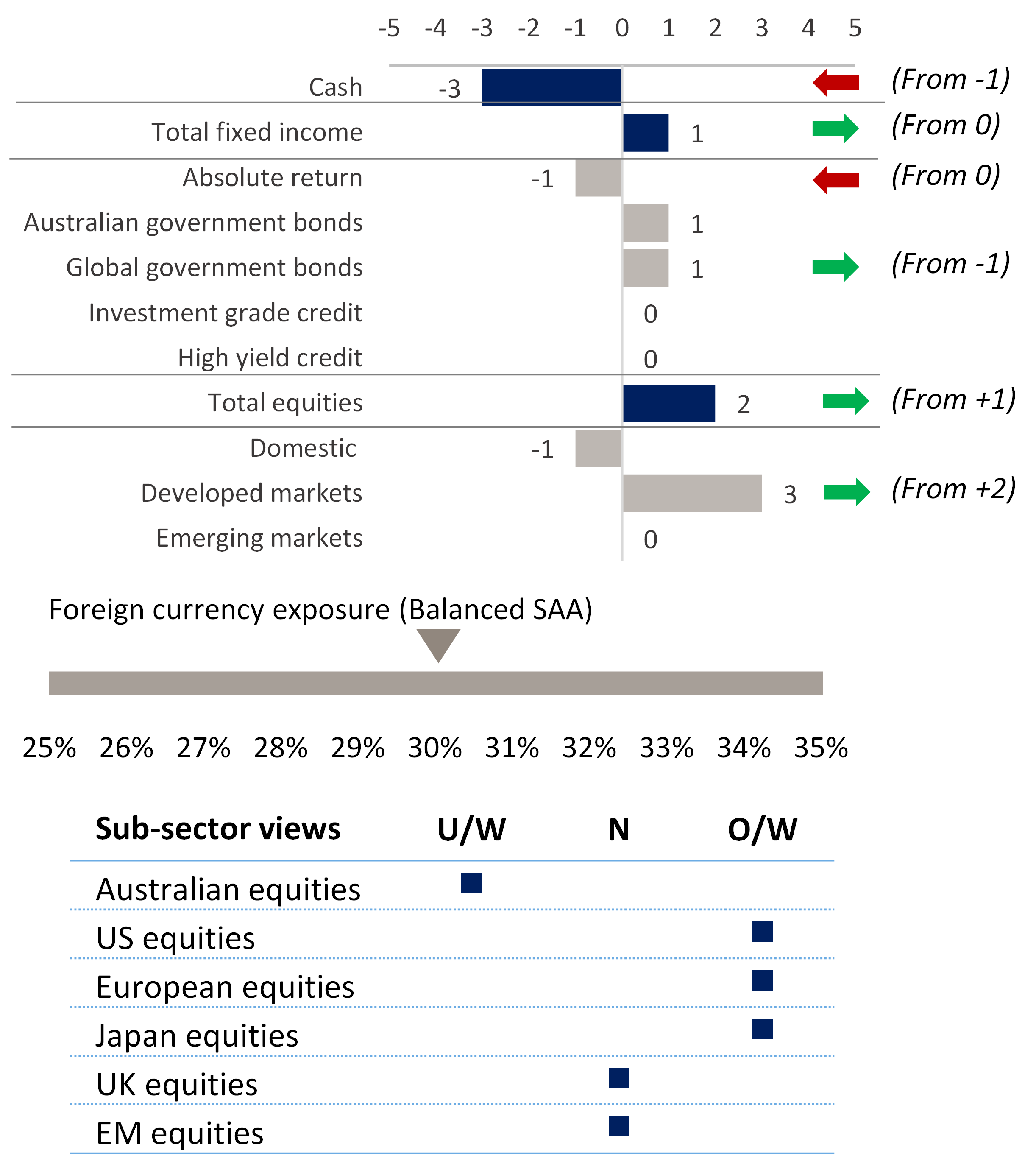
We take the opportunity following last week’s selloff to incrementally increase our equity overweight from +1pp to +2pp via further increasing our overweight to developed market equities. We also move +1pp overweight fixed income via closing our underweight and moving +1 overweight to global government bonds. These moves are funded from cash and from our absolute return fixed income allocations, utilising some of the liquidity and flexibility that we have built up over the year.
The move to lean further into equities reflects our fundamentally constructive macroeconomic outlook for 2027, while our decision to close our underweight and go overweight global government bonds reflects our conviction that inflation and central bank tightening is approaching its peak through Q426 (suggesting attractive valuations of global bond yields at current levels). We also believe that they will provide downside protection to portfolios if equity markets were to fall further in the near term.
Our underlying constructive view for 2027 rests on several key fundamental macro views:
Business activity is still strong. The underlying macroeconomic dynamics within most major economies (particularly the US and Japan) are broadly positive. Many indicators of the business cycle, including corporate cashflows, capital expenditure (capex) – not just in AI but across manufacturing and defence – and business activity are positive.
Global growth has remained near trend. Even in the face of two wars, elevated energy prices, and multi-decade high bond yields, global growth has remained near trend in 2026, and forecasts centre on a faster pace of growth in 2027. In addition, both household and corporate balance sheets in the US are in rude health, with low aggregate debt levels and strong profitability that moderate the risk of a debilitating balance sheet recession. Corporate balance sheets also remain robust in Europe and Japan with the latter seeing an ongoing better consumer trend on the back of improving wage trends, and the former consumer possessing high savings rates should the rate outlook stabilise.
Markets may be overpricing central bank hikes. As we wrote earlier this month, we believe that the extent of central bank hikes this year has been significant, keeping in mind that relative to expectations for multiple cuts at the start of 2026, markets have priced in between 80-100 bps of relative ‘tightening’ across the US, Europe, and UK. This ‘tapping of the brakes’ is already weighing on housing markets and moderating wages growth in the US. While the US-Iran war and its impact on energy prices is a key hurdle here, we believe that central banks are closer to the end than the start of their hiking cycle, and that after a final round of hikes to round out 2026, they may evolve to being ‘on hold’ in Q127.
While our constructive outlook has held since the middle of 2026, we have held a mostly neutral tactical positioning as we monitored three key near-term signposts:
US midterm uncertainty. This event risk has clearly passed, and as we wrote in our Special Report, we believe the divided government that will emerge next year will be characterised by political gridlock, which is generally positive for markets. In addition, the extent of both Republicans’ defeat and voters’ pushback against AI likely has implications for our other two signposts below.
US-Iran political resolution (or signs thereof) and easing pressure on oil markets. The seemingly interminable US-Iran conflict has been a key source of market and newspaper consternation for most of this year. We maintain our view from April that regardless of policymaker preferences, the material constraints on both the US and Iran are limiting the likelihood of a worst-case escalation of the conflict and pushing us more towards the realm of the ‘kinetic equilibrium’ of the past few months, or a more enduring political deal. We believe that the results of the US midterm elections have further exhausted the President’s political capital. After all, given the drubbing they received due to their linkage to Trump, what Republican with aspirations for 2028 would allow him to indulge his worst excesses today? While we are prepared for possible near-term ‘escalate to de-escalate’ hostilities, we expect Trump’s lack of political capital, amongst the other constraints of elevated oil prices and high bond yields, will ultimately push both parties towards a deal that stabilises energy prices. We expect that lower oil prices due to a political resolution, or sustained higher inventories, will play a key role in shifting central banks closer to the peak of their tightening cycles through Q127.
What about the broader economic and market prospects that federal and/or state regulations or moratoria arrest the AI rollout? This is a clear near-term risk that we are monitoring closely. We don’t expect significant federal action due to Trump’s veto power, though we acknowledge that state governors have significant leeway to impose additional restrictions or temporarily halt AI data centre construction. While this would negatively impact growth and economic activity in the near term, such a slowdown in capex could actually be a net positive. This is due to the fact that it would relieve demand for capital and pressure on funding markets, thus relieving upward pressure on bond yields (the so-called ‘competition for capital’). It would also increase the value of existing data centres and infrastructure, boosting hyperscaler profits and free cashflow, ironically boosting the longer-term durability of the AI trade.
Indeed, the now more ‘constrained’ pace of the AI story together with the likely disinflationary impulse of lower oil prices, explains our decision to incrementally deploy our equity risk into non-US markets (see TAA over the page). Moreover, within fixed income, the funding of our overweight from absolute return reflects our belief that only a modest move lower in bond yields – and eventual pricing for lower rates for 2028 – is needed for longer-dated bonds to outperform more cash-like instruments over the coming year.
In addition, we believe that while market dynamics remain fragile, the extent of the volatility spike and selloff last week has eased valuation and technical pressures, reducing technical headwinds to our call. In particular:
The 5.5% decline in the NASDAQ and the around 70% spike in the VIX volatility index on 5 November 2026 have rarely happened outside of severe recessionary periods, and forward-looking returns from leaning into equity markets after such events have in most cases been positive.
Across global and domestic bonds, we are leaning into duration as outright yields look more attractive and we expect inflationary pressures to ease. While the timing is uncertain, a peak in the central bank tightening cycle should support longer-dated bonds. Government bonds may also provide a partial hedge against an AI-related slowdown: if weaker investment reduces growth and inflation pressures, bond yields should fall even as AI-exposed equities weaken. That protection is not assured, however, particularly if inflation remains elevated or yields rise for other reasons.
We remain cognisant of the uncertainties we outlined at the top of this report and their potential to evolve negatively from here. Nonetheless, we aim to utilise our disciplined frameworks and signposts to help us to stage our actions. We duly recognise that there are many key uncertainties and risks to our views, including but not limited to:
While we believe US President Trump has exhausted his political power, it is unclear how lucidly he understands this, and whether or not he will be willing to bow to the will of the US voter (after sufficient venting on social media).
As such, while we expect some form of ‘escalate to de-escalate’ hostilities in the Middle East, we cannot rule out the potential for a worst-case US escalation into energy infrastructure and/or ground incursion that could spike oil prices even higher and lead the world into a global recession.
We are also cognisant that the incoming Democratic Congress and state governors could advance an aggressive anti-AI agenda that leads to a sharp downturn in AI capex (harming the near-term expansion) and harming AI valuations.
As investors sour on the AI trade, a key risk event to watch will be Anthropic’s much-touted initial public offering (IPO). Any complications or failure could be a negative harbinger for our fundamentally positive view on AI.
We are seeing nascent signs that persistently elevated energy prices may be getting ‘passed through’ to general core services prices, which could entrench the supply shock into inflation expectations and force central banks to tighten further than we expect.
In short, there is, as always, a reasonable possibility that we may be a bit early in our call to deploy into equities and fixed income this week. Unfortunately, in markets as in life there will always be risks and uncertainty; if there weren’t we would likely be climbing stratospheric heights in asset prices! In addition, trying to time an exact bottom in markets is a fool’s errand. Instead of attempting this, we are relying on discipline, process, and our advantages as a long-term investor to help us navigate what is an admittedly volatile and uncertain investment environment. We maintain our flexible and nimble stance and stand ready to take further actions as market conditions and our assessments change, whether that be deploying further into weaker markets should they emerge, or de-risking if conditions require it.
Abstracting from the tactical moves that we are making today, we think investors should also not lose track of the fundamental importance of discipline and diversification in their long-term investment strategies. As we discussed in our April 2025 Special Report ‘Staying the Course’, we have spent recent years emphasising the significance of building robust portfolios that are diversified across asset classes and risk factors, and not overly exposed to any particular style or theme.
This disciplined, multi-asset approach is core to our investment philosophy and process, and will play a crucial role in helping investors navigate the vicissitudes of nervous markets.
Beyond this, LGT’s Chief Investment Office have been incorporating into our longer-term investment strategy and portfolio construction over the past few years as we gear our portfolios up for this rapidly evolving world. Below we lay out a summary of our recent research and portfolio actions that incorporate our views for how investors should navigate these shifting currents:
Stepping up our hunt for efficient alpha in portfolios – increasing our scrutiny of active equity managers and deliberately clarifying their expected role in client portfolios.
Build portfolio resilience against a structurally inflationary background – building a practitioner’s framework for understanding and building long-term inflation-resilient portfolios.
Revisiting the role of real assets in total portfolios – recasting the role of real assets within a total portfolio framework.
Building out our AI exposure framework – defining a framework for assessing and evaluating AI exposure across a total portfolio.
Identifying diversifying opportunities within equity markets – further scrutinising the diversifying opportunities within equity markets.
On the face of it, the near-term outlook for the global economy and financial markets seems (as ever) extremely uncertain. Markets are still facing into (1) an unresolved US-Iran conflict (with the prospect of near-term escalation a real risk), (2) uncertainty over how US President Trump will respond to his midterm election rout and how harshly a Democratic Congress will challenge him in 2027, (3) renewed distress over the artificial intelligence (AI) rollout (it seems to be both moving too fast and at the same time may face significant regulatory hurdles next year), and (4) still-elevated inflation and hawkish central banks.
These appear to be stern headwinds indeed, and investors’ first reaction might be to stay put or seek shelter while they await greater clarity. However, as any keen sailor knows, staying passive into a headwind risks leaving your ship dead in the water. To make progress, one must instead use discipline, process, and the courage of their convictions to ‘tack into the wind’.
In this Special Report, we outline the process and key signposts that we have been monitoring since the middle of this year, as we seek signs of enough of a break in uncertainty to deploy into risky assets and embrace our otherwise fundamentally constructive view for 2027. Not all of our signposts have been met, and bouts of bad weather may still lie ahead. Yet, with the passage of the US midterms and the extent of voters’ rebuke of the Trump administration’s policies (as well as last week’s sharp selloff in equity markets and AI-related assets), we believe that we now have sufficient signs of market-based stress and tightening constraints on key policymakers to ‘tack into’. These should in turn contribute to a favourable inflection in policy momentum (with central banks on the cusp of their final one or two hikes) to justify leaning into risk as we set our hopeful sights on brighter shores in 2027.
Receive ongoing access to LGT Wealth Management’s insights and observations - a curated stream of thought leadership, market perspectives, and strategic updates designed to inform sophisticated investors.