

2024 has been an eventful year in US politics. From a disastrous debate performance from President Joe Biden, to an assassination attempt on his Republican predecessor, Donald Trump, the events leading up to the 2024 US presidential election have been like no other. On 21 July, under increasing pressure from members of his own party, President Biden announced his withdrawal from the election, endorsing Vice President Kamala Harris as his replacement. Since then, Democrats have been racing to make ground, coalescing round Harris in a bid to thwart a White House comeback from Trump.
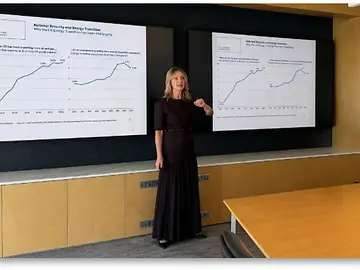
Earlier this month, LGT Crestone hosted a client event with Libby Cantrill, Head of US Public Policy and a managing director in PIMCO's Portfolio Management Group. In her role, Libby analyses policy and political risk for the firm's investment committee, and leads US policymaker engagement and policy strategy for the firm. She also works closely with PIMCO's Global Advisory Board, led by former Federal Reserve Chair, Ben Bernanke.
Ms Cantrill provided her perspective on recent events in Washington DC. She gave an overview of the key issues resonating with US voters, and discussed which sectors of the market will likely be winners or losers under a Harris or Trump presidency. The discussion was facilitated by LGT Crestone's Head of Public Markets, Todd Hoare.
One of the key areas where Harris and Trump differ is tariffs. Trump has proposed a blanket 10% tariff on foreign imports, while Harris is likely to use tariffs and export controls tactically.
Prior to President Biden's withdrawal from the race, Trump was leading in a number of critical states, causing alarm among Democrats. Though the dynamics of the campaign have shifted since Harris became the Democrat nominee, her net approval rating is only slightly better than Trump's. And in terms of polling, she is only leading by a small margin (47.4% versus Trump's 46.9%). But with pre-election polls unreliable this far in advance of an election, Cantrill explained that six swing states could hold the key to the White House. These states are Georgia, Nevada, Wisconsin, Michigan, Arizona, and Pennsylvania. Pennsylvania has been a critical state in the last few presidential elections, and 2024 is expected to be no different.
Among the top issues affecting voters in this election are inflation and abortion rights. The rising cost of gas and groceries has been a headwind for President Biden, and could continue to be an obstacle for the Democrats. On the other hand, a headwind for Trump is opposition to the Supreme Court decision to reverse Roe v. Wade. This latest decision asserts that the Constitution does not confer a right to abortion.
Regardless of who wins the election, the biggest loser will be the US fiscal deficit, although there is unlikely to be a large sell-off in rates.
Assuming Harris' policies are not too dissimilar to those of President Biden, the area where Harris and Trump are most likely to differ is on tariffs. In other areas, such as reform of Medicare or Social Security, there is likely to be less difference in policies.
Regardless of who wins the election, the biggest loser will be the US fiscal deficit. Based on the assumption that Trump's tax cuts will expire in 2025, the US deficit as a percentage of GDP is predicted to rise to 7.1% by 2033. If these tax cuts were extended, that figure is likely to increase to 8.2% . Cantrill explained the key reason why the deficit will remain elevated is due to higher spending on Medicare and Social security, as well as interest expense.
Despite the size of the fiscal deficit, Cantrill does not foresee a large sell-off in rates. The US dollar remains the pre-eminent reserve currency, and this is unlikely to change in the foreseeable future. However, she does expect the US yield curve to normalise and steepen at the long end. For this reason, PIMCO is currently underweight duration in long-dated securities.
From the perspective of markets, Cantrill believes the composition of Congress is just as important as who wins the presidency. While the Senate is likely to flip to Republican control, the House leans slightly Democratic. Although the race is dynamic, Cantrill believes that both candidates stand a 50/50 chance, and a divided Congress is more likely than a Republican or Democratic sweep. With 60 votes needed to pass most legislation in the Senate, it is unlikely that any party will have close to this number, making it difficult to govern.
Under a Trump presidency, tariffs and immigration policies will likely be inflationary and could negatively impact growth. Under a Harris presidency, there could be some headwinds around regulation and increased discretionary spending.
Under a Trump presidency, tariffs and immigration policies will likely be inflationary and could negatively impact growth, although his focus on deregulation could be incrementally positive for growth. On the other hand, a Harris presidency will be much more status quo for the economy, with some headwinds around regulation and increased discretionary spendi'ng.
Cantrill explained that it is difficult to predict how the broader market will respond to either candidate winning the presidency, but that there are clear winners and losers at a sector level. Defense is likely to be a 'winner', regardless of whether Harris or Trump is the next US president. This reflects rising national security threats, as well as heightened geo-political risks. On the other hand, technology will continue to face headwinds, regardless of who is elected. This is because US technology companies continue to be subject to export controls. Cantrill also sees financials and energy benefiting from a Trump presidency, while renewables would benefit under Harris.
| 19-22 August | Democratic National Convention in Chicago, Illinois |
| 4 September | First of three presidential debates |
| 10 September | Second presidential debate |
| 16 September | Early voting in Pennsylvania begins |
| 18 September | President Trump sentenced for 34 felonies; last FOMC meeting before election |
| 25 September | Third presidential debate |
| October | Early voting in other critical swing states begins |
| 5 November | Election day |
Receive ongoing access to LGT Wealth Management’s insights and observations - a curated stream of thought leadership, market perspectives, and strategic updates designed to inform sophisticated investors.