Heading into the US midterm elections, US President Trump asked voters to pretend he was on the ballot. History will likely record that as a flawed strategy! After two years of historic policy shocks from the executive branch of the US government – including the short-lived Department of Government Efficiency, the 2025 Liberation Day tariffs, and the ongoing conflict with Iran – US voters have expressed their Constitutional will in the 2026 US midterm elections. As the dust settles on one of the largest midterm waves in history, all indications are that ‘the people’ have delivered a scathing rebuke to President Trump’s administration and the broader Republican party. Indeed, the Democratic Party looks set to regain control of both the House of Representatives and the Senate, with strong majorities in both chambers of Congress. Notwithstanding that, there will still be significant constraints on what the Democratic party can achieve near-term, given their Senate majority falls short of overcoming a filibuster, and the White House veto right remains in play. Interestingly, evidence suggests ‘centre-left’ Democrats meaningfully out-polled the ‘far left’.
Further down-ballot, Democrats have also won a range of gubernatorial races, with the party now expected to hold 30 out of 50 gubernatorial seats. The popular backlash against the artificial intelligence (AI) data centre buildout was also cemented across a swathe of local ballot issues in individual states. Slower US growth could put downward pressure on rates and inflation in 2027.
In this Special Report, we outline the key results (as they stand early morning on 5 November 2026, Australia time) from the 2026 US midterm elections and their likely implications for policy, the economy, and markets. In doing so, we strive to look beyond the news headlines and the political realm to identify the key constraints facing the 2027 US government, the most probable market-relevant consequences in the near-term and with an eye to 2028, and consider how astute investors should incorporate the election result into their portfolios.
As Clinton-era strategist James Carville eloquently stated, in the end, it was “the economy, stupid,” as US voters punished Republicans over their failure to address – and in many cases, active exacerbation of – cost-of-living pressures across the US economy. President Trump’s ill-guided 2025 tariffs, and equally ill-guided conflict with Iran, were highlighted as specific issues, alongside his domestic crackdown on immigration (which drained the US labour supply) and increasing popular anger at perceived corruption by administration officials.
The signs were evident for some time: Trump’s approval rating had plummeted towards record lows of 32% in the lead-up to the election, while the Democrat lead in the ‘generic Congressional ballot’ had risen to levels not seen since the heady “Yes we can” days of 2008. Individual and national voter polling, indications from early voting, focus group views, and the general ‘national mood’ were pointing towards what PIMCO’s Libby Cantrill termed a “shellacking” for Republicans, and voters duly delivered.
As at 8:45am AEDT on 5 November 2026, Democrats look set to gain control of both chambers of Congress:
| Projected Democrat seats | Seats too early to call | Projected Republican seats |
House of Representatives | 237 | 59 | 139 |
Senate | 54 | 2 | 44 |
Source: Associated Press and various news outlets
These numbers may shift as results are finalised over coming days and weeks, but it seems clear that the Trump administration will be facing a very different Congress in 2027.
The key constraints likely to drive the shape and actions of 2027 US government policy
As we have laid out in our secular outlook, political and geopolitical developments are becoming more impactful on society, economies, and markets as we transition towards a new secular environment. We are seeing increasing polarisation across civil and social discourse, and no doubt these US midterms may also elicit strong emotions in the US and across the world. We cannot ignore these dynamics, but we must also acknowledge our first duty is to best steward our clients’ capital through periods like this with a steady eye on their long-term objectives.
Our constraints-based framework, which we outlined in our February 2025 Observation, arms us with a disciplined and objective process to assess and invest against political and geopolitical risk. As a brief reminder, this framework focuses less on assessing policymaker preferences or declarations, and more on evaluating the material constraints that determine what those policymakers can actually get done. With that in mind, the table below outlines our assessment of the key constraints facing the legislative (Congress) and executive (Presidential) branches of the US government from 2027:
Branch of government | Key powers | Key constraints | Likely policy implications |
House of Representatives |
|
|
|
Senate |
|
|
|
Executive (President) |
|
|
|
The difference between winning one or both chambers of Congress is minimal. While clearly a large political and social statement, the practical difference between winning just the House and also winning the Senate is minimal. Control of even one of these chambers of Congress will give Democrats significant authority to intensify scrutiny and oversight of President Trump, launch a wide range of investigations into the administration, and generally disrupt the President’s agenda.
Don’t expect meaningful legislative action from the 2027 Congress. Even with a majority in both chambers, Democrats will still need 60 votes in the Senate to overcome the procedural filibuster, meaning they will still have to work with Republicans across the floor. Even then, Trump’s veto authority, if exercised, would require a two-thirds majority in both chambers of Congress to overturn. As such, both Trump and Congressional Democrats will likely act as mutual constraints on each other, limiting the ability to pass legislation that meaningfully shifts the US policy stance from here.
Constitutional checks and balances are a design, not a flaw. In broad terms, the divided US government we now face is likely to be characterised by limited significant policy shifts, multiple political investigations, and general gridlock. This is a seminal characteristic of divided governments in the US, and frustrating as it sounds, is a deliberate feature built into the checks and balances of the US Constitution to prevent a single person or entity from wielding too much power.
Trump has exhausted all his political power. US voters have delivered a clear castigation of President Trump’s administration, validating his dismal approval ratings. This clear censure should curb his worst excesses and is likely to cement his lame duck status even within the Republican party, which suffered brutally through its connection with the President.
In short, we expect more oversight, more obstruction, and no significant fixes to the budget deficit or other major changes in policy over the coming two years. We would also anticipate even harsher constraints restraining President Trump’s final two years in office.
While we expect no drastic policy shifts at the Federal level of the US government, an initial assessment of the down-ballot gubernatorial and local races could see more significant market implications, particularly with regards to the ongoing rollout of data centres to power the AI revolution.
While Congress is limited by the Presidential veto, state Governors have the authority to impose temporary moratoriums on data centre construction, as demonstrated by New York Governor Kathy Hochul recently. Indeed, winning Democratic gubernatorial candidates in Ohio, Nevada, Georgia, Iowa, Michigan, and Texas (all key states in the data centre buildout and subsequent backlash) have called for a pause or further regulations on the AI buildout. In addition, voters across 38 local jurisdictions in 10 US states have voted on, and in many cases approved, at least 41 local measures that would delay, prohibit, or impose new requirements on data centres.
In other words, the local popular backlash against AI is strong and increasing, which collectively could result in higher costs, a slower pace of buildout, and lower returns on investment. On the other hand, such a slowdown could ultimately support the long-term social license of AI, while also moderating the intense near-term capital needs that are already weighing on the megacap tech hyperscalers’ free cash flow and share prices. In effect, voter backlash could save the AI roll-out from its own worst excesses. Time, and markets, will tell us how this ultimately plays out.
If our central case view that divided government will lead to no significant policy shifts over the next two years is correct, can we glean any potential lessons for the 2028 Presidential elections and beyond? Firstly, let us clarify that it is incredibly early to start thinking about 2028 – voters will need to see how Democrats handle the mandate they have been given, and as we have seen, two years is a long time in politics and global economics.
That said, there are some areas that investors can and should monitor over coming years, starting with what the Democrats’ strong showing augurs for the US median voter. On the latest numbers, moderate Democrats and Democrats winning in deep red states have generally outperformed ‘far-left’ candidates, which may temper any policy leanings towards higher tax, higher regulation, and higher welfare (especially on healthcare). Investors should watch how the Democratic Congress (and Democratic Governors) manage their large majorities and set their agenda over the next few years and how the median voter responds to it, as shifts in tax and regulation could impact corporate earnings growth and the ever-resilient US share market.
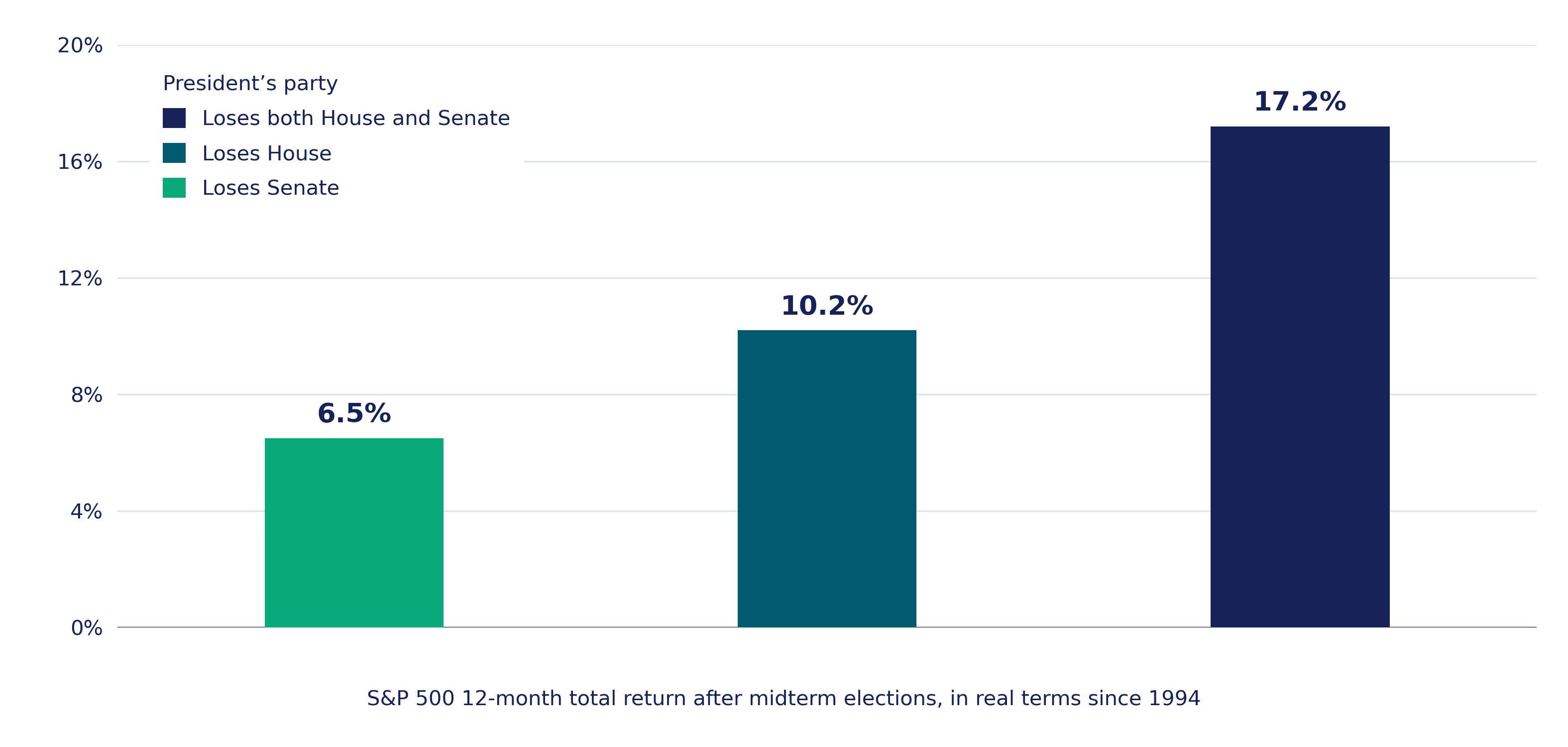
On a tactical (six to twelve month) timeframe, the outcome of the US midterm elections doesn’t significantly change our outlook. In fact, progressing through this event risk was one of our key signposts to get more comfortable deploying capital from our broadly neutral tactical positioning. Indeed, as the chart below from BCA Research shows, after navigating the immediate-term market volatility, a loss for the President’s party in a midterm election is generally a good thing for shares, as policy gridlock reduces the likelihood of policy surprises; something we’re sure many investors would welcome after the past two years!
S&P 500: 12 months total return after midterm elections in real terms since 1994
Beyond the headline level, though, there are potential risks and opportunities that investors can and should turn their eyes to, particularly within equity markets.
In the short term, we think the outcome of the midterms is unlikely to materially change the earnings outlook. Monetary policy, fiscal policy, economic growth, labour markets, corporate profits, and valuations are much better indications of future returns. The economic context, not the political context, tends to be much more relevant to understanding historical market environments and returns. Noting that markets invariably dislike uncertainty, but election outcomes generally bring certainty, it’s worth making some observations:
The S&P 500 has historically performed well in the six and 12 months following the US midterm elections, especially under a Republican president and Democrat government. There have been seven such instances since 1950, with a positive 12-month return 100% of the time (average = 15.5%, median = 12.7%).
Moreover, no matter the outcome, US equities have delivered a positive return in the subsequent 12 months following US midterm elections 100% of the time dating back to 1950 (19/19 for an average 15% gain).
The potential benefit of congressional gridlock is that it typically constrains sweeping fiscal and legislative changes and so at the margin, might result in slightly lower bond yields, helping equity valuations. However, it does not necessarily prevent changes to tariffs, immigration enforcement, or regulation through executive authority.
Although politics will be informative for sectors (eg healthcare, defence), ultimately, it is likely to be US Federal Reserve policy, US bond yields, and corporate earnings that are the decisive factors.
Moreover, at a sector level, it’s possible that investors have already positioned for this outcome. Healthcare valuations have rerated ~20%, while defence stocks have been derated by ~28%. In areas such as reversing healthcare spending cuts in the One Big Beautiful Bill, or reversing restrictions on renewable energy, or data centre buildout, the general consensus is that a divided government may create some initial volatility, but Presidential veto may result in a “holding pattern”.
However, to the extent that AI has been such a predominant influence on equity markets, what a potential change in political direction means for greater regulatory scrutiny of AI and Big Tech could be important, especially at a time where AI momentum has turned negative. Any selloff that occurs on fears of increased AI regulation may end up being a buying opportunity given significant policy changes are unlikely given Presidential veto.
Looking further out, the US midterms are but one of the many evolving themes and dynamics that LGT’s Chief Investment Office have been incorporating into our longer-term investment strategy and portfolio construction over the past few years as we gear our portfolios up for this rapidly evolving world. Below we lay out a summary of our recent research and portfolio actions that incorporate our views for how investors should navigate these shifting currents:
Stepping up our hunt for efficient alpha in portfolios – increasing our scrutiny of active equity managers and deliberately clarifying their expected role in client portfolios.
Build portfolio resilience against a structurally inflationary background – building a practitioner’s framework for understanding and building long-term inflation resilient portfolios.
Revisiting the role of real assets in total portfolios – recasting the role of real assets within a total portfolio framework.
Building out our AI exposure framework – defining a framework for assessing and evaluating AI exposure across a total portfolio.
Identifying diversifying opportunities within equity markets – further scrutinising the diversifying opportunities within equity markets.
Third, investors should carefully monitor how Democrats message their policy agenda for 2028 and how voters respond to that over the next two years. A shift towards higher tax, higher regulation, and higher welfare could pose a potential headwind to US corporate earnings growth as we look to 2028 and beyond.
Our key conclusions and guidance to clients:
Stay invested and look for opportunities to deploy. On a tactical horizon, divided government is usually a tailwind for US equity markets.
Equities will continue to be driven by Fed policy, bond yields, and corporate earnings, although policy gridlock may provide support, and history suggests positive post-midterms returns. AI-related selloffs could offer buying opportunities if fears of legislative change prove overstated.
Longer term, investors should continue to interrogate, assess, and prepare their portfolios as we continue to traverse a rapidly changing investment environment.
Receive ongoing access to LGT Wealth Management’s insights and observations - a curated stream of thought leadership, market perspectives, and strategic updates designed to inform sophisticated investors.