


In a year when markets have often been dominated by headlines, from conflict in the Middle East and renewed tariff uncertainty to sharp moves in memory stocks, earnings season offers investors a chance to look past the noise. Company results provide a clearer picture of sales, costs and profits across corporate America, rather than the picture implied by the headlines.
The latest US reporting season is not yet complete, but the results so far point to an encouraging development. Corporate America is delivering some of its strongest profit growth in years, and that strength is no longer confined to the familiar group of mega-cap technology companies.
A tall building needs a broad, well-supported foundation. Markets are similar. When profit growth rests on more companies and sectors, it is less vulnerable to weakness in any one area. That is what makes the breadth of this earnings season important.
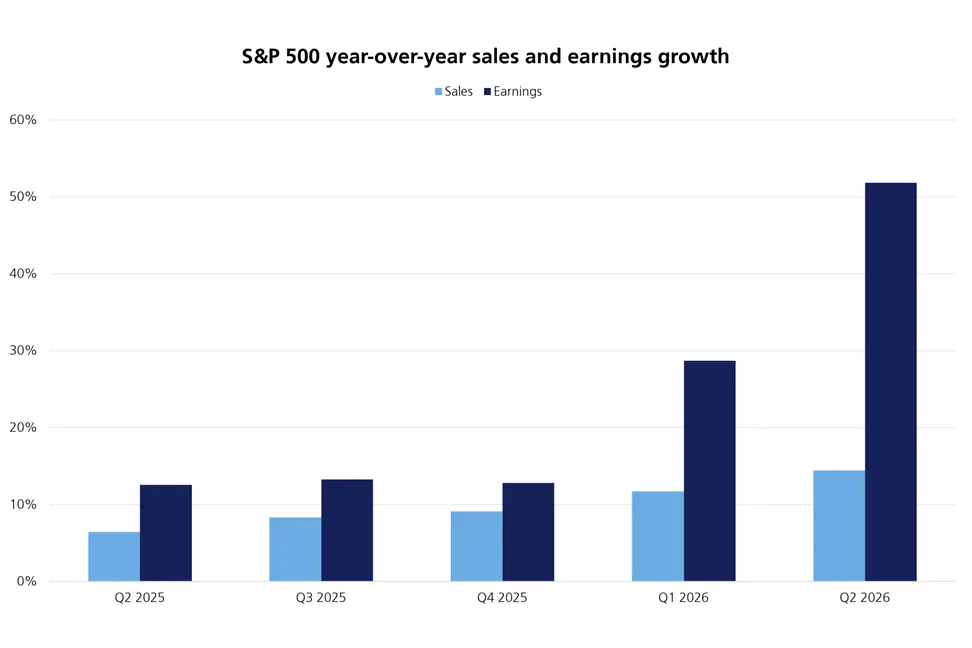
US sales and earnings growth have been improving over the past 12 months, but this quarter has brought a notable step up. Sales growth has reached double digits, while earnings growth has risen above 50%. Big technology remains an important contributor, but it is no longer doing all the heavy lifting.
Ten of the eleven sectors in the S&P 500 are reporting year-on-year earnings growth, and eight of those ten are posting double-digit gains. Energy, Communication Services, Consumer Discretionary and Information Technology are leading, with Materials also joining the double-digit group. Healthcare is the only sector currently reporting a decline.
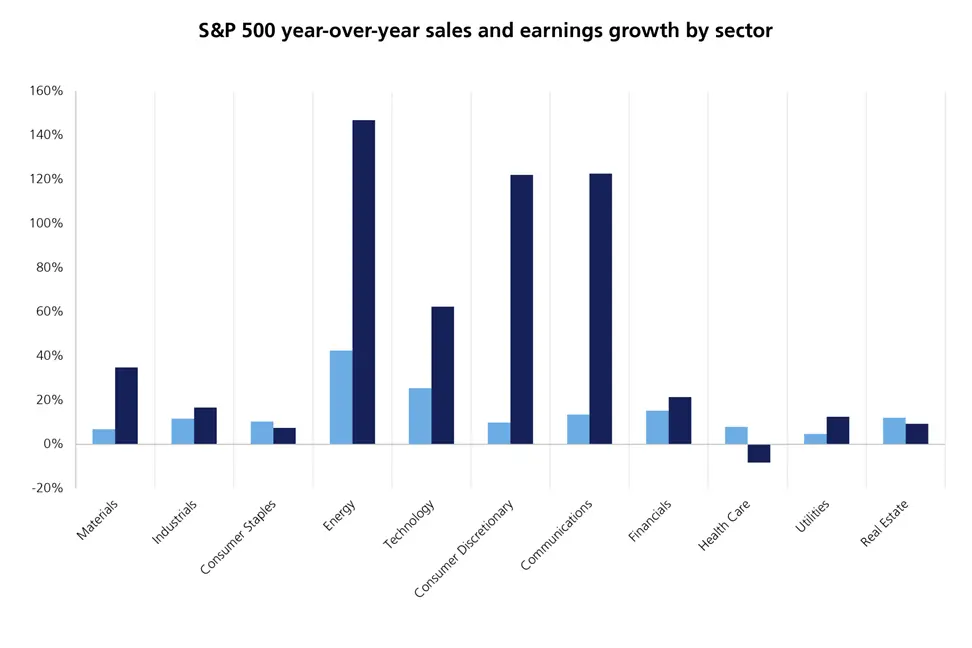
This matters because broad, fundamentally supported profit growth provides a healthier foundation for markets than a rally sustained by only a handful of stocks. It also suggests that the opportunity set for investors may be widening.
One of the clearest drivers is the extraordinary investment taking place in artificial intelligence. In 2022, five of the largest technology companies (Alphabet, Amazon, Apple, Meta, and Microsoft) collectively spent around $170 billion on capital expenditure. ChatGPT was released near the end of that year. Over the latest 12 months, the same companies spent $521 billion, and by the end of this year their annual spending is expected to approach $750 billion, more than four times what they spent in a pre-AI world.
The scale is remarkable, but the more important point for the wider market is where the money goes. AI infrastructure requires advanced semiconductors, data centres, electricity generation and transmission, cooling systems, construction, specialist equipment and financing. Spending by a relatively small number of technology leaders therefore becomes revenue for businesses across several sectors.
Some of this investment will eventually be recognised as depreciation in the technology companies’ income statements rather than as an immediate expense. For now, however, the buildout is creating current demand for suppliers while much of the cost to the buyers is spread over the useful life of the assets. That helps explain why the earnings benefits can appear across the supply chain before the full cost becomes visible in the buyers’ reported profits.
Technology earnings have been strong for some time. What is changing is the reach of the investment cycle: the AI story is increasingly visible not only in the companies developing the technology, but also in those providing the physical and financial infrastructure behind it.
AI spending is only part of the explanation. Companies across sectors have also maintained a firm grip on costs, allowing more of each dollar of revenue to become profit. Some are beginning to use AI tools in their own operations, but conventional cost discipline remains just as important. Stronger margins create capacity to reinvest in the business, reduce debt or return capital to shareholders.
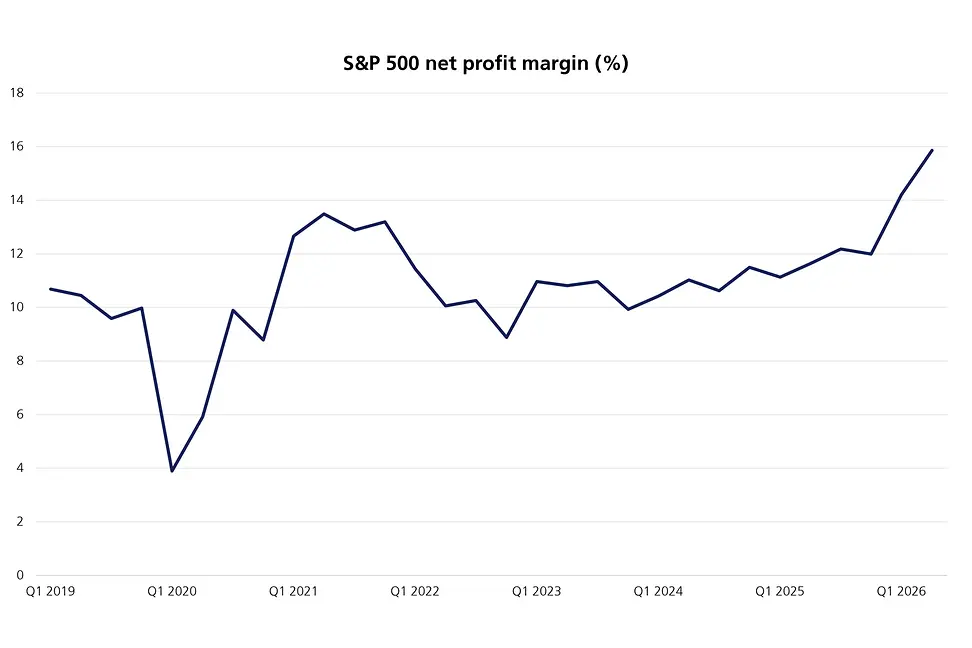
The economic backdrop has also held up better than many expected. Consumer spending and business investment have remained resilient, while several sectors continue to benefit from their own specific tailwinds. Bank of America Chief Executive Brian Moynihan said: “Consumers are demonstrating resilience, as evidenced by increases in average deposit, investment balances, and spending, with consumer credit quality remaining strong and in line with expectations.”
The AI buildout is influencing financial activity as well. S&P Global reported that large debt issues used to fund AI infrastructure supported its Ratings business, where sales rose 16% year on year during the quarter as investment-grade debt issuance increased by 25%. This is another example of spending in one part of the market creating activity elsewhere.
Together, resilient demand, disciplined costs and a major investment cycle are producing a broader mix of earnings growth than the headline focus on mega-cap technology might suggest.
Broader profit growth is good news for diversification. It means opportunities are not necessarily confined to the largest companies that have dominated indices and passive investment returns in recent years. Value-oriented, cyclical and mid-sized businesses, many of which have lagged, may now have firmer fundamental support behind them.
There are early signs that investors are taking notice. Following the launch of ChatGPT in late 2022, the market-capitalisation-weighted S&P 500 outperformed its equal-weight counterpart by 14% in 2023, 13% in 2024 and 12% in 2025. So far in 2026, that pattern has reversed, with the equal-weight index ahead by 1.7%.
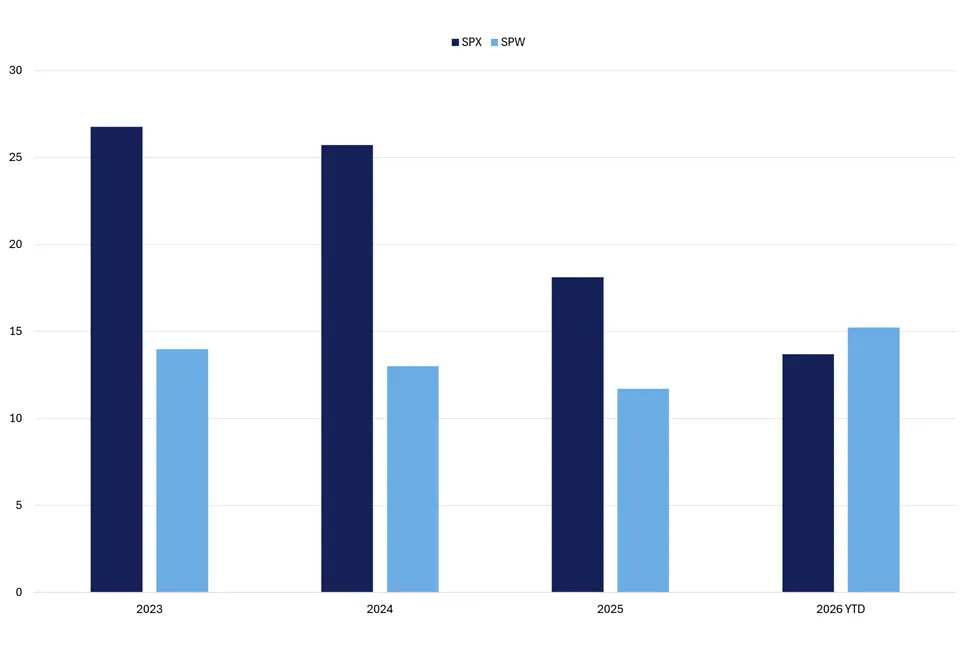
This reversal year-to-date does not necessarily signal a lasting change in market leadership. Nor is this a reason to abandon mega-cap technology companies, many of which remain highly profitable businesses with strong competitive positions. It is instead a sign that investors may have more sources of potential return to consider than they did when market performance was becoming increasingly concentrated and narrow.
Whether the broadening persists will depend on companies continuing to deliver earnings, protect margins and navigate an uncertain economic and geopolitical environment. Valuations, as always, still matter, and strong profit growth does not make every company an attractive investment at every price.
The latest reporting season has revealed more than strong headline growth. It suggests that more parts of corporate America are contributing to it.
The important change is not that mega-cap technology has stopped contributing, but that other parts of the market are increasingly contributing too. AI investment, improving margins and resilient demand are helping more sectors participate. If that breadth continues, it should create a healthier foundation for the market and a wider range of opportunities for patient, selective investors.
This communication is provided for information purposes only. The information presented herein provides a general update on market conditions and is not intended and should not be construed as an offer, invitation, solicitation or recommendation to buy or sell any specific investment or participate in any investment (or other) strategy. The subject of the communication is not a regulated investment. Past performance is not an indication of future performance and the value of investments and the income derived from them may fluctuate and you may not receive back the amount you originally invest. Although this document has been prepared on the basis of information we believe to be reliable, LGT Wealth Management UK LLP gives no representation or warranty in relation to the accuracy or completeness of the information presented herein. The information presented herein does not provide sufficient information on which to make an informed investment decision. No liability is accepted whatsoever by LGT Wealth Management UK LLP, employees and associated companies for any direct or consequential loss arising from this document.
LGT Wealth Management UK LLP is authorised and regulated by the Financial Conduct Authority in the United Kingdom.