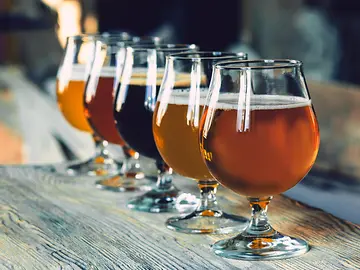

Eighteen months ago, I wrote about the storm brewing in the craft beer industry. Rising costs, squeezed consumers and an over-saturated market left many independent breweries facing an uncertain future. The story since has been mixed: closures have been real and painful, yet at the same time the craft beer world has shown remarkable resilience, reinventing itself through community, creativity and experience.
A sunny afternoon at the Leeds International Beer Festival offered a glimpse of that resilience first-hand. Now in its thirteenth year and firmly part of the city’s cultural calendar, the festival was buzzing, with stalls from Yorkshire favourites such as Amity, Kirkstall, and Horsforth Brewery standing alongside national names like Verdant, Siren and Thornbridge.
There’s no denying that the past 18 months have been hard for the industry. Roughly 100 breweries closed in 2024 – the fastest rate on record.1 Rising ingredient costs, higher energy bills and a cautious consumer made it a tough year. However, while closures are painful, the industry’s ability to reinvent itself is what keeps the narrative from being one of outright decline. Many breweries are now enjoying a second life: some have been bought and reimagined by successful local breweries like Kirkstall, and SALT. Others have reopened as community-led taprooms, funded by locals who want to preserve their town’s social fabric. The result? Far from hollowing out our high streets, craft beer is reshaping them, breathing new life into neighbourhood hubs.
Not all rescues have been grassroots. In 2024, Keystone Brewing Group (formerly Breal Group) embarked on an acquisition spree, snapping up several well-known but struggling independents including Yorkshire’s own Black Sheep Brewery and London’s Brick Brewery.2 Since forming its roll-up vehicle, Keystone has built a portfolio now valued at around £100m and has set an ambition to grow its beer business to £100m turnover by 2028.3,4
The logic is straightforward: by acquiring distressed or under-capitalised breweries and integrating them into a larger, more efficient footprint, the group can reduce redundant cost, centralise sales and distribution and accelerate market reach. As one analyst put it, consolidation allows “scale, broader distribution and survival where going it alone might have meant closure”.5
It may be too early to judge Keystone’s results, but similar strategies abroad suggest the potential: in the US, the CANarchy Collective was rolled up and later sold to Monster Beverage for $330m, delivering a clear exit for its private equity owners,6 while Tilray’s acquisition of several AB InBev craft brands has since helped drive 19% year-on-year growth in its beverage alcohol revenues and achieved $24m of annualised cost savings through the integration and streamlining of its operations.7
For investors, the strategy mirrors patterns seen across other consumer sectors, where scaling from niche to national brings negotiating power, improved margins and a platform for innovation. For drinkers, it means some cherished names live to fight another day. For the industry, it raises familiar questions: can “craft” remain true to its independent ethos when financial survival depends on institutional backers?
If survival in 2024 was about cutting costs, success in 2025 is about innovation. Breweries large and small are pushing the boundaries with new styles. Low- and no-alcohol beers, once a novelty, are now serious parts of brewery line-ups. Indeed, the share of independent brewers offering non-alcoholic options has nearly doubled from 8% to 15% over the past year.8 Health-conscious drinkers and shifting tastes have fuelled this surge, and the UK’s low-alcohol beer market is currently the fastest-growing in the world,9 with sales more than doubling in 2024 and forecast to reach over £1bn by the end of the decade. Key players like Lucky Saint, Big Drop and Adnams are setting the pace in the UK, while global brewers such as Heineken (with 0.0) and AB InBev are investing heavily worldwide.
Heritage styles like bitters and milds are also making a quiet comeback. Brewed with a modern twist to attract a new generation of fans, younger patrons are discovering its freshness and flavour – a hopeful sign for British brewing tradition.
So where does that leave us in late 2025? The pint glass, while not overflowing, is certainly half full. The shake-out of the past 18 months has been tough, but it has left behind a leaner, more resilient industry that knows where its strengths lie: quality, community and experience.
[1] Kyle Phillippi, “The UK Lost 100 Breweries Last Year,” VICE, Feb 21, 2025 - https://www.vice.com/en/article/the-uk-lost-100-breweries-2024/
[2] Ina Verstl – “A private equity roll-up bets on the future of UK craft beer“ Brauwelt International 2024, May 2, 2024 - https://brauwelt.com/en/international-report/europe-russia/646886-a-private-equity-roll-up-bets-on-the-future-of-uk-craft-beer
[3] Just Drinks, “Acquisitive Keystone Brewing Group nears more UK beer M&A,” Jan 2025 - https://www.just-drinks.com/news/acquisitive-keystone-brewing-group-nears-more-uk-beer-ma/
[4] Inside Beer, “Keystone Brewing expands portfolio with North Brewing Co,” Feb 2025 - https://www.inside.beer/news/detail/uk-keystone-brewing-expands-portfolio-with-north-brewing-co
[5] Financial Times, “Britain lost 100 breweries last year as closures outpace openings,” Feb 2025 - https://www.ft.com/content/1c5e7338-5bad-48c0-8d62-421574fd9d9b
[6] Brewbound, “CANarchy to be sold to Monster Beverage Corporation in $330m deal,” Jan 13, 2022 - https://www.brewbound.com/news/canarchy-to-be-sold-to-monster-beverage-corporation-in-330m-deal/
[7] Tilray Brands, “Reports Fourth Quarter and Fiscal 2025 Financial Results,” Jul 28, 2025 - https://www.globenewswire.com/news-release/2025/07/28/3122877/0/en/Tilray-Brands-Reports-Fourth-Quarter-and-Fiscal-2025-Financial-Results.html
[8] Guild of Beer Writers (report by SIBA), Apr 28, 2025 - https://www.beerguild.co.uk/news/heavy-headwinds-threaten-to-blow-independent-breweries-off-course-according-to-new-report
[9] WARC News, “Low-alcohol beer sales in the UK double in a year,” Sep 24, 2024 (via Financial Times and IWSR) - https://www.warc.com/content/feed/low-alcohol-beer-sales-in-the-uk-double-in-a-year/9919
This communication is provided for information purposes only. The information presented herein provides a general update on market conditions and is not intended and should not be construed as an offer, invitation, solicitation or recommendation to buy or sell any specific investment or participate in any investment (or other) strategy. The subject of the communication is not a regulated investment. Past performance is not an indication of future performance and the value of investments and the income derived from them may fluctuate and you may not receive back the amount you originally invest. Although this document has been prepared on the basis of information we believe to be reliable, LGT Wealth Management UK LLP gives no representation or warranty in relation to the accuracy or completeness of the information presented herein. The information presented herein does not provide sufficient information on which to make an informed investment decision. No liability is accepted whatsoever by LGT Wealth Management UK LLP, employees and associated companies for any direct or consequential loss arising from this document.
LGT Wealth Management UK LLP is authorised and regulated by the Financial Conduct Authority in the United Kingdom.