


In an earlier article, we explored the planned changes from April 2027, when unused pension funds will generally be included within an estate for inheritance tax (IHT) purposes. This follow-up article looks at what those changes could mean in practice when someone passes away.
As well as changing the tax position, the new rules are expected to make estate administration more challenging. Personal representatives – the executors or administrators legally responsible for dealing with the estate – will have a central role in gathering information, reporting the position to HMRC and arranging payment of any IHT due in respect of pension death benefits. They may be family members or friends appointed as executors, or professional advisers such as solicitors or tax advisers. Where there is no valid will, administrators are appointed to fulfil this role.
The exact process that personal representatives will need to undertake will depend on the pension arrangements and the circumstances of the estate, but it is likely to follow four key stages. They will:
The personal representatives will first need to notify each pension scheme of the death. The scheme administrator should then provide the value of the pension benefits and confirm the nominated beneficiaries.
In most cases, scheme trustees or administrators will take your beneficiary nominations into account and allocate per your wishes. However, the nomination is at their discretion, and they may request supporting paperwork, so it could take longer for them to reach a decision. This matters because the identity of the beneficiary will determine whether an exemption applies. For example, benefits passing to a surviving spouse or civil partner will normally be exempt from IHT, whereas benefits passing to children or grandchildren may not be.
The personal representatives will combine the value of pension benefits with the other assets in the estate to calculate whether IHT is due and whether an IHT account must be submitted to HMRC. Confirmation of the pension beneficiaries is therefore important to clarify before the position can be finalised.
Where IHT is expected, the personal representatives may ask the pension scheme to retain up to 50% of the pension fund for up to 15 months. This can allow part of the benefits to be paid earlier, while the IHT position is being finalised (these retained funds could then be used to settle the IHT later on). This option will not be available where:
The benefits are IHT-exempt, such as benefits payable to a spouse or civil partner
The total pension fund is less than £1,000
The payment is a continuing annuity
Once the entitlement of each beneficiary has been confirmed, the personal representatives can calculate the IHT attributable to each beneficiary’s pension benefits. They will submit the IHT account to HMRC and inform both the pension scheme and beneficiaries of how much tax is due.
If no IHT is due on the pension benefits — for example, because the estate falls within the available nil-rate band or the benefits are exempt — they can usually be paid without delay. Subject to the death benefit options available within the scheme, drawdown income or a lump sum, the beneficiary can choose how to receive their death benefits without the need to wait for probate.
Where IHT is due, the personal representatives and the pension beneficiaries will both be liable. This is known as joint and several liability, meaning HMRC may seek the full amount from either party. There are several ways the tax can be paid, and the most suitable route will depend on the pension scheme, the wider estate and the beneficiary’s circumstances.
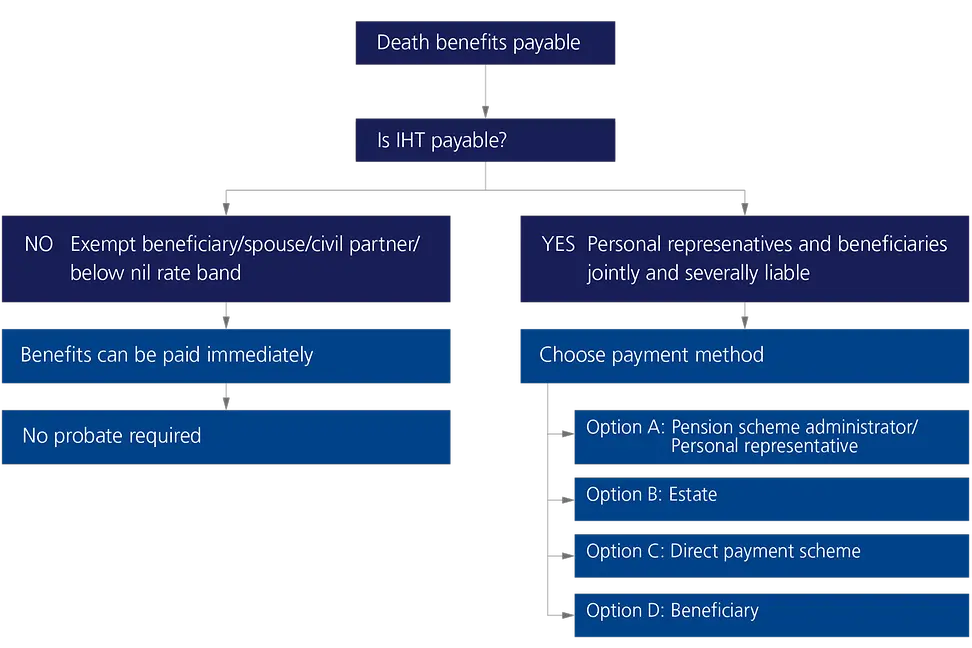
If the pension scheme has retained up to 50% of the pension fund, it can use those funds to pay the IHT directly to HMRC. Any remaining balance can then be paid to the beneficiary.
The personal representatives may instead settle the tax using other estate assets, rather than using the pension itself. This can help avoid delays in applying for probate. If the person receiving the pension benefits is not also inheriting from the estate, the personal representatives can usually reclaim from them the share of IHT linked to their pension benefits. If the person is both a pension and estate beneficiary, the relevant IHT may be deducted from their estate entitlement (rather than pension benefits), where there are sufficient assets to do so.
A beneficiary may ask a UK pension scheme to pay IHT directly to HMRC through the Direct Payment Scheme. In this instance, the tax will be deducted from the pension fund before benefits are paid. If the tax payment exceeds £4,000, schemes will have to accept the payment request. If a payment request is less than £4,000, it would be left to each scheme to decide. This option will not be available for overseas pension schemes.
Alternatively, a beneficiary can pay the IHT themselves, either from their own funds or by withdrawing from the inherited pension. Where these inherited pension benefits will also be subject to income tax, if death occurs after age 75, the IHT paid will generally be taken into account in determining the income tax payable on subsequent withdrawals. This is intended to prevent the same amount being taxed twice, although the detail should be considered in the context of the individual’s circumstances.
The changes reinforce the value of keeping pension and estate planning under regular review. Practical steps may include:
Keeping pension nomination forms up to date so that benefits can be distributed in line with your wishes
Reviewing whether pension pots can be consolidated, which could make administration simpler for personal representatives
Considering whether using pension income during retirement is appropriate for your needs and tax position
Reviewing the timing of any tax-free cash withdrawals
Considering whether a charitable legacy could be made from pension funds, where this supports your wider objectives
From April 2027, unused pension funds will require closer coordination with the rest of an estate. For families and personal representatives, early preparation, including clear nominations, up-to-date records and a considered retirement-income strategy, can make the administration process smoother and help ensure that pension benefits continue to support both retirement and legacy goals.
Pensions will no longer sit outside inheritance tax from spring 2027. Read our previous article which summarises the new rules and what this could mean for long-term wealth transfer and legacy structuring.
This communication is provided for information purposes only. The information presented herein provides a general update on market conditions and is not intended and should not be construed as an offer, invitation, solicitation or recommendation to buy or sell any specific investment or participate in any investment (or other) strategy. The subject of the communication is not a regulated investment. Past performance is not an indication of future performance and the value of investments and the income derived from them may fluctuate and you may not receive back the amount you originally invest. Although this document has been prepared on the basis of information we believe to be reliable, LGT Wealth Management UK LLP gives no representation or warranty in relation to the accuracy or completeness of the information presented herein. The information presented herein does not provide sufficient information on which to make an informed investment decision. No liability is accepted whatsoever by LGT Wealth Management UK LLP, employees and associated companies for any direct or consequential loss arising from this document.
LGT Wealth Management UK LLP is authorised and regulated by the Financial Conduct Authority in the United Kingdom.