


It is often said that the “only free lunch in investing is diversification”.
For the last two decades, investors have held high-quality government bonds to diversify equity exposure. In the decades prior to 2020, these two asset classes moved counter to one another when markets were choppy. Therefore a balanced approach to both helped smoothing investment returns and created the opportunity to sell the asset that had performed well, in order to buy more of the one that had fallen.
Covid and the subsequent inflationary shock in 2022 broke that relationship. Since then, the growing number of shocks and the uncertain pathway for interest rates has continued to put pressure on the typical bond-equity relationship.
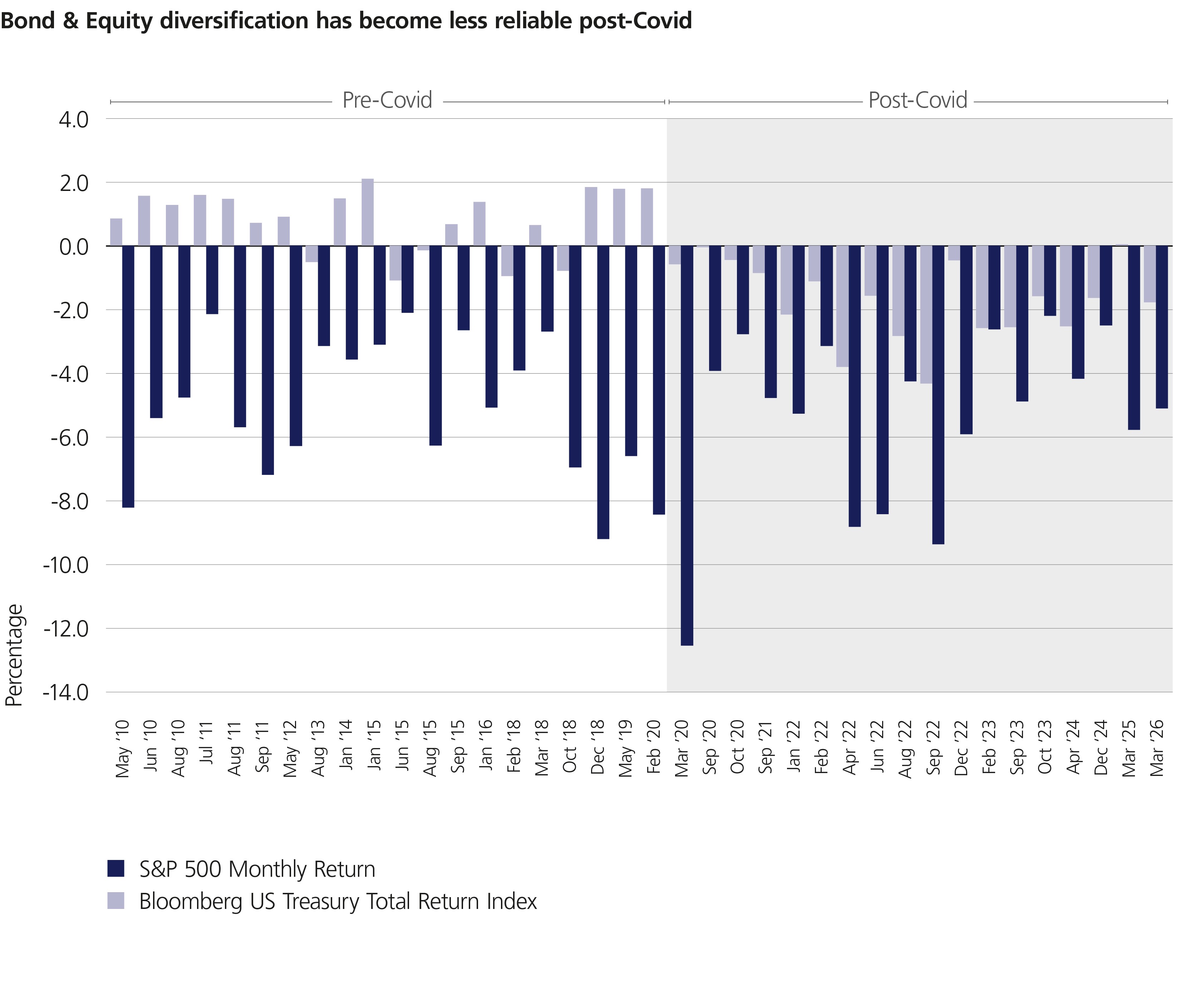
Meanwhile, concerns are rising around equity market valuations, the increased concentration in equity market indices and individual stock volatility is contributing towards the need to look outside of the two traditional asset classes to smooth the investment journey for investors.
Alternatives are a broad basket and comprise a wide-ranging set of different strategies including real assets, gold, commodities as well as a category known as liquid alternatives. Liquid alternatives are typically funds or ETFs that utilise sophisticated, hedge-fund-like investment strategies, with the ability to access capital weekly or even daily. By not just relying on traditional stock or bond market performance to generate returns, liquid alternatives can act as a diversifier, a risk reducer or as a return enhancer.
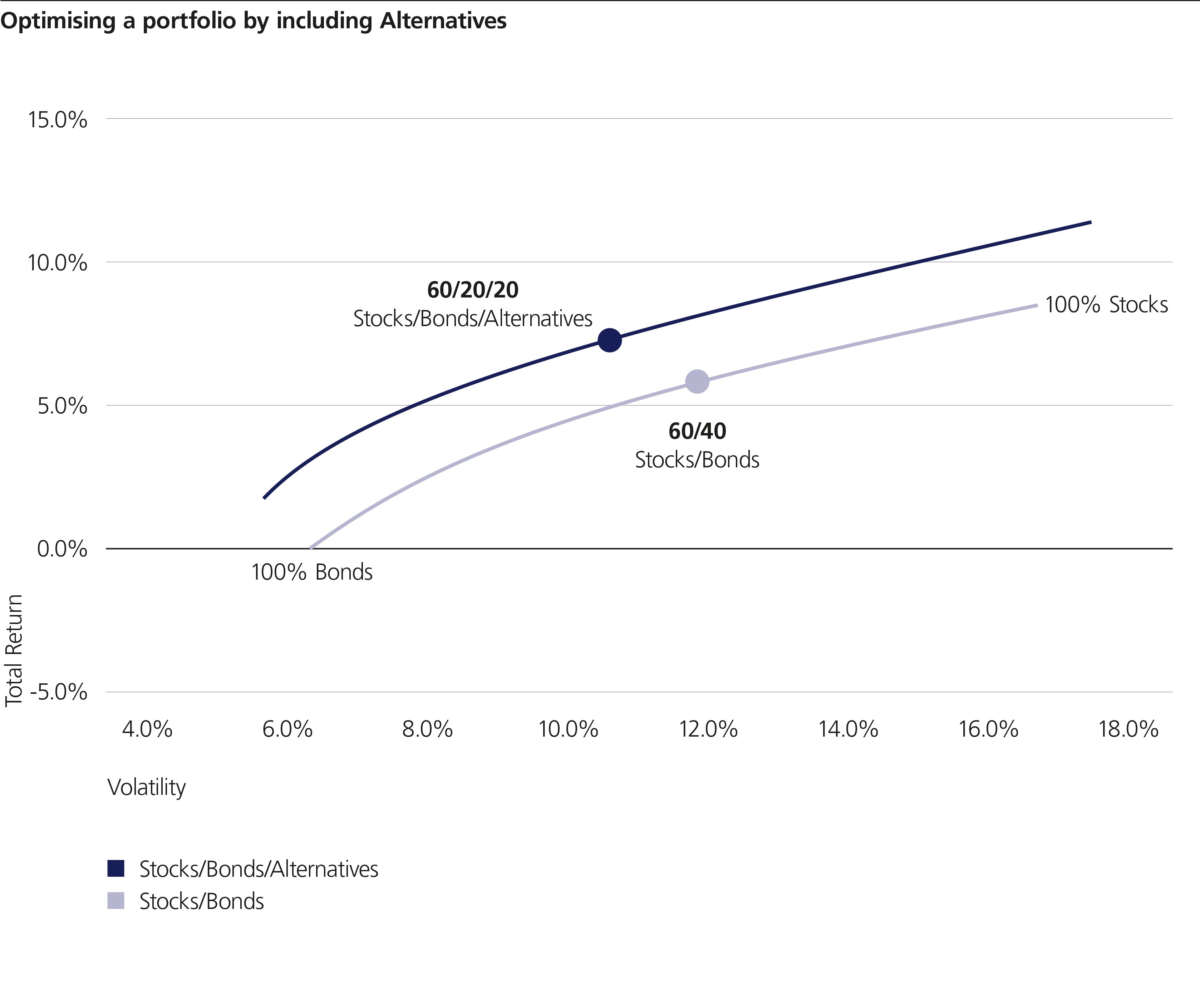
The category is extremely broad, and so some strategies will rely on some kind of market return but broadly speaking the aim is deliver outcomes that are differentiated from conventional markets. Utilising these assets within a portfolio aims to improve risk-adjusted returns, as the below chart illustrates.
A key consideration when investing in liquid alternatives is their additional complexity. Their returns may behave differently from mainstream markets, reflecting the broader range of instruments and strategies they can employ. This makes rigorous due diligence particularly important, including careful assessment of managers’ investment approaches, risk management frameworks and controls.
Alternative strategies can have different, and sometimes higher, fee structures than traditional investments, including management and performance fees, as well as transaction costs. These costs need to be considered in the context of potential net returns. Where performance fees apply, it is also important to assess their structure, including any relevant benchmarks or high-water marks, and whether they are appropriately aligned with investors’ interests.
Some alternative strategies have limited capacity and may not be readily accessible to individual investors. This makes access an important consideration alongside manager research and selection, particularly in areas where specialist expertise is required to assess more complex strategies.
As the investment landscape evolves, so too does the range of tools to investors. While equities and bonds remain important building blocks, alternative strategies can provide additional sources of diversification and return that behave differently across market environments.
We have identified a number of alternative strategies that we believe can complement traditional asset classes and provide additional diversification across different market environments.
As a result, investment approaches may evolve over time in response to changing market conditions and long-term objectives.
This communication is provided for information purposes only. The information presented herein provides a general update on market conditions and is not intended and should not be construed as an offer, invitation, solicitation or recommendation to buy or sell any specific investment or participate in any investment (or other) strategy. The subject of the communication is not a regulated investment. Past performance is not an indication of future performance and the value of investments and the income derived from them may fluctuate and you may not receive back the amount you originally invest. Although this document has been prepared on the basis of information we believe to be reliable, LGT Wealth Management UK LLP gives no representation or warranty in relation to the accuracy or completeness of the information presented herein. The information presented herein does not provide sufficient information on which to make an informed investment decision. No liability is accepted whatsoever by LGT Wealth Management UK LLP, employees and associated companies for any direct or consequential loss arising from this document.
LGT Wealth Management UK LLP is authorised and regulated by the Financial Conduct Authority in the United Kingdom.