
On 11 June, the FIFA World Cup kicked off in a format never seen before. For the first time, three countries share hosting duties, with matches across 16 cities in the United States, Mexico and Canada. The competition has expanded from 32 to 48 teams, and from 64 to 104 matches, a 63% increase on Qatar 2022. By every commercial measure, it will be the largest sporting event ever staged.
Past World Cups placed the full weight of hosting on a single country, often requiring substantial new construction with mixed legacy outcomes. The 2026 tournament takes a different approach. All 16 stadiums are already built and operational, from the historic Estadio Azteca in Mexico City to SoFi Stadium in Los Angeles. Infrastructure costs are spread, operational risks are diversified across three governments and each host captures meaningful tourism and commercial activity. Nothing of this scale has been attempted in the tournament's 96-year history.
FIFA's revenue for the 2023-2026 cycle is projected to reach approximately $13 billion, a 73% increase on the $7.5 billion generated in the 2019-2022 cycle.1 Broadcast rights, sold across more than 200 territories, account for roughly $4 billion, with sponsorship contributing a further $2.5 to $2.8 billion. All 16 of FIFA's global sponsorship positions sold out by March 2026.
Hospitality and ticketing tell the same story. Combined revenue is expected to reach approximately $3 billion, up from $950 million at Qatar 2022, with over 500 million ticket requests for just 7 million tickets. The most valuable commercial positions sit within the transaction itself, however. As the tournament’s payments sponsor, Visa secured exclusive access to first-round ticket sales, collecting a fee on every transaction, while also having the opportunity to collect valuable customer data from each transaction.
| Key tournament metrics, side by side | Qatar 2022 | 2026 |
| Host Countries | 1 | 3 |
| Host Cities | 5 | 16 |
| Participating Teams | 32 | 48 |
| Total Matches | 64 | 104 |
| Maximum Venue Distance | 34 Miles | C. 3,000 Miles |
| Hospitality & Ticketing Revenue | $0.95bn | C. $3.0bn |
| FIFA Tournament Cycle Revenue | $7.5bn | c. $13bn |
Sources: FIFA published budget 2023-26 cycle; The Guardian
The expansion to 48 teams is best understood as a market-development strategy. Sixteen additional nations now reach the sport's biggest stage, and several, including Jordan, Uzbekistan, Cape Verde and Curaçao, qualified for the first time. Each debut brings a new national audience into the tournament's commercial ecosystem, from broadcast rights to sponsorship activation, in markets where engagement was previously limited.
The bigger strategic prize is the host market itself. Football remains under-penetrated in the United States relative to its established sports, yet the US is the world's largest sports and media market.2 Staging 78 of 104 matches there, with a substantial Latino audience already engaged, is a deliberate attempt to convert the world's deepest pool of consumer spending into football's long-term growth engine.
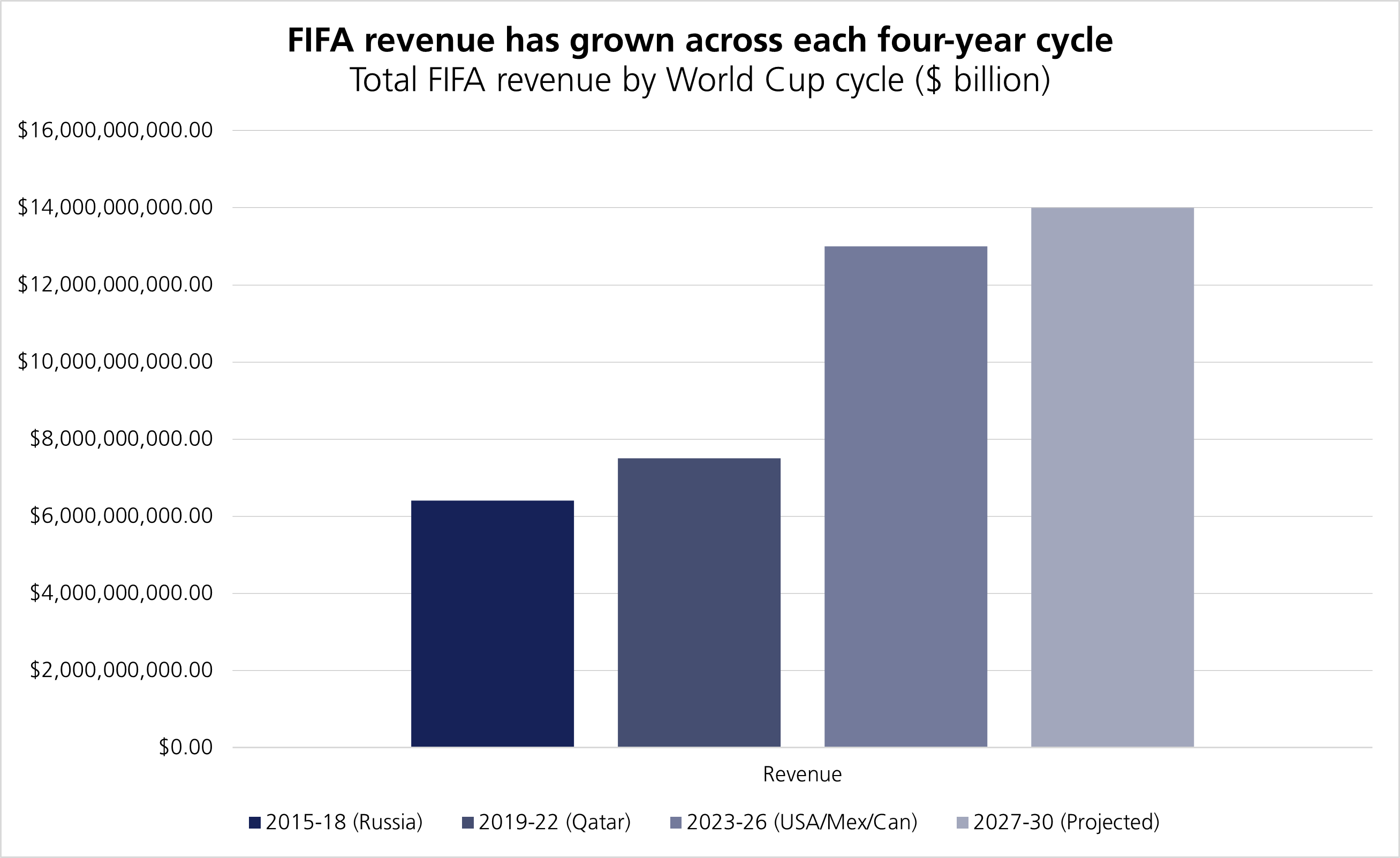
The 2023-26 cycle is set to deliver FIFA’s largest-ever revenue uplift, driven by an expanded format, the North American media market and record sponsorship and hospitality inventory.
The shared-host model is, in part, a sustainability decision. Using 16 existing stadiums, the tournament avoids the construction footprint and "white elephant" legacy that followed several previous hosts, where purpose-built venues fell into disuse.
However the picture is not one-sided. Scientists for Global Responsibility estimates the event will generate over 9 million tonnes of CO2 equivalent, approximately 85% from air travel between far-flung host cities, against Qatar 2022's eight stadiums within 34 miles.3 FIFA's mitigation, on the other hand, has focused on venue-level measures such as hybrid grass and waste diversion. There are social questions too: US lawmakers have criticised dynamic ticket pricing as financially exclusionary.
For Environmental, Social and Governance (ESG)-conscious investors, the tournament is a live case study in how mega-events are internalising these pressures, and a signal that future formats may be shaped by sustainability alongside commercial logic.
With an expanded format, multi-nation hosting model and unprecedented reach across media, sponsorship and hospitality, the 2026 World Cup is not only the biggest tournament football has staged – it demonstrates how mega-sporting events now sit at the intersection of consumer spending, infrastructure and commercial investment opportunities.
That scale has implications beyond the tournament itself. Host nations have historically averaged a 0.4 percentage point GDP growth lift the following year, while Bank of America Global Research estimates the tournament could generate around $41 billion in global GDP impact, support over 800,000 jobs and reach up to 6 billion viewers.4 In that sense, the World Cup not only offers a meaningful short-term boost through tourism, jobs and GDP; it also reinforces North America’s position in the long-term growth of football as a commercial market.
More broadly, it underlines the continued expansion of the global sports industry. Having generated approximately $2.3 trillion in 2025 and projected to reach $3.7 trillion by 2030,5 the sector’s growth may create a larger and more diversified opportunity set for investors exposed to businesses linked to live sport – although investors should remain aware that industry growth alone does not guarantee positive investment returns.
For investors, the 2026 World Cup is a new model tested at unprecedented scale. The more interesting question is not whether the tournament delivers, but which parts of the value chain stand to benefit most. From broadcasters and payment networks to hospitality providers and consumer brands built around shared cultural moments, it’s a reminder that some of the most compelling returns may sit beyond the pitch.
[1] https://gis.sport/news/the-size-of-us-sport-a-1-trillion-industry/
[3] https://www.sgr.org.uk/resources/2026-fifa-men-s-world-cup-be-most-polluting-ever
[5] https://www.weforum.org/stories/2026/01/what-is-the-sports-economy-improve-health-livelihoods/
This communication is provided for information purposes only. The information presented herein provides a general update on market conditions and is not intended and should not be construed as an offer, invitation, solicitation or recommendation to buy or sell any specific investment or participate in any investment (or other) strategy. The subject of the communication is not a regulated investment. Past performance is not an indication of future performance and the value of investments and the income derived from them may fluctuate and you may not receive back the amount you originally invest. Although this document has been prepared on the basis of information we believe to be reliable, LGT Wealth Management UK LLP gives no representation or warranty in relation to the accuracy or completeness of the information presented herein. The information presented herein does not provide sufficient information on which to make an informed investment decision. No liability is accepted whatsoever by LGT Wealth Management UK LLP, employees and associated companies for any direct or consequential loss arising from this document.
LGT Wealth Management UK LLP is authorised and regulated by the Financial Conduct Authority in the United Kingdom.