

In 2025, the UK recorded a mean temperature of 10.09°C, the warmest in a series running back to 1884. This was accompanied by 1,648.5 hours of sunshine, the most since records of that measure began in 1910.1 In the same twelve months, English and Welsh growers harvested the equivalent of 16.5 million wine bottles, the second largest harvest the country has produced.2
The two records are closely connected, and the relationship between them goes a long way towards explaining why a country better known for its rainfall now supports an established wine industry – one that has begun to attract serious international capital.
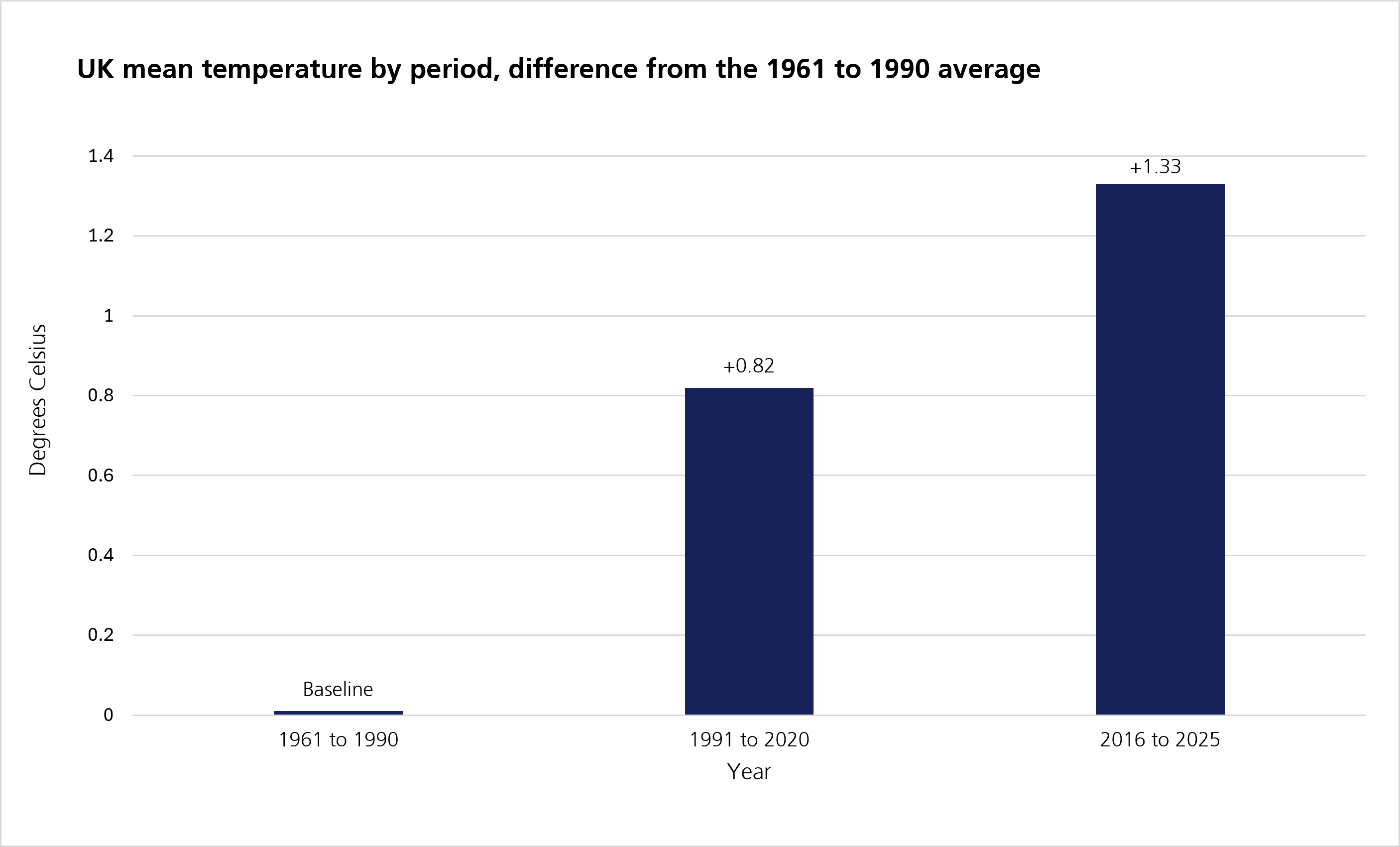
The warmth of 2025 was not an isolated season. The Met Office's annual review of the UK climate, published in July, found that the decade from 2016 to 2025 was 1.33°C warmer than the period from 1961 to 1990. Warming has run at roughly a quarter of a degree per decade since the 1980s, with the last four years all sitting among the five warmest on record.1
The analysis that accompanies those averages is in some ways more striking than the averages themselves. Met Office scientists calculate that human-induced climate change made the record annual temperature of 2025 around 260 times more likely, and that a summer of comparable warmth would have been expected roughly once every 340 years in a climate without industrial emissions, where the current expectation is closer to one year in five.1
For a grower, these are not abstractions but the difference between fruit that ripens reliably and fruit that does not. So-called growing degree days, which viticulturists use to measure the cumulative heat a vineyard receives during the growing season, came in above the five-year average in 2025. The average potential alcohol, a measure of the sugar in grapes and therefore their capacity to produce alcohol during fermentation, also rose by a full percentage point on the previous year.2 The pattern has continued into this year, with summer 2026 provisionally warmer still at a UK mean of 16.5°C, breaking a record that had been set only twelve months earlier.3 Its effects are already visible in the vineyards at the time of writing, with one English winery having begun picking on 14 September, the earliest date since it planted its first vines in 1988, and several other producers reporting the earliest harvests they have recorded.4
Conditions of this kind, sustained over two decades, have supported an expansion that would have seemed improbable when the first modern plantings went into the ground.
| England and Wales, then and now | 2017 | 2025 |
| Hectares under vine | c. 2,500 | 4,841 |
| Registered vineyards | c. 700 | Over 1,100 |
| Wineries | c. 165 | c. 280 |
| Bottles produced | 5.3 million | 16.5 million |
| Full-time employment | under 1,000 | c. 3,500 |
Sources: WineGB; ICAEW industry profile 2026
The sector now employs around ten thousand people once seasonal work is counted, and WineGB notes that wine supports more jobs per hectare than any other agricultural sector in the country.5 Wine tourism has grown alongside it, increasing by more than half since 2022 to roughly 1.5 million visits a year. Producers have responded with substantial hospitality options, including vineyard tours, tastings and visitor facilities. Balfour, at the Hush Heath Estate in Kent, now runs tours and tastings across a 400-acre estate of vineyards, orchards and ancient woodland, and has since extended into London with a tasting venue of its own.6 Growth on that scale, in a category with genuine international standing, has not gone unnoticed abroad.
Champagne houses were among the earliest international investors. In 2015, Taittinger became the first grande marque to commit, acquiring 69 hectares of former orchards near Chilham in Kent. The attraction was chalk, the same geological seam that runs beneath Champagne in France and resurfaces on the English side of the Channel. A decade after the initial investment, its first bottle went on sale in March 2025. Another champagne house, Vranken-Pommery, has also been producing wine in Hampshire for a similar period.6
More recent investment tells a broader story: international interest is no longer confined to champagne houses or to chalk-based sites. In 2023, Jackson Family Wines, among the largest family-owned wine companies in the world, invested in Essex, and has since released an inaugural 2024 Pinot Noir through its English label, Marbury.6 Domaine Duroché, a highly regarded Burgundy estate, has announced a joint venture with English grower, Danbury Ridge, while Alex Moreau of Chassagne-Montrachet now buys Chardonnay from the Crouch Valley and ships François Frères barrels to a new winery beside London City Airport, returning every few weeks to check on its progress.6
Essex is just one example of the diverse regions now contributing to English wine production. In and around the Crouch Valley, for example, the Rivers Crouch and Blackwater help moderate the climate, while London clay can retain water through dry spells more effectively than lighter soils. As England’s warmest and driest county, Essex also offers favourable conditions for reliably ripening grapes and for the production of still wine.
The consequence is visible in the national production mix. Still wine, long treated here as a consolation for a disappointing sparkling year, accounted for around 31% of output in 2024, having come from a category that barely registered a decade earlier.7 That shift, more than any single investment, is what has changed the character of the industry.
For all that, the sector remains young, and its commercial record is correspondingly short. Chapel Down, England's largest producer and the sector’s only publicly listed company, offers some sense of the commercial trajectory, having reported a 19% rise in net sales revenue for 2025 and a 25% rise in earnings, followed by a further 19% increase in the first half of 2026. International sales grew by 66%, although from a base still representing under 5% of the business.8 Strutt & Parker has estimated that the sector attracted in the region of £570 million of investment over the past decade.9
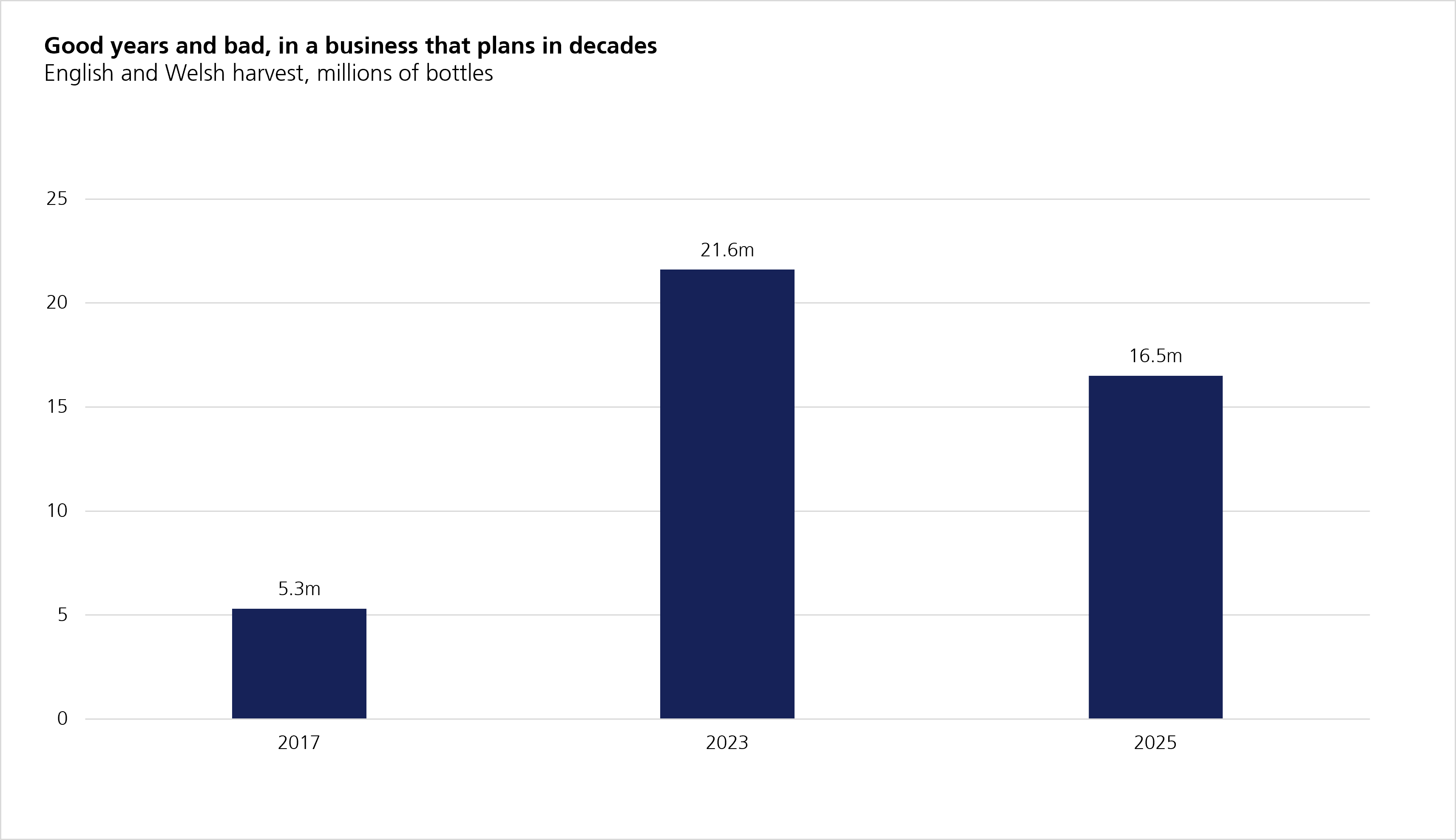
Set against that backdrop, output across England and Wales continues to vary dramatically, from 21.6 million bottles in the record year of 2023 to a poor crop in 2024, before recovering by 39% to 16.5 million bottles in 2025.5 Even in a season as warm as 2026, late-spring frosts are expected to leave the crop slightly below normal. Warmer conditions can bring budburst – the emergence of new vine shoots – forward, leaving these vulnerable to subsequent frost and reducing yields, a reminder that a longer growing season brings exposure as well as opportunity.4 The volumes produced in that record 2023 vintage have also still not fully cleared the market, suggesting that supply may, for now, be ahead of demand.7
The industry has been unusually deliberate about the environmental side of its growth. Sustainable Wines of Great Britain, launched in 2020, certifies producers across carbon emissions, soil health, biodiversity, water use and packaging, and had 37 certified producers as of June 2026.5
There is nonetheless an uncomfortable symmetry that is difficult to set aside. The same European heat that has delivered England a potential vintage year has pushed ground temperatures in Bordeaux towards 50°C, with yield reductions estimated at 20% or more, and has brought the Burgundy harvest forward to around 20 August against a traditional start in early to mid-September.10 What appears here as good fortune is better understood as one local consequence of a global change that is, taken as a whole, doing considerably more harm than good.
Climate change, together with the Great British weather, will continue to make this an unpredictable business. The swings in recent harvests are a reminder that a longer growing season alters the shape of the risk rather than removing it, which is true of most emerging industries.
What is clearer is that English wine has already moved beyond its experimental phase, becoming a more diverse industry with a clearer sense of its regional strengths and a growing place in the international wine conversation. New plantings, and international participation are broadening the industry beyond its earlier heartlands. The next two decades will show how successfully producers convert those favourable conditions into enduring brands, markets and regional identities.
Whether English wine eventually reaches the global scale or the standing of the established French and Italian regions is not a question this decade will answer. The vines going into the ground this autumn will still be producing in the 2050s, and those planting them are building for the long term.
This communication is provided for information purposes only. The information presented herein provides a general update on market conditions and is not intended and should not be construed as an offer, invitation, solicitation or recommendation to buy or sell any specific investment or participate in any investment (or other) strategy. The subject of the communication is not a regulated investment. Past performance is not an indication of future performance and the value of investments and the income derived from them may fluctuate and you may not receive back the amount you originally invest. Although this document has been prepared on the basis of information we believe to be reliable, LGT Wealth Management UK LLP gives no representation or warranty in relation to the accuracy or completeness of the information presented herein. The information presented herein does not provide sufficient information on which to make an informed investment decision. No liability is accepted whatsoever by LGT Wealth Management UK LLP, employees and associated companies for any direct or consequential loss arising from this document.
LGT Wealth Management UK LLP is authorised and regulated by the Financial Conduct Authority in the United Kingdom.