

On 12 September, OpenAI CEO and co-founder Sam Altman said the company would not pursue a stock market listing this year, describing the current moment as ill-advised given the safety work still required.1 Shares across the AI supply chain fell sharply on 14 September, even though none of the largest technology companies had reduced their spending plans.2 The reaction underscored how sensitive equity markets have become to news around a single theme.
For investors, that sensitivity matters because it is no longer confined to technology funds. Anyone holding a global index tracker now has a large and growing exposure to a small group of companies whose share prices move with AI expectations. We looked at how these companies are raising the capital to fund their expansion in an earlier article.
In this article, we will discuss how concentrated global indices have become, why the scale of AI investment brings risks as well as opportunities, and why the FTSE 100 stands out as a way to broaden equity exposure.
The largest global indices are weighted by the market value of the companies they track, so as the biggest companies have grown, so too has their share of the index. According to MSCI, US companies now account for more than 63% of the MSCI All Country World Index, up from around 45% in 2011, driven largely by the rise of a handful of technology stocks.3 Within the US market, chipmaker Nvidia and Apple together account for close to 15% of the MSCI USA Index, more than the combined weight of its energy, utilities, materials and real estate sectors.4
Most of these companies are building AI infrastructure, supplying it, or relying on it for future growth. Consequently, an investor who believes they own a broad spread of the world's companies may in reality be making a significant bet on a single theme.
The pattern is not confined to the US. Taiwan Semiconductor Manufacturing Company, which produces the majority of the world's most advanced chips, including those designed by Nvidia, now accounts for more than 58% of the MSCI Taiwan Index and has become the largest single stock in the MSCI Emerging Markets Index.5 This concentration to a handful of AI-linked businesses is therefore a global phenomenon, not solely an American one.
The largest US technology companies are expected to spend around $697 billion on capital investment this year, much of it on data centres and chips, an increase of $173 billion on expectations at the start of the year.6 That spending has supported the earnings of chipmakers, hardware manufacturers and power companies, and a large share of recent equity market gains has come from these businesses.
However, it remains too early to judge whether this investment will generate commensurate returns. Companies need customers to pay enough for AI services to justify hundreds of billions of dollars of spending, and some are increasingly relying on borrowing to fund it. Investors have already begun to distinguish between companies that can show a clear link between spending and revenue, and those that cannot. Should enthusiasm fade more broadly, the companies that have led markets higher could also lead them lower, and because of their size, the effect on global indices would be considerable.7
Diversification is often thought of in terms of the number of holdings. Yet owning shares in 100 companies offers less protection than it appears if the largest holdings respond to the same news in the same way. What matters is whether the businesses in a portfolio are driven by different factors, so that when one part of the portfolio struggles, another may hold up.
In practice, this means looking beneath the headline index at the sectors and economic forces that drive its returns. Our own screening of the major equity indices, carried out to identify markets whose performance depends less on the AI theme, has consistently highlighted the FTSE 100.
The composition of the FTSE 100 differs sharply from its global counterparts. Financial companies, including banks and insurers, account for around 26% of its value, and consumer staples such as food, drink and household goods make up a further 15%.8 Banks, health care, industrial companies and energy together account for more than half of the index, alongside major mining businesses, while technology companies represent only a small share.9 Its returns are therefore shaped more by commodity prices, interest rates and global economic growth than by AI expectations.
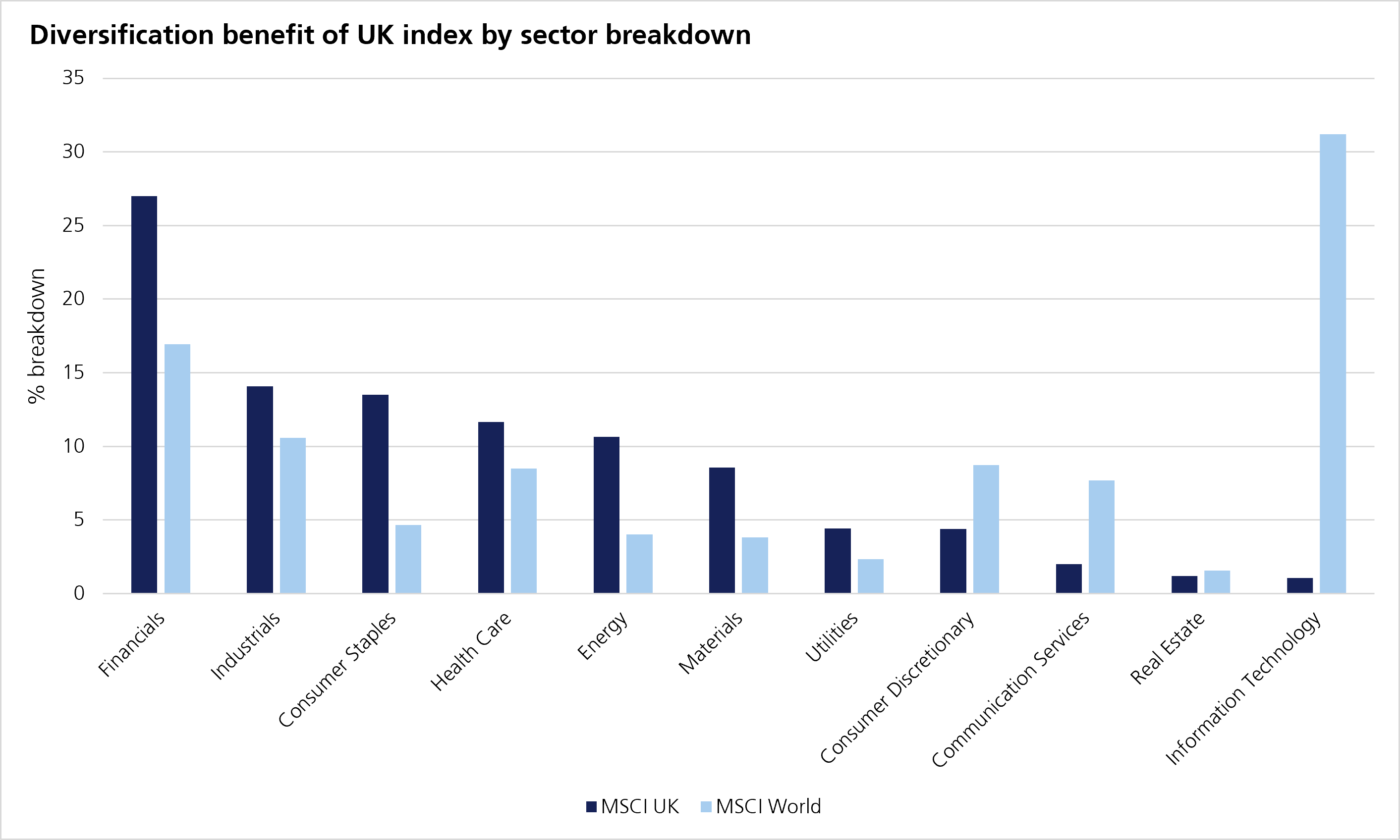
The index is not entirely insulated from the AI theme. Miners that produce copper and utilities that operate power networks stand to benefit from the construction of data centres, meanwhile some data and software businesses have been affected by concerns that AI could disrupt their business models. Nevertheless, the index’s exposure to the theme is considerably smaller and less direct.
The FTSE 100 is also cheaper, trading on around 13 times forward earnings against 21 times for the S&P 500.10,11 FTSE 100 companies are also forecast to pay a record £88 billion in dividends this year.12 That combination has already attracted investors and in 2025, the index outperformed the S&P 500 for the first time in almost a decade.12
This is not an argument for abandoning technology exposure altogether. The companies at the centre of the AI boom are among the most profitable in the world, and the technology may yet grow into the valuations markets have already priced in. However, their weight in global indices means that many investors hold more exposure to a single theme than they may realise.
On balance, we believe the more prudent approach for some investors is to complement global equity holdings with markets driven by different factors, rather than relying on the headline index alone. The FTSE 100, with its emphasis on financials, energy and materials, is one such market. For investors with a longer-term horizon, a portfolio that does not depend on the success of a single theme is better placed to withstand the volatility that is likely to accompany it.
LGT Wealth Management is not in any way connected to, sponsored, endorsed, sold or promoted by the London Stock Exchange Group plc and its group undertakings (collectively, the "LSE Group"). FTSE® is a trade mark of the relevant LSE Group company and is used under license. The LSE Group does not accept any liability to any person arising out of the use of or error in the Index.
This communication is provided for information purposes only. The information presented herein provides a general update on market conditions and is not intended and should not be construed as an offer, invitation, solicitation or recommendation to buy or sell any specific investment or participate in any investment (or other) strategy. The subject of the communication is not a regulated investment. Past performance is not an indication of future performance and the value of investments and the income derived from them may fluctuate and you may not receive back the amount you originally invest. Although this document has been prepared on the basis of information we believe to be reliable, LGT Wealth Management UK LLP gives no representation or warranty in relation to the accuracy or completeness of the information presented herein. The information presented herein does not provide sufficient information on which to make an informed investment decision. No liability is accepted whatsoever by LGT Wealth Management UK LLP, employees and associated companies for any direct or consequential loss arising from this document.
LGT Wealth Management UK LLP is authorised and regulated by the Financial Conduct Authority in the United Kingdom.