
Charity trustees are custodians of an organisation’s values, assets, and future impact. As financial landscapes and governance expectations evolve, charities increasingly face challenging investment decisions to generate sustainable income, safeguard reserves, and ultimately deliver on their missions. For trustees, many of whom may be serving for the first time, the complexity and perceived risk of investment can prompt uncertainty or cautiousness. Building the board’s confidence is essential if charities are to make sound investments that deliver both social and financial returns.
At the heart of charity governance are trustees who make pivotal decisions on behalf of beneficiaries. Trustees often come from diverse backgrounds, some with deep professional experience, others motivated by personal connections to the cause. New trustees must quickly grasp their legal duties, financial responsibilities, and the principles of strong governance, whilst this can be daunting, the information below conveys how to build confidence, connections and how Investment managers and organisations can assist with this.
Investment decisions often raise the concerns; will the investment risk the charity’s core assets? does it align with our mission and values? is there a sufficient understanding and oversight among board members? These are legitimate questions, particularly in an environment where every pound entrusted to a charity is precious and accountability is paramount.
Trustees who possess financial, legal, or strategic acumen can enhance the board’s ability to assess opportunities and risks. However, not all charities have ready access to such resources. Where knowledge and experience are still maturing and in need of some navigation, there are three main points we believe can be a North Star in building a foundation and confidence.
Investments should not only be financially sound, they must also align with the charity’s mission. The concept of Creating Legacies Through Philanthropy reminds us that every decision should be guided by values, long-term vision, and impact.
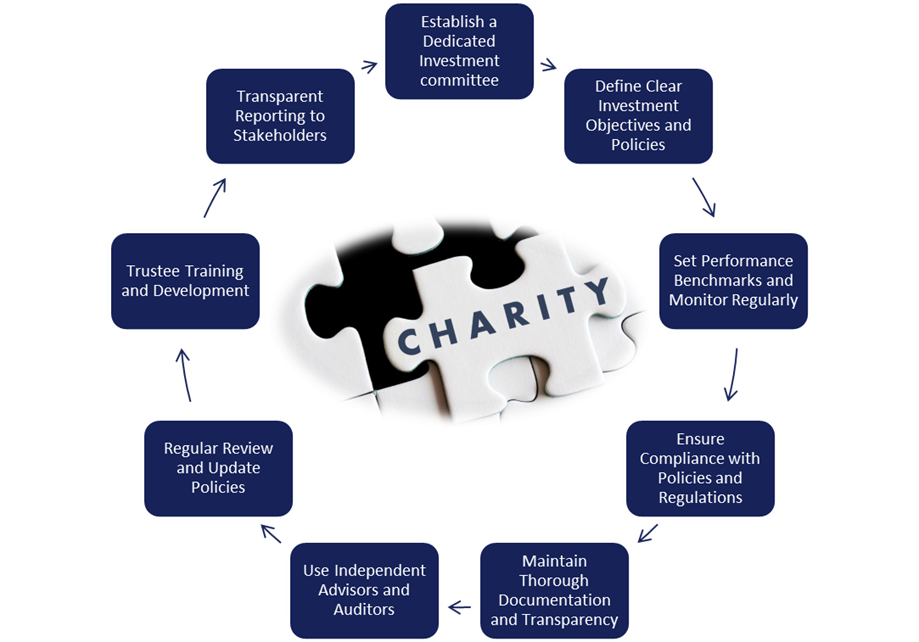
Establishing a clear investment policy allows a Charity to document the ethical guidelines and investment criteria, defining what is and is not acceptable (e.g. exclusions on certain industries, weighting impact investments). By assessing social and financial outcomes, Charities can further consider how investment choices advance your mission in addition to generating returns and communicate these connections openly with the board.
To build confidence, and a strong working relationship, board members and directors need to prioritise collaboration with transparent decisions and actions. Effective boards function through collective decision-making. Trustees should never feel rushed or pressured into agreements; rather, boards should adopt a deliberate, collaborative approach to investment options.
Decision-making frameworks and risk assessments shared openly can empower all trustees to contribute with confidence.
Charity investment is rarely a “set and forget” process they are often perpetual. As markets fluctuate and the charity’s needs evolve, boards must stay informed and adaptable. Encourage ongoing education, such as attendance at sector conferences or webinars. Peer networking can also help trustees learn from the experiences of other organisations. Additionally, create a safe environment for trustees to admit gaps in understanding or uncertainties. A culture of continuous learning fosters board maturity and confidence, which translates into better investment decisions and improved outcomes for the charity.
Strong investment decisions can be transformative for charities, securing financial stability and empowering greater impact. Trustees, whether seasoned or new to the sector, need knowledge, skills, and assurance that their choices reflect both fiduciary duty and their institution's enduring values. By investing in trustee development, encouraging open debate, aligning decisions with mission, and fostering collective responsibility, charity leaders ensure that trustees not only back investment strategies but champion them confidently, competently, and in service to those who matter most.
This communication is provided for information purposes only. The information presented herein provides a general update on market conditions and is not intended and should not be construed as an offer, invitation, solicitation or recommendation to buy or sell any specific investment or participate in any investment (or other) strategy. The subject of the communication is not a regulated investment. Past performance is not an indication of future performance and the value of investments and the income derived from them may fluctuate and you may not receive back the amount you originally invest. Although this document has been prepared on the basis of information we believe to be reliable, LGT Wealth Management UK LLP gives no representation or warranty in relation to the accuracy or completeness of the information presented herein. The information presented herein does not provide sufficient information on which to make an informed investment decision. No liability is accepted whatsoever by LGT Wealth Management UK LLP, employees and associated companies for any direct or consequential loss arising from this document.
LGT Wealth Management UK LLP is authorised and regulated by the Financial Conduct Authority in the United Kingdom.