

Government bond yields rose to multi-decade highs during the third quarter as higher energy prices increased concerns about inflation, while technology shares helped US equities remain close to record levels.
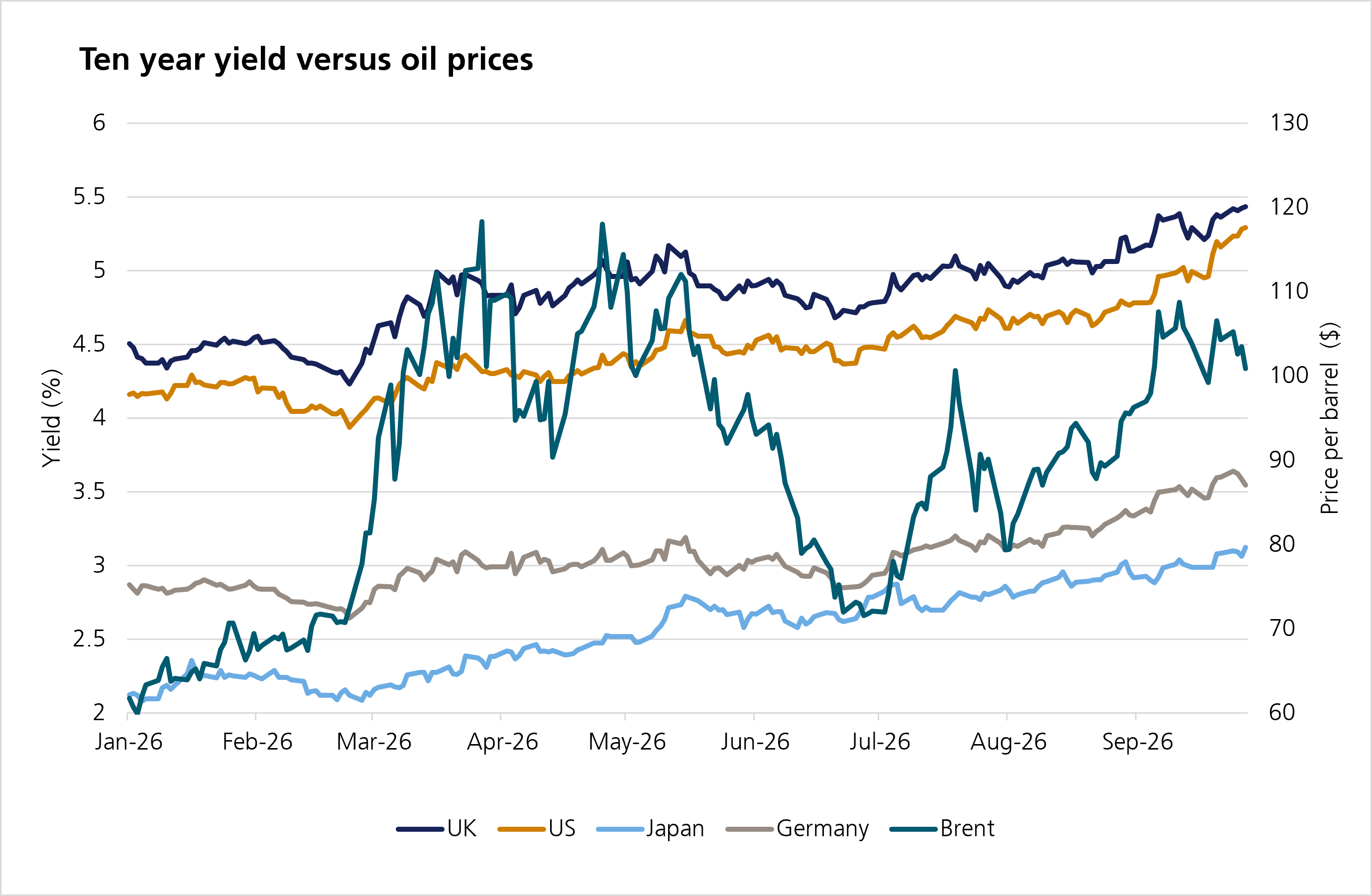
Rising oil prices heightened concerns that inflation would stay higher for longer, leading global central banks to raise rates, resulting in a sell-off in government bonds. The 30-year US Treasury yield ended the quarter at 5.63%, its highest in more than two decades.1 Brent crude ended the quarter at $104 a barrel, up 42%, after the June US–Iran interim accord failed to unblock shipping lanes.2
Despite higher yields, the Nasdaq reached a record close on 22 September before easing towards the end of the quarter.1 This raised questions about whether earnings linked to AI could continue to support equity valuations as borrowing costs increased and central banks maintained tighter monetary policy.
Despite earnings and technology driving the S&P to new highs, concerns surrounding bond yields meant the European, UK and Japanese markets lagged. The US 10-year Treasury yield rose 0.82% over the quarter to 5.28%, its highest close since 2007, and Germany’s 10-year yield rose 0.73% to 3.58%.2 Japan’s 10-year yield ended the quarter at 3.1%, around its highest since 1996.1
US Treasury Secretary Scott Bessent tried to steady bond markets over the quarter by announcing his intent to at least double the size of its buybacks of longer-dated bonds. This, however only provided temporary relief, with yields climbing to fresh highs in September.1 Over $200bn of borrowing by US hyperscalers also put pressure on bonds as heavy issuance put further pressure on yields.
In the UK, 30-year gilt yields ended the quarter at 5.95%, having reached their highest level since 1998 in mid-September.1 Andy Burnham became prime minister in July and appointed John Healey as chancellor. Both have committed to keeping the existing fiscal rules, but higher borrowing costs have eroded the government’s room for manoeuvre. The Budget on 28 October will be their first real test with bond investors.4
Equity-market performance was mixed. The S&P 500 returned 2.3% and the Nasdaq 2.6%, supported by resilient growth, robust earnings and enthusiasm for AI.2 Europe’s STOXX 600 reached a record in August but declined 0.6% over the quarter, as the energy shock and firmer central banks weighed on sentiment.2 The FTSE 100 returned 1.8%, its seventh consecutive quarterly gain, with its smaller technology weighting cushioning it during a July sell-off in chip stocks.2, 1 Japan’s TOPIX returned 3.8%, although it slipped in September, its first monthly fall in six months, as rising government-bond yields weighed.1, 5 Hong Kong’s Hang Seng returned 8.6%, with the whole gain coming in July.2 The Shanghai Composite fell 5.3%, as weak domestic demand persisted.2, 6
Hopes that the June US-Iran interim accord would reopen the Strait of Hormuz faded over the summer. The US withdrew an Iranian oil-sales licence in July, and by August fewer than ten vessels a day were crossing. With supply constrained, Brent rose 24% in July and a further 14% in September as both sides resumed strikes.2 At the United Nations, Iran offered to reopen the strait within seven days on conditions that President Donald Trump rejected. Contacts through mediators continued, but no new agreement had been reached by the end of September.8 Brent futures for delivery in December 2027 rose 16% to $81, their highest to date, suggesting investors expect prices to stay high for some time.2
European gas futures rose 67% over the quarter, although prices remained far below their 2022 crisis levels, and the European Central Bank judged this shock smaller than in 2021-22.2, 9 In the UK, Ofgem's price cap rose 4% from 1 October, leaving typical household bills about half their 2022 peak.10 Gold rose 3.7% over the quarter despite a September setback. A weaker dollar, inflows into gold funds and central-bank buying lifted it 9.7% in August, but higher bond yields and a stronger dollar pulled it down 6.3% in September.2, 11
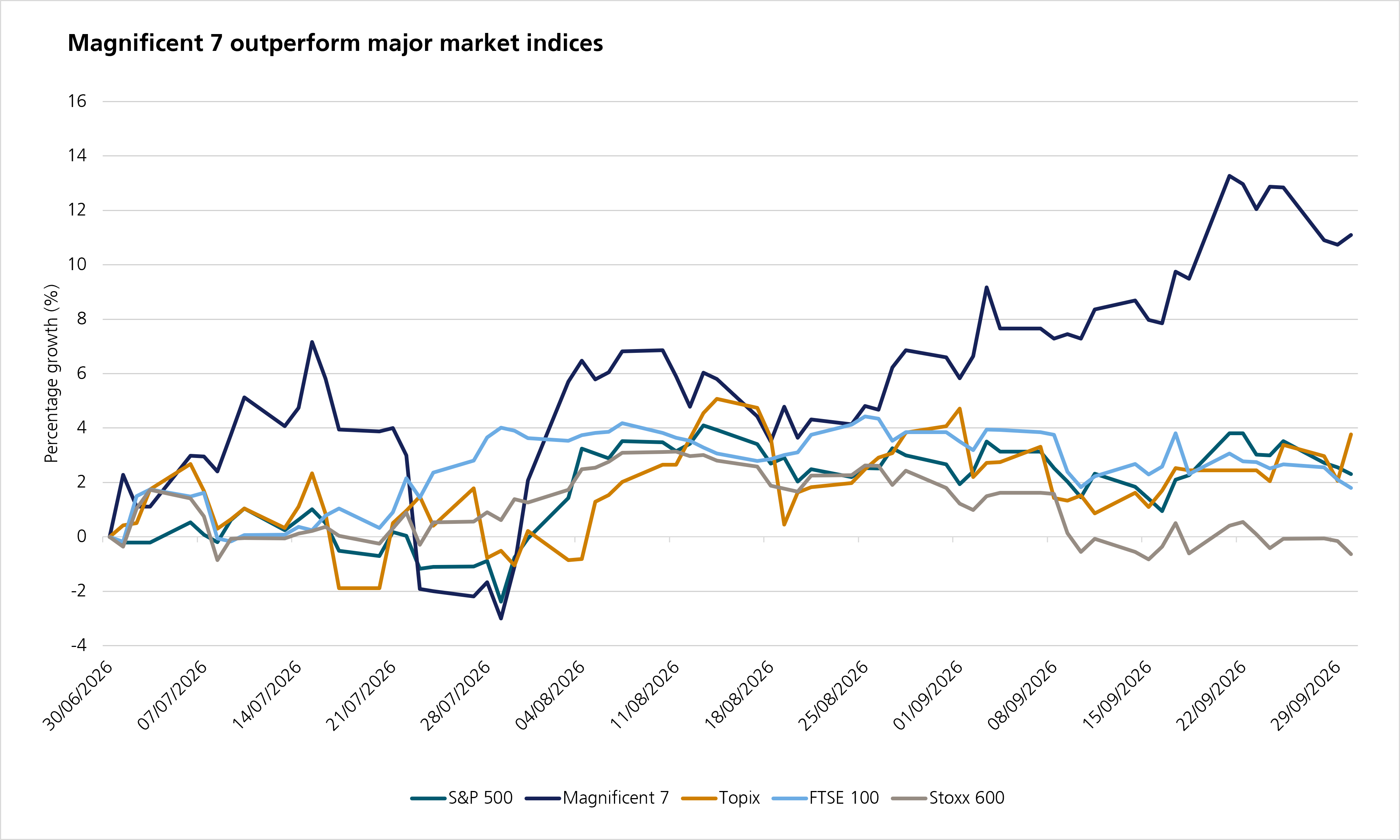
Technology shares led US markets, but gains continued to be concentrated in a small number of companies. The Magnificent 7, the largest US technology companies, returned 11.1% over the quarter, against 2.3% for the S&P 500 as a whole.2 Meta rose 26.7% in September after launching its Muse AI agent, and Micron’s market value rose above $1 trillion.1, 12
Strong demand for memory and cloud computing services helped drive earnings and resulting gains in AI-related shares. High-bandwidth memory, a specialised type used alongside advanced processors, was in short supply, prompting some Chinese AI-chip makers to raise prices.13 Cloud computing continued to impress: Microsoft’s and Amazon’s latest quarterly results showed Azure revenue grew 43% and Amazon Web Services revenue grew 37% to $42.2 billion.14 In our view, it may take some time for this investment to translate into productivity gains across the wider economy.
For the Federal Reserve (Fed), a pause in July was followed by a rate rise in September. When the Fed held rates in July, three of its 12 voting members had preferred a rise, while Chair Kevin Warsh gave little indication of how he would respond to higher inflation. Some investors questioned the Fed’s credibility. Yields on short-term US government bonds fell as expectations of a near-term rise faded, while longer-dated yields climbed, widening the gap between short- and long-term borrowing costs.15
At the Jackson Hole symposium in August, Warsh set out a firmer stance, saying the Fed needed confidence that underlying inflation was returning to target: “Otherwise, we have work to do.”16 The Fed followed through in September, voting unanimously to raise rates by 0.25% to 3.75-4.00%, with consumer price inflation at 3.4%.17 The firmer message went some way to restoring the Fed’s credibility: the gap between short- and long-term yields, which had widened further in August, narrowed in September after the rate rise.1 Softer-than-expected inflation data at the end of the month then lowered the odds of a further rise in October to around a third, although investors were still pricing in another rise by December.18, 1
The Bank of England (BoE) held Bank Rate at 3.75% in September by six votes to three, with all three dissenters preferring a rise to 4.00%. It also paused active sales of its government-bond holdings, bringing some relief to the UK bond market without reversing the earlier rise in yields. UK consumer price inflation rose to 3.1% in August, from 2.9%. The BoE warned that a prolonged energy shock might affect wages and other prices, while noting little evidence so far of material knock-on effects.19 By the end of the quarter, traders were pricing at least one rise before year-end, after UK second-quarter growth was revised up to 0.5%.20
The ECB raised its deposit rate by 0.25% to 2.50%, and markets expect at least one more increase this year.21 The Bank of Japan (BoJ) raised its overnight target to around 1.25%, its highest since 1995, by seven votes to two, and another rise is expected in December.22, 1 Together with joint US-Japan intervention to support the yen in August, the rise helped the yen gain 3.3% against the dollar, the strongest performance among major currencies.2
At the end of the second quarter, the key question was whether earnings and productivity gains could continue without prompting intervention from central banks. Rising energy prices paired with resilient growth led to the Fed, ECB and BoJ raising rates in September. Earnings held up, supported by strong demand for cloud computing and memory chips, although the wider productivity gains from AI investment are yet to show.
After another strong show of earnings growth in Q2, third-quarter earnings season, which begins this month, will show whether company profits can keep pace with higher borrowing costs. While geopolitical risks and interest rates will affect sentiment for some time, it is ultimately companies’ ability to grow earnings over time that matters, and a diversified, long-term approach remains important.
LGT Wealth Management is not in any way connected to, sponsored, endorsed, sold or promoted by the London Stock Exchange Group plc and its group undertakings (collectively, the "LSE Group"). FTSE® is a trade mark of the relevant LSE Group company and is used under license. The LSE Group does not accept any liability to any person arising out of the use of or error in the Index.
This communication is provided for information purposes only. The information presented herein provides a general update on market conditions and is not intended and should not be construed as an offer, invitation, solicitation or recommendation to buy or sell any specific investment or participate in any investment (or other) strategy. The subject of the communication is not a regulated investment. Past performance is not an indication of future performance and the value of investments and the income derived from them may fluctuate and you may not receive back the amount you originally invest. Although this document has been prepared on the basis of information we believe to be reliable, LGT Wealth Management UK LLP gives no representation or warranty in relation to the accuracy or completeness of the information presented herein. The information presented herein does not provide sufficient information on which to make an informed investment decision. No liability is accepted whatsoever by LGT Wealth Management UK LLP, employees and associated companies for any direct or consequential loss arising from this document.
LGT Wealth Management UK LLP is authorised and regulated by the Financial Conduct Authority in the United Kingdom.