
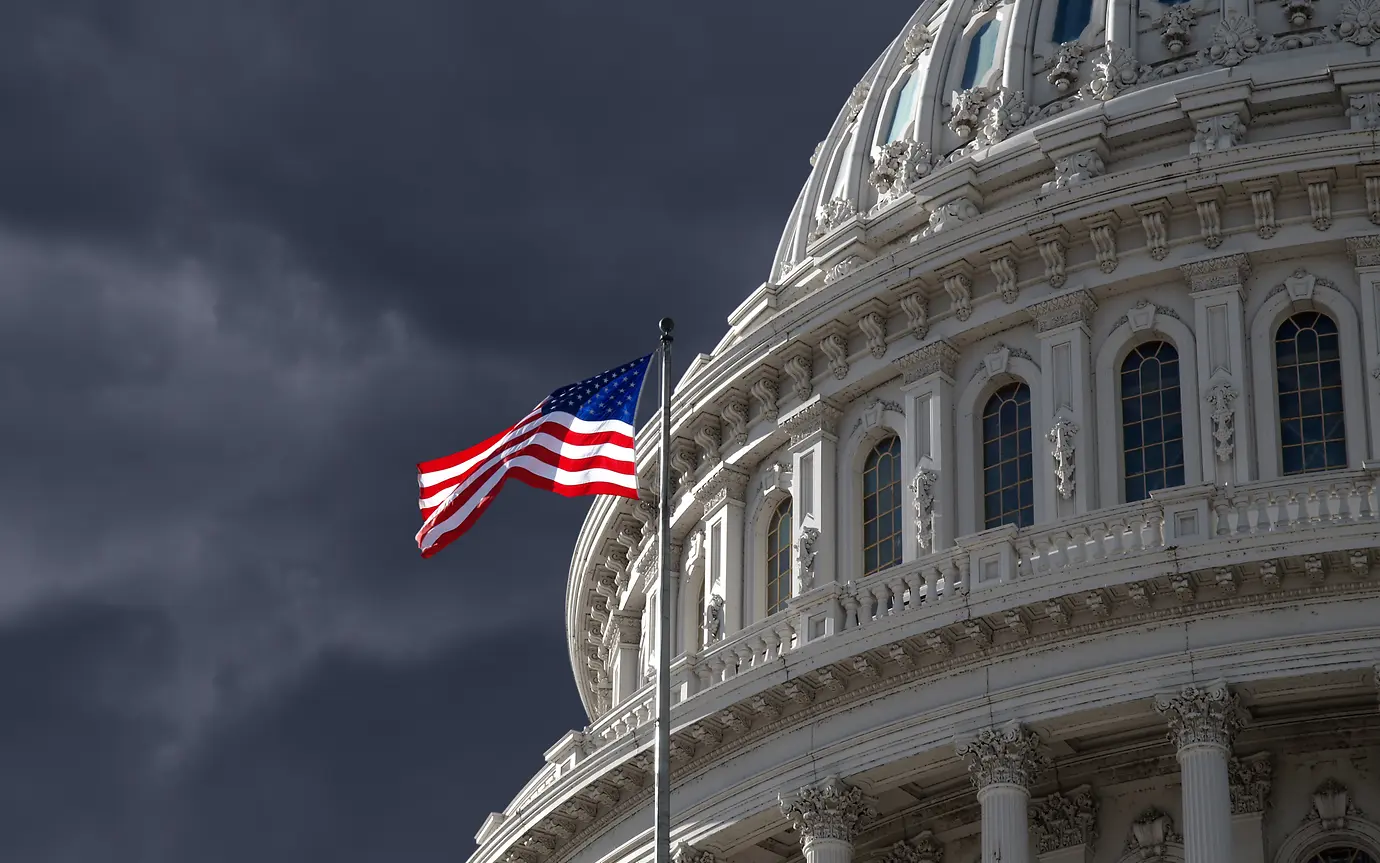
The longest US government shutdown in history came to an end this week. On 10 November, the Senate passed legislation to end the shutdown after a group of Democrats joined Republicans to support a spending package that omits the chief concession their party had spent weeks demanding – an extension of federal health care subsidies.1
The final House vote to reopen the government took place on the evening of Wednesday, 12 November, but lawmakers faced one last big hurdle to end the shutdown – flying to Washington, DC. Given the Federal Aviation Administration required airlines to cancel flights to reduce the strain on air tariff controllers, who went weeks without a paycheck,2 it was unclear if lawmakers would be able to physically make the vote in Washington.3
Shutdowns typically cause greater costs than the issues that led to them. The good news is that once a government reopens, payments can be made quickly, reversing some of the economic damage. Given the shutdown lasted 43 days, it is likely to result in so-called “soft patch” for the US economy over the fourth quarter. Looking ahead, investors are now turning their focus back to the $250 billion in business and consumer tax cuts and the Federal Reserve (Fed)’s efforts to ease financial conditions through rate cuts.4
The shutdown meant the Fed only had a partial view of the economy, as agencies such as the Bureau of Labor Statistics stopped collecting and publishing key economic data. Following the reopening on 12 November, the White House suggested that October Consumer Price Index (CPI) data and jobs reports would likely be skipped altogether. The CPI has been published every month since 1919 and the monthly employment report since 1948, so skipping a month of data would be truly remarkable.5 Although the Fed cut rates at its November meeting, Fed Chairman Jerome Powell said a December cut was not certain, noting that the best course of action when “driving in the fog” is to “slow down.”6
Against this backdrop of limited visibility and a soft patch, attention turned to the political fallout after the shutdown. There is division among Democrats now over reopening the government and stepping back from some of their demands. The backlash is not limited to the Democrats, with President Donald Trump’s approval ratings declining. Consequently, the recent November 2025 elections in New York, New Jersey, Virginia and California shifted in the Democrats’ favour.7 This comes at a critical juncture for the Republicans, with Zohran Mamdani winning a landslide victory in New York’s mayoral election and next year’s midterms coming into closer focus.
The prospect of an end to the shutdown drove markets higher. On 10 November, the S&P 500 rose over 2%. Retail stocks, such as Kohl’s and Ross Stores declined early during the shutdown, but rebounded strongly, and several factors now stand to boost this sector heading into the new year.
The renewed government funding for Food Stamps, more visibility on economic data and $150 billion of new consumer aid coming through in the early 2026 tax refund season, will likely help buoy consumer stocks.
Another area which faced additional pressure as a result on the shutdown was the US repo market. The repo market – where institutions borrow cash for short periods, often overnight, using government securities as collateral – tends to tighten during a shutdown or debt ceiling standoff, because the Treasury slows its spending and debt issuance. This means less money flows out of the government’s main account and into the financial system, temporarily reducing the cash available to banks and other institutions. As a result, short-term lending can become harder and more expensive. However, with federal spending resuming, liquidity pressures should subside as money moves back into the system.
The end of the longest US government shutdown marks a turning point for both policy makers and financial markets. As federal operations resume and economic data returns, the Fed will get greater clarity on the state of the economy. Both parties face political fallout, but recent elections suggest momentum is shifting towards the Democrats. With the shutdown ending, investors can focus on upcoming tax cuts which are likely to boost consumption and will pay a closer eye on the polls ahead of the crucial US midterms.
[1] Senate Passes Bill to Reopen Government Amid Democratic Rift - The New York Times
[2] What We Know About Flight Cancellations and Air Travel During the Shutdown - The New York Times
[3] Lawmakers face a last big hurdle to end shutdown: Flying to DC
[4] Strategas
[5] Deutsche Bank
[6] Fed Cuts Rates to Lowest Level Since 2022 but Casts Doubt on December Move - The New York Times
[7] Strategas
This communication is provided for information purposes only. The information presented herein provides a general update on market conditions and is not intended and should not be construed as an offer, invitation, solicitation or recommendation to buy or sell any specific investment or participate in any investment (or other) strategy. The subject of the communication is not a regulated investment. Past performance is not an indication of future performance and the value of investments and the income derived from them may fluctuate and you may not receive back the amount you originally invest. Although this document has been prepared on the basis of information we believe to be reliable, LGT Wealth Management UK LLP gives no representation or warranty in relation to the accuracy or completeness of the information presented herein. The information presented herein does not provide sufficient information on which to make an informed investment decision. No liability is accepted whatsoever by LGT Wealth Management UK LLP, employees and associated companies for any direct or consequential loss arising from this document.
LGT Wealth Management UK LLP is authorised and regulated by the Financial Conduct Authority in the United Kingdom.