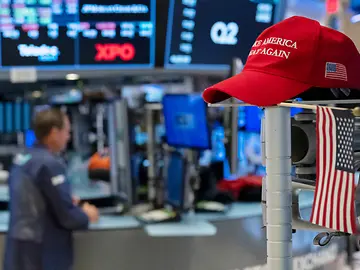


When Donald Trump returned to the White House one year ago, many expected him to use familiar tools to pursue his “America First” agenda. Tariffs were among the most prominent, which he unveiled in April in dramatic fashion on some of the US’s largest trading partners. The tariffs created stock market volatility, but throughout the year, most of the US’s trading partners negotiated agreements that reduced tariffs well below their original levels. Stock markets recovered and most finished the year with double-digit gains.
In early January 2026, the US military operation to remove Venezuelan President Nicolás Maduro signalled a shift in approach. Rather than relying solely on economic pressure, the US administration combined it with direct military action. Although this interventionist stance represents a notable change, the administration has been laying the groundwork for some time.
On the campaign trail, Trump repeatedly argued that bringing Greenland under US control would strengthen America’s access to essential commodities such as rare-earth elements, oil and gas – resources that could support sustained growth while keeping price pressures under control.
The US administration claims the rationale for the recent military action in Venezuela is linked to drug trafficking – the US Department of State had a $50 million reward on Maduro for any information leading to his arrest.1 But Trump’s comments about the country’s oil infrastructure suggest that this invasion was tied to domestic politics as the midterm elections approach. Venezuela holds the world’s largest oil reserves. Gaining access to this supply could help lower oil prices and, in turn, ease inflation. Alongside securing access to other key commodities, the administration believes this strategy could support US growth and bolster Trump’s approval ratings ahead of November’s midterms.
China has historically been the main consumer of Venezuelan oil, and this recent action will upend its supplies, as the US has earmarked supplies for itself.
The relationship with China remains complex. Trump has labelled China as a “strategic competitor”, and while his first term focused heavily on trade deficits, his second term has brought new dimensions to the relationship. China has responded by leveraging its dominant position in rare-earth metals – it produces 90% of the world’s rare earths and rare-earth magnets, which are used in everything from electric vehicles to smartphones to defence systems and military aircraft. In April and again in October, China enacted export controls that allowed it to withhold supplies of these critical materials.2 But in late October, Trump and China’s President Xi Jinping met in South Korea, where Xi agreed to reduce export controls in exchange for lower tariffs, creating another period of de-escalation between the two powers.
For decades, America has played a central role in maintaining global security and promoting democracy and free-market economies. More recently, however, it has increasingly used its economic power – through measures such as tariffs – to press for concessions, marking a shift away from the post-war order often referred to as Pax Americana, a period of relative stability led by the US after World War II.
This change has been highlighted by recent comments from Trump regarding Greenland, a self-governing territory that forms part of the Kingdom of Denmark. While Greenland controls most of its domestic affairs, Denmark – a North Atlantic Treaty Organization (NATO) member – remains responsible for its defence and foreign policy, and provides financial support. Despite these long-standing arrangements, the US administration has not ruled out the use of military means to secure access to Greenland’s resources.
Private sector hesitation is already evident. During a 9 January White House meeting with oil executives, Exxon Mobil CEO Darren Woods made clear his company’s reluctance to invest in Venezuela: “We’ve had our assets seized there twice, and so you can imagine to re-enter a third time would require some pretty significant changes. Today it’s uninvestable.”3 Two days later, Trump said he would “probably be inclined to keep Exxon out” of Venezuela, adding, “I didn’t like their response. They’re playing too cute.”4
Investors appear more constructive on the rebuilding efforts for Venezuelan oil infrastructure, with US oil service companies Schlumberger and Halliburton experiencing large gains in response to recent US military action. Oil prices, however, have been volatile, as markets weigh the immediate disruption against the reality that restoring Venezuela’s oil production will take many years before meaningfully increasing supply.
Attention has also turned to a much larger oil producer, Iran. Political tensions have intensified following a sharp fall in the currency, sparking widespread protests that have continued despite state pressure. The US administration is considering various military and non-military options, but these carry significant risks and offer limited scope for improving conditions for Iranian citizens in the near term.5
With the US midterms approaching – which will determine how easily policy can be passed through Congress – the administration’s stance has become more assertive, a trend that will likely continue. High inflation was a central reason for Trump’s re-election, and recent efforts to push down commodity prices suggest a clear focus on improving the cost of living for US consumers. If successful, this could support confidence and strengthen the Republicans’ chances of retaining their majority.
Against this backdrop, investors should be prepared for continued geopolitical uncertainty and periods of market volatility. History shows that reacting too quickly to short-term noise can be costly. Those who reduced exposure at the first signs of volatility following so-called Liberation Day in 2025 would have missed out on double-digit market gains. Maintaining a disciplined, long-term approach remains crucial, particularly in unsettled market environments.
[1] Wanted: Narcotics Reward Program - Venezuelan Targets - United States Department of State
[2] Inside China’s Six-Decade Campaign to Dominate Rare Earths - The New York Times
[3] Trump’s $100 Billion Venezuela Oil Plan Gets a Cool Reception - The New York Times
[4] Trump threatens to keep ‘too cute’ Exxon out of Venezuela after CEO provides reality check | Fortune
[5] The new Iranian revolution has begun | Brookings
This communication is provided for information purposes only. The information presented herein provides a general update on market conditions and is not intended and should not be construed as an offer, invitation, solicitation or recommendation to buy or sell any specific investment or participate in any investment (or other) strategy. The subject of the communication is not a regulated investment. Past performance is not an indication of future performance and the value of investments and the income derived from them may fluctuate and you may not receive back the amount you originally invest. Although this document has been prepared on the basis of information we believe to be reliable, LGT Wealth Management UK LLP gives no representation or warranty in relation to the accuracy or completeness of the information presented herein. The information presented herein does not provide sufficient information on which to make an informed investment decision. No liability is accepted whatsoever by LGT Wealth Management UK LLP, employees and associated companies for any direct or consequential loss arising from this document.
LGT Wealth Management UK LLP is authorised and regulated by the Financial Conduct Authority in the United Kingdom.