


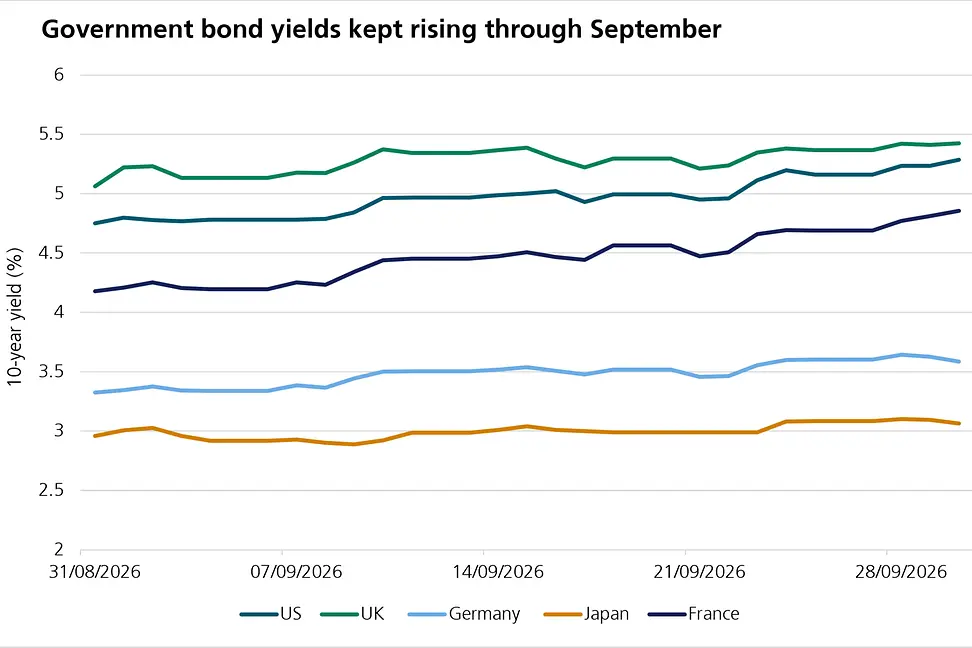
For much of this year, UK investors' attention has been fixed on gilts, where 10-year yields rose to 5.42% at the end of September, their highest level since 2007. Over the past week, however, rising pressure has emerged across the Channel, and it has begun to weigh on confidence across the eurozone.
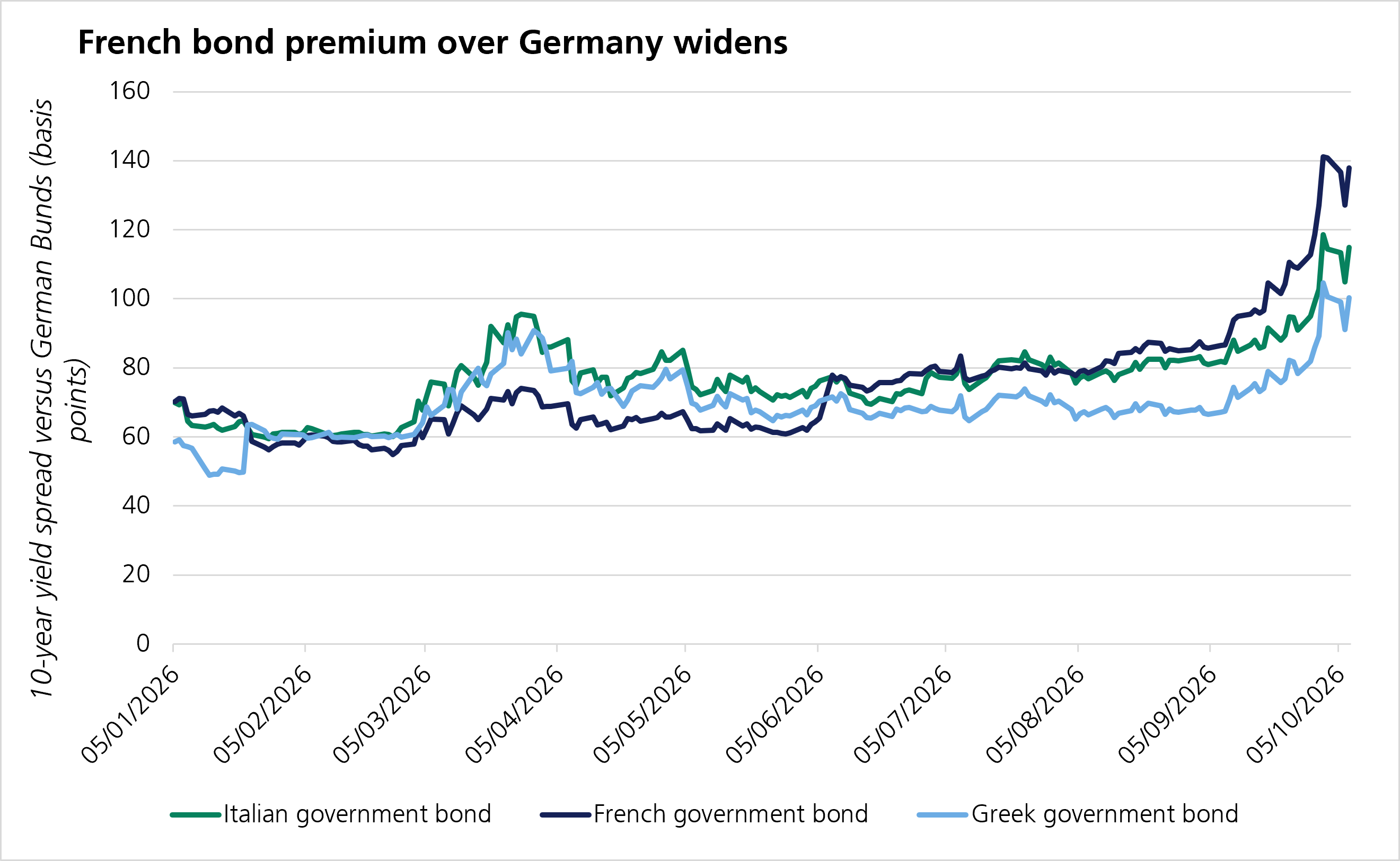
French 10-year yields rose close to 5% last week, their highest level since July 2002.1 The gap between French and German 10-year borrowing costs, often referred to as the "spread", reached around 1.5%, the widest since 2011. At the start of October, it widened by more in a single day than at any time since March 2020, when European Central Bank (ECB) President Christine Lagarde said the central bank was "not here to close spreads".2
This week, we look at the political and fiscal factors behind the move, how the strain has spread beyond France, and why Spain and Greece look very different.
Prime Minister Sébastien Lecornu's 2027 budget, published last Thursday, proposes €54 billion of savings to cut the deficit to 5% of GDP from an expected 5.4% this year. France's fiscal watchdog described its growth assumption as optimistic and the investment bank, BBH, expects parliament may instead roll over this year's budget, which could push the deficit towards 6%.3
The budget has also met resistance outside parliament. Public sector workers went on strike on 29 September against a proposed pay freeze and spending cuts. Since mid-September, high school students have blockaded schools across the country over overcrowded classrooms and teacher shortages, and more than 5,000 people have been arrested. Mr Lecornu has convened a crisis meeting, having said the students' difficulties "must be heard and addressed".4 For bond investors, each concession makes the planned savings harder to deliver.
The protests are unfolding six months before the presidential election is due to take place in April 2027. In July, a Paris appeals court shortened Marine Le Pen's ban from office, allowing the leader of the National Rally (RN) to stand. A poll published on 28 September put her on 35–36% in the first round, with the left-wing candidate Jean-Luc Mélenchon projected to be her opponent in every scenario tested.5
For bond investors, the key concern is how fiscal policy would be managed after the vote. During the 2024 parliamentary election, the RN pledged to cut energy taxes and raise spending, and the then finance minister warned of a risk of financial crisis if either the far right or far left won.6 Mr Mélenchon has notably since proposed cancelling French government bonds held by the ECB.7
As the bonds issued when interest rates were close to zero mature, they are replaced at much higher rates. Last week the French Treasury sold 10-year debt at a yield of 4.93%, compared with 3.86% in early August. Interest payments are on course to reach around €65 billion this year, making them the largest single item of state spending. Higher interest costs widen the deficit, a wider deficit requires more borrowing – a record €340 billion of bond sales is planned next year – and greater supply pushes yields higher still.
On Monday, the euro fell below $1.12, its lowest level against the dollar in 17 months, and also weakened against sterling, the Swiss franc and the yen. The gap between Italian and German borrowing costs posted its largest weekly rise since the Covid crisis, and analysts at KBC, a Belgian bank, described "clear contagion" towards Belgium and Italy.8 European bank shares fell sharply on 1st October, recording their worst performance since March, while investors seeking relative safety moved into German government bonds, pushing yields sharply lower.
The ECB has raised interest rates twice since June to contain inflation of 3.8%, leaving it caught between fighting inflation and calming bond markets. Its tool for buying the bonds of a country facing a disorderly rise in borrowing costs also comes with conditions, including sound public finances, which market participants believe France does not fully meet. Lagarde has called France's debt position "a serious matter" while stressing that this is not 2008 or 2011.9 The French gap remains below its 2011 record of 1.89%, and eurozone business activity grew at its fastest pace in nearly three and a half years in September.
On Monday, Spanish Prime Minister Pedro Sánchez called a snap general election for 29 November, after Congress rejected two of his minority government's housing decrees. Spanish 10-year yields barely moved, holding at around 4.1%, a premium over Germany of roughly 0.65%, less than half that of France. In July 2012, that premium stood at 6.38%.
Greece, whose 10-year bonds yielded close to 40% in March 2012, now borrows more cheaply than France despite a higher debt burden. Its debt is falling, helped by a budget surplus of 1.7% of GDP last year, whereas France ran a deficit of 5.1%. Investors appear to be distinguishing between political uncertainty and a deteriorating fiscal position.
France is not facing a crisis on the scale of the eurozone sovereign debt crisis and remains supported by deep bond markets and a large base of domestic savers. Last week's 10-year auction, for example, attracted more than twice the demand on offer. What has changed is the premium investors demand for uncertainty around France's fiscal direction, and how far that uncertainty now reaches across the eurozone. On balance, we believe the gap between French and German borrowing costs is likely to remain elevated into the presidential election, unless parliament passes a budget with a credible path to lower borrowing or the leading candidates commit to reducing the deficit.
The episode is also a reminder that political uncertainty does not affect all government bond markets in the same way. The relatively calm response of Spanish markets to its own election suggests markets are distinguishing between countries based on their individual fiscal positions and outlooks. This reinforces the importance of assessing each country on its own fundamentals, rather than treating European government bonds as a single group.
This communication is provided for information purposes only. The information presented herein provides a general update on market conditions and is not intended and should not be construed as an offer, invitation, solicitation or recommendation to buy or sell any specific investment or participate in any investment (or other) strategy. The subject of the communication is not a regulated investment. Past performance is not an indication of future performance and the value of investments and the income derived from them may fluctuate and you may not receive back the amount you originally invest. Although this document has been prepared on the basis of information we believe to be reliable, LGT Wealth Management UK LLP gives no representation or warranty in relation to the accuracy or completeness of the information presented herein. The information presented herein does not provide sufficient information on which to make an informed investment decision. No liability is accepted whatsoever by LGT Wealth Management UK LLP, employees and associated companies for any direct or consequential loss arising from this document.
LGT Wealth Management UK LLP is authorised and regulated by the Financial Conduct Authority in the United Kingdom.